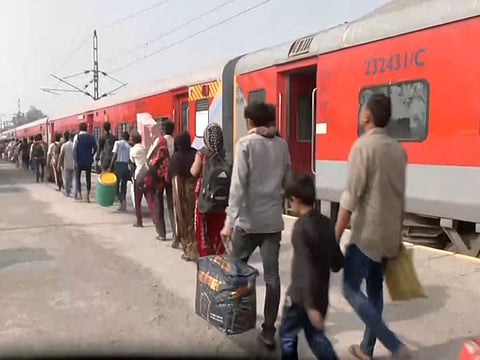

As West Bengal votes in April 2026, the returning migrant worker has moved to the centre of the political stage. From Chennai, Kochi, Mumbai, and Surat, thousands are travelling home, losing wages to cast their vote. Bengal exports labour but depends on that same labour to decide power. With over 21,59,737 migrant workers officially recorded outside the state (WB Assembly, August 2023), their anxieties—employment, welfare, and citizenship—now shape campaign strategy across parties.
The scale of migration reflects a structural transformation. Bengal, once a net in-migration state, has turned into a major exporter of labour.

Out-migration has surged sharply, with Bengal now ranking fourth nationally in interstate out-migration. The underlying causes—deindustrialisation, closure of 169 factories (FY2023–24), stagnating wages, and rural distress—are widely acknowledged but unevenly addressed in political discourse.
This outflow divides into two streams with distinct electoral effects. Blue-collar migrants dominate: construction workers, domestic labour, and informal workers from districts like Murshidabad, Malda, and Uttar Dinajpur. Kerala alone hosts 5–6 lakh Bengali workers, while Maharashtra remains the largest destination. These migrants retain strong ties to their home constituencies and return to vote in large numbers. White-collar migrants—IT professionals and corporate workers—form a smaller stream and largely disengage electorally.
Electorally, the blue-collar migrant is decisive. Around 22 lakh migrant voters are estimated to have direct political salience. Their voting behaviour is shaped by immediate needs—ration access, welfare schemes like Lakshmir Bhandar, and local patronage—but also by a deeper anxiety around citizenship. Unlike migrants from Bihar or Uttar Pradesh, Bengali-speaking Muslim migrants face the risk of being labelled illegal Bangladeshis. This threat has intensified. Between November 2024 and April 2025, around 700 deportations were reported from Delhi. Rajasthan marked 1,000 workers for deportation; Odisha detained 444 workers. The deportation of Sonali Khatun from Birbhum, later declared illegal by the Calcutta High Court (September 2025), has become emblematic.
Parties have responded with sharply divergent strategies. The Trinamool Congress (TMC) has built its campaign around protection and welfare. It frames migrant workers as victims of harassment in BJP-ruled states and positions itself as their defender. Welfare schemes—Lakshmir Bhandar, subsidised ration, and direct cash transfers—are depocted as guarantees for families dependent on migrant income. Its messaging blends sub-nationalism with economic security, seeking to convert migrant vulnerability into loyalty.
The BJP, by contrast, centres its campaign on illegal immigration and identity consolidation. The promise of the Citizenship Amendment Act (CAA) is positioned as protection for Hindu refugees. Campaign rhetoric links job scarcity to “outsiders,” attempting to align economic grievances with cultural and religious anxieties. The Left Front and Congress have adopted a different line, highligting unemployment, industrial decline, and labour rights. Their campaign seeks to reframe migration as a class issue, arguing that both TMC and BJP have failed to generate employment within the state. While their approach aligns closely with the structural causes of migration, its electoral traction remains limited.
In 2019, migrant voters contributed to the BJP’s surge, driven by a national wave and expectations around CAA. In 2021, the experience of the COVID lockdown—when 13.84 lakh West Bengal migrants were stranded—triggered a sharp reversal, with TMC winning decisively. By 2024, citizenship anxieties and welfare dependence consolidated TMC’s advantage. In 2026, the contest is tighter and more layered.
A new electoral factor is emerging in migrant-heavy constituencies such as Samserganj and Lalgola: women voters managing households in the absence of migrant men. Increasingly engaged with welfare systems and local governance, they are exercising greater autonomy in voting decisions. Their preferences are less shaped by identity politics and more by economic security, making them a potentially decisive bloc.
Migration has thus become the organising principle of Bengal’s electoral politics. It structures party messaging, voter mobilisation, and political imagination. The migrant worker is not just a demographic category but a political subject—embodying economic displacement, negotiating identity pressures, and participating actively in democratic choice.
The 2026 election is therefore a referendum on migration itself. The travelling voter stands at the centre of this contest, and their decision—shaped by both survival and belonging—will determine not just the outcome of the election, but the future direction of Bengal’s politics.