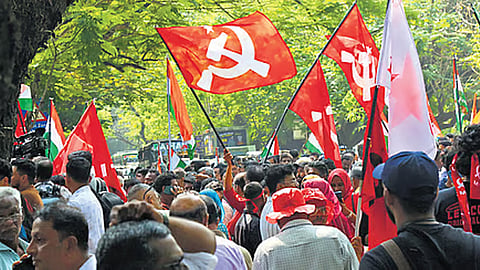

NEW DELHI: Not long before the 2026 West Bengal assembly election was announced, a gathering of CPI(M) leaders in the state produced a moment of unusual candour. Ashok Bhattacharjee—five-time MLA from Siliguri, former state minister, and the most recognisable Left face in north Bengal—made a statement in public: that its own voters had started voting for BJP.
From 2006 to 2021
In 2006, the Left won 233 of 294 assembly seats—the largest majority in the state’s post-Independence history. Buddhadeb Bhattacharjee returned as CM for a second term. Five years later, TMC swept to power. Left’s vote share still stood above 30% in 2011. It fell to 19% in 2016, 5% in 2021.
Between 2016 and 2019, over one crore voters appear to have shifted from LF to BJP. The informal slogan that crystallised the transfer—‘agey Ram, porey Bam’ (first Ram, then Left)—was not ideological. It was transactional. Left’s vote share collapsed from 23% to 7.5% in that single LS cycle. BJP’s shot from 10% to over 40%.
In an interview to Ganashakti before 2019 LS elections, he described BJP’s rise as a “danger” and pleaded with Left voters not to make switch.
2018 Panchayat Election Violence as Turning Point
The 2018 Bengal panchayat elections produced some of the worst bloodshed the state had seen in years. Opposition failed to field a candidate in over 34% of seats—TMC secured a third of the seats uncontested.
Atleast 25 people had died on the poll day.For Left voters the calculation was bleak and simple. BJP seemed the only formidable force capable of physically standing up to TMC cadre. BJP won Tripura that had been under CPI(M) rule since 1993.

Attempts for Recovery
Left attempted recovery. In 2021, it assembled Sanjukta Morcha—bringing in Congress and Abbas Siddiqui’s Indian Secular Front, and filling Brigade Parade Ground in Kolkata in a rally. The alliance won one seat, but it was neither INC nor CPI(M); ISF won the seat.
In 2023 panchayat polls, the Congress-Left-ISF combine increased its vote share to 21%. BJP’s share, meanwhile, declined to 22%. For 2026, Congress has gone its own way. CPI(ML) Liberation has, however, announced candidates in 10 seats. For the first time, the entire ideological spectrum of the Indian Communist movement may contest a Bengal poll with a degree of coordination.
Presidency: Embers Still Glow
Presidency—encompassing Kolkata and its immediate hinterland—retains the most residual Left energy. Urban, educated, historically given to ideological voting, the division still has constituencies where CPI(M) can expect serious consideration. Former Rajya Sabha MP and ex-Kolkata Mayor Bikash Ranjan Bhattacharya contests from Jadavpur. Dipsita Dhar from Dum Dum Uttar. Minakshi Mukherjee, party’s nationally recognised young face, contests from Uttarpara.
The Message it Might Carry
The CPI(M) is banking on job creation as its central 2026 plank, deploying a large number of young candidates alongside volunteers to win back youth support. The party is also attempting to position itself as the sole option for voters who are secular, anti-BJP, and disillusioned with TMC’s record on corruption.