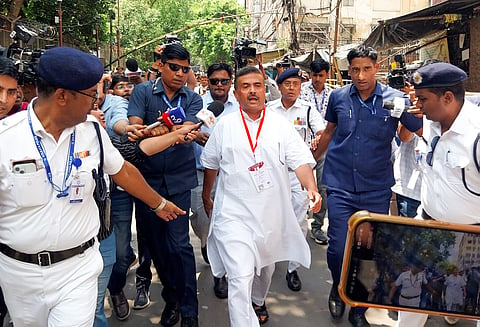

In a landmark political shift, the Bharatiya Janata Party (BJP) on Monday stormed to power in West Bengal with 206 seats in the 294-member Assembly, crossing a two-thirds majority and ending the Trinamool Congress’ (TMC) 15-year rule in the state. The result marks the BJP’s first-ever formation of government in West Bengal and signals a decisive realignment of the state’s political and ideological centre.
The mandate acquired added political symbolism with Chief Minister Mamata Banerjee losing the Bhabanipur seat to BJP’s Suvendu Adhikari by 15,105 votes after 20 rounds of counting. The defeat came despite Banerjee initially leading by a wide margin, before Adhikari staged a late surge that mirrored his 2021 Nandigram victory over her. Adhikari, once a close aide of Banerjee, has now defeated her twice in high-profile contests and emerges as a central face of the BJP’s leadership in Bengal, with other names such as Samik Bhattacharya, Sukanta Majumdar and Swapan Dasgupta also in circulation for the top post.
According to Election Commission data, the BJP crossed the halfway mark of 148 seats well before mid-counting and steadily expanded its lead to 206 seats, while the TMC finished with 80 seats and led in one. The scale of the victory reflected a statewide sweep, cutting across north Bengal, Junglemahal, border districts, industrial belts and urban centres, including gains in constituencies such as Dinhata, Gosaba, Baghmundi, Bankura, Binpur, Nayagram, Asansol Dakshin, Durgapur Purba, Kalimpong, Darjeeling, Monteswar, Bhatar and Medinipur.
The BJP’s vote share rose sharply to around 45 per cent from 38 per cent in 2021, while the TMC’s declined to nearly 40.94 per cent from 48 per cent, indicating both consolidation of anti-incumbency sentiment and erosion of the ruling party’s base across segments. In 177 constituencies where past victory margins were smaller than voter deletions, the BJP not only held ground but converted those openings into wins, pointing to a deeper structural shift rather than a temporary swing.
The setback for the TMC was severe across organisational levels, with at least 20 ministers losing, including Bratya Basu, Manas Ranjan Bhunia, Shashi Panja and Chandrima Bhattacharya. Senior leaders also suffered defeats in key constituencies, including Sabang and Dinhata, while even Kolkata saw reversals with BJP candidates defeating sitting ministers. The party’s traditional strengths, welfare delivery, booth-level mobilisation and centralised leadership under Banerjee, appeared weakened across both rural and urban belts.
At Bhabanipur, the contest unfolded as a high-stakes political battle with symbolic weight, as Banerjee’s initial lead of over 17,000 votes steadily eroded before Adhikari overtook her in the final rounds. The constituency, long considered her political stronghold and administrative base, had earlier restored her to the Assembly after her Nandigram defeat, making this loss particularly significant for the TMC leadership.
Prime Minister Narendra Modi hailed the result, saying the “Lotus blooms in West Bengal,” and credited the mandate to the BJP’s focus on development and public outreach. The campaign was spearheaded by Modi as the central face, while Union Home Minister Amit Shah managed strategy, organisational expansion, booth-level networks and candidate selection, building on the party’s steady rise from a marginal presence in 2011 to 77 seats in 2021.
The election also triggered sharp political reactions. Mamata Banerjee called the verdict “immoral” and alleged that “more than 100 seats were looted,” claiming irregularities at counting centres and lapses by the Election Commission. Congress leader Rahul Gandhi echoed similar allegations, calling the election “stolen” and citing West Bengal and Assam along with other recent polls as part of what he described as a repeated pattern of electoral manipulation. The BJP rejected the allegations.
Beyond West Bengal, the result fits into a broader national political moment in which regional dominance is being reshaped, with the BJP consolidating its position in eastern India. The outcome also reflects the party’s long-term strategy since its 2019 breakthrough in the state, when it moved from single-digit vote share in earlier years to a major opposition force.
For the TMC, the defeat marks a structural rupture after 15 years in power, pushing it into opposition for the first time since its rise under Mamata Banerjee. Anti-incumbency, allegations of corruption, governance fatigue and organisational strain under internal leadership dynamics have converged into a decisive electoral setback.
With this verdict, West Bengal transitions into a new political phase. The BJP has moved from challenger to ruler, the TMC from dominance to rebuilding, and the state itself from a long era of single-party control to a sharply competitive bipolar landscape, marking not just a change of government, but a fundamental reordering of its political order.
(With inputs from PTI and ANI)
