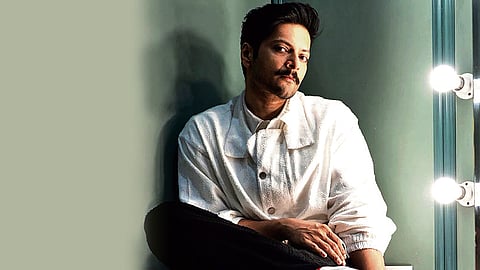

Ali Fazal is an actor of illusion, disappearing so completely into his characters that each role feels worlds apart from the last. He was the lovable, vulnerable Joy Lobo in 3 Idiots, the ruthless Guddu Pandit in Mirzapur, and now, in Raakh, he ventures into yet another unfamiliar territory—as an introverted Dalit police officer navigating the rigid hierarchies of 1970s India. Constantly reinventing himself, Fazal has built a career that resists typecasting and embraces transformation. In this conversation, he reflects on inhabiting one of his most restrained performances yet, the life-changing experience of fatherhood, and finding a deeper sense of peace in his craft.
For someone who has played the anti-hero, a romantic lead, and now a cop, which version of Ali surprised you the most?
I think the antagonist, the Mirzapur stuff. I am nothing like that character.

Raakh is set in 1978, and you play a sub-inspector. What was it like to immerse yourself in a character in that period of time?
It was challenging, but we had a lovely team. If I talk about my character, Jay Prakash, there were a few things for me to understand about him: is he a smoker, why is he doing what he is doing, and all the other things that had to be correct as per the period. And of course, the uniform—we had ample trials on that, and had to be sure of how a police officer was in those days. This is also a story of a very common man who’s just come up on merit. He studied for it, and he got into the system, and then he is fighting those layers of society, of the status that he belongs to. It was also important to keep in mind that there’s another kind of chaos on the other side of the story, because my character is not somebody who’s verbose, and it’s not all spelled out in each dialogue.
Also, the fact that he is a Dalit cop trying to prove his competence in a system which was never built for him. It was also a time when the caste conversations were not as loud as they are now.
I think it is still, in many ways, stifling for a lot of marginalised communities. I had to be respectful of the time and of that name. The whole show is a dramatised version of the Billa Ranga case. They had to do it because we had no information about the criminals, so they had to create a story and turn the show into a study of criminal psychology. On the other side is my character, Jay Prakash. It’s a study of the claustrophobia of this simple man in a uniform, who is always going to be stuck in a system. He is also larger than life, trying to shy away from his place in society. It’s like trying not to be seen and be seen at the same time. So it’s a battle. I was interested in seeing a cop who is also an introvert, and doesn’t get violent or angry, but has been educated and wants to use it the right way.
You are a father now. Has that also changed you somewhere as a person?
Yes, I have a new outlook on time. I did respect time, but now I’m grateful for it because each hour, each minute I get, I want to spend with my daughter and family. It is so enriching. You are parenting, and you were parented once, because as actors, we’re also kids; there’s a part of us that doesn’t grow up. It works in our favour because we have to be open to every experience, like a 6-year-old would be, probably.
After so many successful films and shows, when did Ali Fazal go from promising to formidable in his own right?
I cannot answer that... You know, actually, there’s a film that didn’t do that well. It’s called Milan Talkies by Tigmanshu Dhulia. I really learned a lot from him on that set, which I have taken with me for a long time. I got comfortable. Earlier, there used to be a lot of confusion and apprehensions. I think the time when I shot Death on the Nile with Kenneth Branagh, and then Mirzapur Part Two and other things, I noticed a change, because I started to enjoy the process. It became addictive, because it’s like meditation. The film starts, and I’m answerable to nobody in the world. I’m switched off. That’s the change—being answerable only to yourself.
You are an actor who’s loved by audiences and critics. Have you reached a state where this validation doesn’t interest you?
I’d be lying if I said it doesn’t mean anything. It means something, because it’s the last piece of the edit, right? When it’s transferred to the audience, I think it’s beautiful when that happens. And the ones that don’t work—I am reminded of words of Raj Kapoor Saab. He said that the films that work, those are forever with the audiences; the ones that don’t work, those characters stay with the actors forever.
You are now back with the Mirzapur movie, and your character Guddu has become one of the most iconic characters.
I think Mirzapur is an experiment for all of us. We’re really excited that, for the first time, an Indian show is turning into a film. It’s one of the best decisions made by the makers. I think it’s going to be a standalone film. Regarding Guddu, I’m surprised that people still want more of this character. It is like an asset. There’s a lot of love for it, and I’m glad that the same people are now watching Raakh.