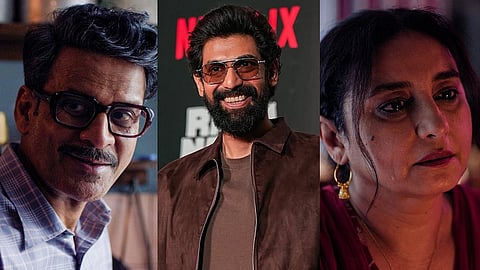

In the past few years, Rana Daggubati has established himself as a champion of independent cinema. His venture Spirit Media, has backed projects like All We Imagine as Light (2024), Sabar Bonda (2025), and Shape of Momo (2026), as a distributor. However, Last Man in Tower marks a new beginning for Rana, marking the maiden Hindi film production for his banner. Backing unconventional stories has always been the underlying philosophy of his production house, Rana tells us. While the theatrical business has faced a setback in the past few years, he notes things are slowly improving, adding, “Two-three years ago, we wouldn’t even see this release happen. I heard someone say short content is like snackable stuff — chips and cola — and it made sense. Sometimes in our life, we want chips and cola — but after that, we need a full meal of real stories. That’s what has happened. There were a lot of OTT and Instagram reels for a while. We crazily engaged with it. But now, we need to sit back in a theatre with a community, see ourselves in movies which talk about our problems. We just want to make sure cinema like this exists along with the big, spectacle movies.”
Elaborating on the core issues tackled in the film, Rana says, “Last Man In Tower is every Bombay person's story. Today, every city is a growing city, but this will eventually become a problem and everyone will have to let go of something they are attached to. When that turn comes in your life, and a decision can split everyone apart, how do humans react? What do they hold on to — the future that is perceivably bright, or an emotion that made you who you are? What does capitalism do, coming between them? I thought it’s a beautiful topic to raise a discussion.”
Besides telling the story of the conflict between capitalism and community, Last Man in Tower, directed by Ben Rekhi, is also a film about fragile relationships and the grey-shaded human condition. Both Manoj Bajpayee and Divya Dutta play two such characters who cannot be slotted easily into either good or bad. Manoj shares that he read Aravind Adiga’s novel Last Man in Tower, on which the film is based, after signing the project. He shared his key takeaways. “Master ji is all grey. Nobody is a hero here; there's no black-and-white. This element seeped into the script, which calmed me down because this is a story of fragile human relationships. You touch it a little bit and it all falls down. That's the idea I got from the book,” he says. Crediting screenplay writer Sooni Taraporewala, Manoj adds, “Every character has their own story, and you can write a full-fledged film on each of them. Their rationale for their choices is as valid as Master ji's.”
Meanwhile, Divya plays Mrs Puri, Masterji’s neighbour and friend who, however, is more flexible with circumstances and less ideologically rigid. Talking about her character, Divya says, “What worked for me was Mrs Puri’s vulnerability, her fighting spirit, greed and her protectiveness towards her family — and somewhere, a hidden affection for Masterji. We all are grey-shaded like that.” Divya also credits Manoj with whom she is working for the first time. “So many things would happen creatively on the spot, just looking at him — that’s what happens when you have amazing co-actors.”
The two actors also recall their early years in the city, sharing minute visual memories to underline the contrast with the present-time Mumbai. Manoj notes, “We rented a place in DN Nagar, where we had a PCO downstairs. Standing in the line, one could actually hear all conversations. But you couldn't run away either, then you would lose your turn. That DN Nagar is in different shape now; long towers have replaced the chawl system. There were fewer people in societies, on the roads, so were the number of vehicles on the road. But I can't complain either because I am one of the people in the crowded.” Divya too shares her early memories of the city. “My mom bought me a one-bedroom house; that's where I began my life. People knew people; there was an intent to know who's living next door. There was a budding ad filmmaker on 3rd floor, Farah Khan lived on 2nd floor. I would befriend all the people there. I realised that’s how flat system works. That concept is gone.”
Divya’s recent OTT show Chiraiya became extremely popular. Dealing with heavy themes like marital rape and oppressive patriarchal system, the show also received extreme trolling from a section of netizens. When asked if such extreme reactions bother her, Divya responds, “Everything impactful comes with its pros and cons. For me what mattered was how conversations started, and how people shared their lives were impacted. Everyone feels this was their story, which they can’t even share with anyone. But when you see it on the screen, you feel this story belongs to someone else too. It reiterates the power of the visual medium.” Addressing the criticism, she adds, “It becomes a small world with social media. Of course there will be the other side but you don’t need to pay attention to it, because the love coming your way is way bigger. It all boils down to talking, being transparent, holding hands. That story held hands in a unique way.”
Divya steers the conversation back to how Last Man in Tower holds hands in a different way. “The last time we made an effort to know people was during COVID, when you were also forcibly home. I think we all have that humane, compassionate side in us. But we forget that amidst all the bustle. This film reiterates the power of community, and brings back what we've lost.”
