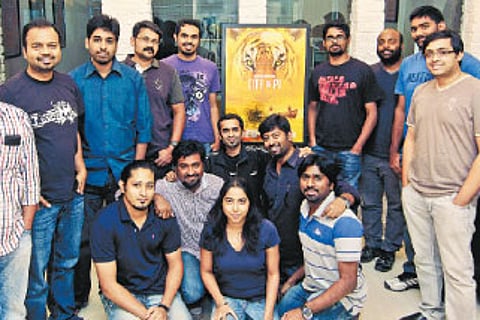

By now, the breath-taking visuals of Ang Lee’s Life of Pi—the ferocious Bengal tiger Richard Parker, the stormy sea, the spectacular flying-fish sequence and the wonderful Meerkat Islands—have become a cult among cine buffs, gathering award after award, including the Special Visual Effects of the British Academy of Film and Television Awards recently.
Dubbed as the most visually arresting movie of recent times, Life of Pi is in contention for the Academy Awards in many segments, including its astounding visual effects.
While the world is talking about the film, many are unaware of the Indian hands that worked hard to provide the visual effects. This is a team of young professionals working at the Hyderabad and Mumbai office of ‘Rhythm and Hues’, a studio specialising in computer animation and visual effects.
The team, in coordination with the Oscar-winning VFX supervisor Bill Westenhofer and his team in Los Angeles, spent over a year perfecting Richard Parker— the refraction from its eyes, every single of his 10 million furs, paw movements and balance on the boat, besides umpteen other effects such as creating a sync between the real and computer-generated water.
“Our team worked on complex shots like the death of Richard Parker and even tackled multiple departments like tracking, lighting and compositing,” says Lead Compositor Arnab Sanyal. “Life of Pi was a challenge for us, as over 60 per cent of the work, including the tiger and ocean, was done on computers,” says senior compositor Shyamchand.
“Almost 690 of the 960 shots required VFX work. A major chunk was done by us under the supervision of Westenhofer,” says Rakesh Venugopal, a senior compositor at the firm, adding that there were instances where the team had to spend over three months to perfect a single shot that lasted just three seconds.
According to Westenhofer, the biggest challenges were the animals and ocean. “The toughest was to perfect Richard Parker. We relied on an extensive study of the four real tigers used for a few shots. Every detail, from the way the paws moved to the way the skin folds and the fur behaves in various lighting conditions, was studied and recreated. Some of our most successful shots were handled by our teams in Mumbai and Hyderabad,” he says. “Our team pored over hundreds of photographs and over 100 hours of video footage. It took over a year to build the tiger and the final version has about 10 million hair and can take as long as 30 hours to compute a single frame of him.”
Creating the ocean and water effects was an equally backbreaking effort. “Since the ocean played a significant role in the film, it had to look real. The stormy ocean was VFX-crafted. The team spent a lot of time studying the ocean as it did for the tiger,” says Shyamchand.
The team members say that since the film was made in 3D, it needed double the effort. “3D is hard because you have to make a pair of images, one for each eye. A mismatch of a single pixel can alter the depth and perception of the images. A lot of techniques we take for granted in VFX, like element shoots and blue screen comps, are either impossible or a lot more difficult in 3D,” says Shyamchand.
According to the team, they had to resort to high-quality projectors and work equipment to test the scenes. “We used an advanced compositing software, ICY, which is company-owned, and supports stereo-viewing (supports both left eye and right eye). The finished images are then checked and reviewed on a screening room in 3D,” says Sanyal.
The team had worked earlier in many acclaimed Hollywood movies, including the 2008 Oscar-winning Golden Compass, Hulk-2, X-Men: First Class and the Night at the Museum series. Ironically, their efforts for the The Golden Compass went largely unnoticed in India though they claim to be the ‘first Indians to have won Oscars’.
