
KOCHI: Christopher Nolan’s brother and the co-writer of the movie, ‘Interstellar’, Jonah Nolan is adopting the Foundation Trilogy of Isaac Asimov for HBO. The news could not have come out at a better time when the ‘bromance’ of Warner Bros and Nolan Bros is at its celestial point. Proof: Watch Interstellar.
The movie has pushed Christopher Nolan one step closer to the auteur hall of fame. While quantum mechanics and gravity can co-exist under Unified Field theory’s jurisdiction is a moot point, it is safe to assume that the film has brilliantly blended physics and philosophy.
Interstellar, as a visual experience, is an astronomic feat. The sci-fi elements of the movie is compelling, though the human drama falls flat at times. That touch of Nolan in dealing with the intricacies of human psyche, Memento is a case in point, doesn’t have the same old vigour. The movie has its highs and lows.
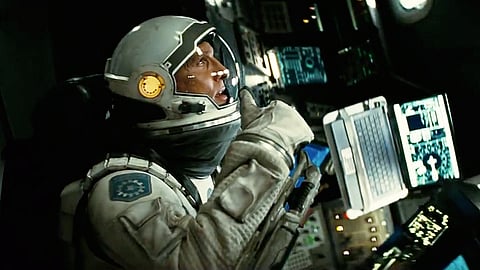
The movie opens on a less optimistic note. The humankind is facing a wipe-out: the scourge of blight, crops are becoming extinct and the food shortage has forced the homosapiens to turn to farming. Cooper (Matthew Mcconaughey) is an astronaut turned corn-grower. A widower who lives with his father and two children. His daughter’s penchant for cracking codes puts Cooper on a trail. The trail leads him to NASA. There he learns that NASA is on a mission to find habitable places elsewhere in the Universe. And as you have already assumed, Cooper is made part of the mission. He leaves his children to embrace the unknown. Typical Hollywood? Couldn’t be more wrong!
Half way into the movie you start to wonder whether the science in the movie follows a revisionist line. A policy that flies in the face of reason. The movie is replete with themes like Lazarus mission, Noah’s ark, the saviour complex, whiteman’s burden, extra-terrestrials, etc. The repeated mention of ‘they’ reiterates the case. Just when you are prepared to settle for less, the movie catches you offguard. Remember the line ‘the piper will lead us to reason’ from Stairway to Heaven? Well, Cooper is the piper of the movie.
The genius of the Nolans in weaving a philosophical discourse into the fabric of science puts Interstellar on the same pedestal with erstwhile Solaris and 2001: A Space Odyssey. At least, in the scale of the effort gone into making the movie.
Like always, Americans are born to save the world. Some things can’t be helped. This space epic orbits around human emotions. Faith,love, hope, survival instinct, and selfishness are the equalizers in the human symphony.
Nolans have put reason in place of god. On questions of AI, he seems affirmative on quantifying the attributes of human species. TARS, the robot, seen in the movie can be programmed with humour, honesty and other attributes are manually-adjustible parameters. But they are built to listen, not to understand. Or maybe its still too early before the cyborgs finally rise.
The movie comes with a package of high-end physics: wormhole, blackhole, tesseract, time-travel, time dilation, grandfather’s paradox, twins paradox you name it. The movie has it all.
The great physicist Richard Feynman said, if universe were to be destroyed, e=mc2 is the one message he would put in the bottle. He believed if another dispensation could get a handle on the equation, the whole information will be unlocked. Nolan’s solution to the problem of Earth is an extension of the same logic. Except, ‘they’ are the custodians of the sacred knowledge. It’s not an accident that ghosts chose to communicate through a library. Libraries were the preserve of medieval scholasticism, and information was always sacredly guarded. Put two and two together and you will see the motifs are still biblical in nature.
For Americans, it always takes a ship to land on civilization. Be it rangers or Mayflower, once they start to lose the ground, they seek higher dimensions to stay fittest.
If Hans Zimmer’s background score keeps up the tension of an expedition into the unknown, Hoyte van Hoytema’s cinematography rivets you to the seat with stunning depiction of an apocalyptic Earth and spacial encounters. The one thing from Interstellar that will stay with you is the inspiration it seeks from Dylan Thomas’s poem, which goes, “Do not go gentle into that good night, Old age should burn and rave at close of day; Rage, rage against the dying of the light.”
Interstellar’s protagonist dares to plunge into the heart of darkness, beyond the event horizon, to save the light of the days in the pale blue dot. Maybe there’s more to the theory of singularity. May be not. Whatever the dimensions beyond us, a stellar proposition is what Interstellar offers on the whole.
