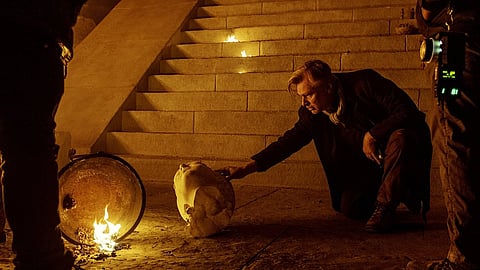

Christopher Nolan has often admitted that the days leading up to a film’s release terrify him. Not because of critics or box office numbers, but because he believes his audience becomes the film’s final collaborator. A film, in Nolan’s eyes, is never truly complete until viewers make it their own. It’s an insightful comment coming from a director whose life has been dedicated to total confidence in himself and his vision. For someone celebrated as one of modern cinema’s great architects, Nolan still approaches every release like a leap into the unknown.
That may be why The Odyssey, his most ambitious film thus far, seems not to be another Nolan blockbuster, but a new chapter in his never-ending quest for excellence. Released globally on July 17, the film is based on one of civilisation’s oldest tales. Yet through Nolan’s prism, it feels strikingly current and mainstream. Beneath it lies the question haunting so many of his films: can we ever get back home when time has changed us?
In many ways, he remains the filmmaker who has spent two decades bending time and showcasing it as the most complex character in his films. While others use it to advance their plots, Nolan warps it, breaks it down, folds it upon itself, and sometimes even keeps it frozen in painful stasis. Time reverses the flow of memory in Memento. It layers dreams upon one another in Inception. It expands love into the infinite distance between stars in Interstellar. In Oppenheimer, history becomes an ever-ticking moral clock. But remove all the dazzle and impossible architecture, and it becomes clear that Nolan has never made films about time alone. He has made films about what time does to people.
While the way in which he tells these stories is always the subject of much analysis, it would appear that Nolan never intended the mechanics themselves to be the point. They’re merely the path toward a far more fragile subject: guilt, mourning, obsession, regret, and the impossible weight of living with your decisions. These burdens are carried by the characters he writes. Leonard doesn’t trust his own memory, Cobb is consumed by guilt, Bruce Wayne bears his trauma as faithfully as he wears the Batman costume, and Oppenheimer is burdened by the terrible weight of his genius. Here comes Odysseus, looking not just for Ithaca but for the person he used to be.
It would be easy to say that Nolan is one of cinema’s greatest intellects, and he certainly is. But intellect alone does not sell out IMAX theatres around the globe. Behind the dazzling structure of his blockbusters lies the surprising heart of an old-fashioned filmmaker. For all their intellectual ambition, Nolan’s films are powered by deeply human emotions. There is something rebellious about Nolan too. In an age when directors have to brand themselves and constantly explain their films, he chooses to remain enigmatic. It simply arrives and speaks for itself.
Nolan’s approach to filmmaking is also rather out of step with modern times. While almost anything is now possible through digital technology and the industry increasingly flirts with artificial intelligence as the next creative frontier, he continues to seek what is real. The reason behind his persistent interest in IMAX lies in the idea of making cinema overwhelming, embracing and humbling for the viewer. Mountains must be climbed and oceans crossed because, as Nolan sees it, reality offers textures that computers cannot faithfully recreate.
Oppenheimer could easily have made Nolan play safe and stick to his tried-and-tested methods. But the very opposite happened. Its success gave him the freedom to mount Homer’s 2,700-year-old poem on a scale few studios would even consider. That one decision tells us almost everything about the filmmaker Nolan has become.
Maybe that’s why he manages to remain timeless in an industry that thrives on the notion of being up to date. Every generation seems to inherit one filmmaker who reminds us that films can still surprise us, demand our attention, and leave some questions unanswered. In our case, it has been Christopher Nolan. And with The Odyssey, he sets sail for the impossible once again.
