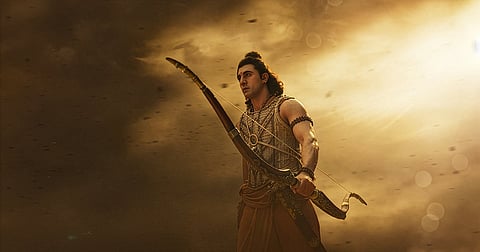

Reimagining an epic as revered and widely known as the Ramayana for contemporary cinema entails twin responsibilities: artistic competence and cultural responsibility. Producer Namit Malhotra and filmmaker Nitesh Tiwari are embarking on this ambitious attempt to bridge generations — those who grew up with the epic and those stumbling upon it for the first time — through a visual medium. In this interview, they open up about the challenges in retelling a familiar story, but aiming to reintroduce its emotional and philosophical core with authenticity, scale, and technological superiority. In this interview, Namit and Nitesh talk about their extensive research rooted in the Valmiki Ramayana, carefully considered casting choices like Ranbir Kapoor and Sai Pallavi, and global collaborations, including music by Hans Zimmer and AR Rahman. Ramayana aspires to be Indian in spirit and universally relatable in its storytelling.
Excerpts:
Ramayana is a story told and retold for centuries. How have you balanced presenting the film for generations that know and don't know the epic?
Namit Malhotra: Why do we pray to Ram? Why do we love him so much? I want to introduce the foundation of that admiration. There is a challenge and an opportunity in it. My mother knows Ramayana, but she doesn't watch movies. My sons are Marvel and DC fans, and they do not know Ramayana. The aim is to make the older generation praise the authenticity of the content and the younger generation walk in to watch the cool visuals and learn the timeless epic and its ideals.
Nitesh Tiwari: Ramayana will have a multi-generational impact. See, many films that youngsters watch cannot be watched by their parents, and vice versa. With Ramayana, we will bring in a much wider audience to the theatres.
How extensive was the R&D that went into the making of Ram and Ramayana?
NT: The film will try its best to stay close to the image you get in your mind when you think of Lord Ram. Also, there are many reference points for it, such as texts and artworks that describe what he looked like, and even minute details like the texture of his hair. Although we primarily based our film on the Valmiki Ramayana, we also drew on other materials to support our work.
NM: Our team spent a lot of time brainstorming, and we would argue over the perfection of the looks. Once the feeling of seeing Ram and Sita was attained, we did not believe in following any rulebook that said otherwise. Sensing the authenticity of the looks and the divine feeling was more than enough.
How crucial were the casting choices of Ranbir as Ram and Sai Pallavi as Sita?
NT: Ram is described as someone who doesn't express much, especially his grief; so the actor should be able to communicate it without much emoting. At the same time, he has a towering physique, and valour. You should be able to see him as an exemplary husband and brother. The actor we choose should tick all these boxes. The choice of Ranbir is something we all agreed on and were happy about.
NM: You cannot find another woman who can portray Sita's purity as she did. You see her as Sita once, case closed, no more room for argument. There is a scene where Sita responds to Ranbir's Ram with a glance. Her look will give you goosebumps.
The choice to bring on board Hans Zimmer and his part in giving the film a global appeal
NM: Hans Zimmer is a true artist and deeply respects our culture. When I went on to narrate Ramayana to him, he refused to hear it and said, 'This is one of the beloved stories of India for over 5,000 years. You don't explain and spoil it for me. I have to understand it without you explaining it.' We planned to do an 'East meets West' with AR Rahman and him. Our story required both the Indianness and the Western soundscape, but the Indianness should eventually dominate.
DNEG's efforts in making Ramayana a technically competent film on par with Hollywood films.
NM: In DNEG, there is no Hindi, Tamil, English, Hollywood, or Bollywood. We don't understand languages; we only understand shots. There is absolutely no compromise on the technical quality of Ramayana. The big releases DNEG is having this year are Dune 3, Odyssey, and Ramayana. We have read about Ram fighting against 14,000 soldiers, but we haven't experienced it cinematically. We have 11 teams around the world working on Ramayana, and visual artists attached to Dune and Odyssey are also a part of this project. After winning eight Oscars, Ramayana remains the most challenging and complicated visual effects work for DNEG. Need I say more?
What are the ideals Ramayana would be imparting to the current generation?
NM: The world is torn in pursuit of conflict and revenge. Ramayana will teach the world about tolerance, duty, and forgiveness. This is a film from India for a better world. Being Ram is a choice. He was not a victim of circumstance. He could have chosen not to go into exile, but to ensure peace in the country and family, he made that decision. This distinguishes him from a victim and highlights the power of moral conviction. I believe it is this mindset that's eroding in the present generation.
