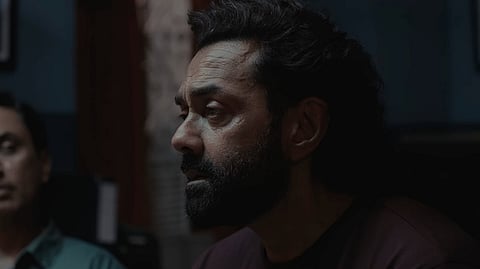

In Animal, which effectively proved to be a major comeback role for him, Bobby Deol played Abrar, a ruthless criminal who cannot speak. However, in Bandar, there is a moment where his character almost loses his voice amidst an emotional outburst in front of his sister and lawyer. The more he speaks, the less identifiable it becomes. In that one moment alone, Anurag Kashyap captures something of Bobby that we hadn’t seen ever. His complete surrender to a character, and almost a rebirth for him as an actor. While somewhat inconsistent in his performance otherwise, Bobby snags some of these emotionally searing moments in the film that are a complete revelation.
In Bandar, he plays Samar Mehra, a has-been actor-singer who finds himself framed under charges of rape and blackmail. While his sister Suhani (Sanya Malhotra) and lawyer Nitin struggle to get him out, Samar slowly finds himself becoming part of a landscape that is hellbent on moulding him to its whims.
Cast: Bobby Deol, Sapna Pabbi, Sanya Malhotra, Sukant Goel, Indrajith Sukumaran, Saba Azad
Directed by: Anurag Kashyap and Sakshi Mehta Lau
Written by: Abhishek Banerjee and Sudip Sharma
Watching Bandar unfold, one realises that a prison film was only a gradual stepping stone for a filmmaker like Anurag Kashyap. The film is brimming with grit and grime. If there is one filmmaker we can trust to show the unappealing and capture the discomforting, it’s the man who made Gulaal (2009) and Ugly (2014). Kashyap refuses to mollycoddle us on a visual level. There are unsettling forms of smoking up I didn’t know about, and graphic visuals of fecal matter that would make anyone squirm. There is also a gruesome bit of dialogue of what Tihar prison inmates do to the rape accused.
Kashyap makes space for interesting scribbling on the sidelines. There are plenty of hilarious off-handed jokes, like the ones about Subhash Ghai, and ‘achche din.’ A scene early on, built around Samar and an indifferent cop, is hilarious, while having a major hangover of the police station scene from Ugly. There is that one magistrate who is too trigger-happy to push the entire entertainment industry under one ominous cloud. Laden with dark humour, ‘Pinjra’ song cleverly captures the hopelessness of a space with hundreds who resemble each other. There is also a surreal touch of many aeroplanes passing by, and everyone waiting for it, as they await the decision of a bail plea. The performances from the ensemble, including Sanya Malhotra and Indrajith Sukumaran, are uniformly impressive. Sukant Goel is earnest, and Raj B Shetty is delightfully askew.
Kashyap manages all these little wins on the periphery, but the central ground is a little shaky. For all the visual grit, Bandar suffers from a lack of equally visceral interiority. We get a sense of Samar’s gradual decay, but we don’t get to immerse ourselves in his headspace. There is an emotional distance despite all the brutality on screen. Some of the moments that work early on — like Samar's delusion about the three girls at the wedding, or how he looks at the many windows outside his lonely balcony — hit home because we are getting to know a broken man. That sense of psychological intimacy is somewhat missing in the second act when Samar gets pushed deeper into the ecosystem of a cold-blooded prison.
The film gets a little mired in the multiple subplots it has embarked upon. Samar’s internal struggle, his legal battle to get out, and his harsh encounters with everyone inside who threatens to change him a little, one conversation at a time — there is too much happening, and the narrative somewhat loses focus of Samar’s inner fall.
Bandar is a tricky film to make in other ways too. On one level, it feels unnecessary to broach a topic as sensitive as #MeToo (writers even place the narrative in 2018, when the movement exploded), without diving into it knee-deep. At the same time, the writers (Abhishek Banerjee and Sudip Sharma) and directors (Sakshi Mehta Lau is credited as co-director) make great attempts to keep the fire controlled, to convince us that they are not taking sides. The film resists creating overarching binaries out of its skewed perspective. Gayatri (A brilliant Sapna Pabbi) is hugely flawed, but also deeply hurt. The film goes out of its way to establish her as somewhat understandable in her misdeeds, if not justifiable. Samar is unduly imprisoned, but is nowhere close to being faultless. He has his own messy struggles with attachment issues, and has seemingly ruined many relationships owing to it. Samar’s days in prison are intermittently haunted by Gayatri’s voice, her arbitrary, philosophical musings which now beg for significance. And rather unfairly, in Samar’s head, Gayatri begins to take form of someone indestructible, something whose powering presence he cannot escape anymore.
Meanwhile, we also get glimpses of other men and their violent misogyny. At many points, Samar begins to think like one of them. In a subtly impressive touch the lawyer Nitin, after being initially standoffish towards Samar, begins to support him as Suhani gets increasingly impatient with her brother. In one way or another, a silent bro-code is always at work.
And yet, these moments are not enough to brush off the nagging feeling that something is amiss in this narrative. Bandar ends on a terrific note, even if it doesn’t fully earn it. There is a lot missing in the second act. One wishes Kashyap and the writer duo went deeper into Samar’s psyche — it used to be the filmmaker’s USP once. In one of the early scenes, Samar casually says, “Sometimes I feel like a nice person, other times I feel I am a terrible person.” This film is a journey of complete erosion of someone’s self worth, a total emotional destruction for someone who never liked himself to begin with. It’s intriguing how Kashyap finds himself telling stories of men stuck between existential crisis and disillusionment with the system. In that sense, Bandar, like his previous Kennedy, is the most quintessential Anurag Kashyap film. And yet, in many important ways, it is not.
