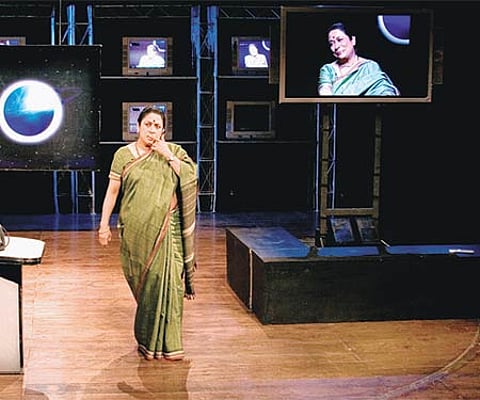

Girish Karnad’s hugely successful play Bikhre Bimb (in Hindi) will be staged at Ranga Shankara on May 29. Bikhre Bimb is among the most successful plays produced recently in India.
The play has seen more than 100 shows and has been invited to all the major festivals of India. Arundhati Nag’s masterly portrayal of two characters in a skillfully conceived plot has won her accolades and awards.
The one-act one-performer play tells the story of Manjula Nayak, a professor of English literature who has been an unsuccessful writer in Kannada. She finds international acclaim when she writes a novel in English, which becomes a bestseller.
The story starts with her introducing the audience to her novel in a TV studio prior to a film on telecast. After she finishes her introduction, she is confronted by her own image on the screen which poses questions on betrayal of her language and identity when she chooses to write in English.
The twenty-first century is the age of the electronic image.
From every corner of our world, electronic images fling themselves at us, entertaining, educating, enticing, offering us a virtual world of global dimensions to immerse ourselves in. The very notion of a private self seems threatened by this onslaught from outside. But suppose the most vociferous of these images were one’s own? Manjula suddenly becomes wealthy and internationally famous by writing a best-seller in English. The question haunting her is whether in thus opting for the global audience she has betrayed her own language and identity.
A little-known face in Karnataka, she has now acquired an international image.
And inherited problems of loyalty and betrayal. And, without warning, it’s her own image that decides to play confessor, psychologist and inquisitor.
Girish Karnad’s Bikhre Bimb was born as Odakalu Bimba in Kannada and was written exclusively for Ranga Shankara’s opening festival in October 2004. When the 35-day festival was designed to celebrate the birth of Ranga Shankara, it was decided that a new production of its nature was more appropriate for a later date.
Subsequently Karnad also wrote the English version, A Heap of Broken Images.
Three unique things happened when Ranga Shankara produced the play in March 2005 — Girish Karnad directed his play for the first time (the last time Karnad directed a play was 40 years ago when he did Badal Sircar’s Evam Indrajit) Ranga Shankara produced it’s first play a play opened in two different languages.
The lead actors of the two plays — Arundhati Nag in the Kannada version and Arundhati Raja in the English version, infused different energies and layers of characterisation to the play.
It was very interesting for audiences who could follow both languages to see how the same play manages to hold sway over two entirely different sets of audience members with two different interpretations of the same text.
