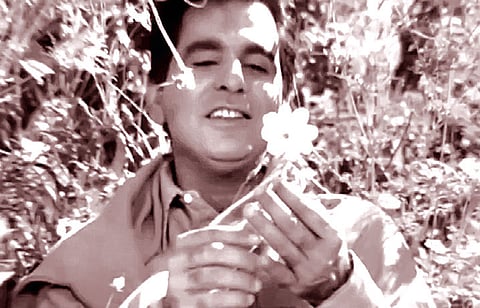

In the 70s, if you switched on the radio, you would invariably hear a Madhumati (1958) song.
Salilda’s timeless music defies definition and description. It is elevating, soothing, refreshing and very Indian despite allegations that he picked up from various symphonies. His reply to his critics: “Music has to, at all times, dissolve and evolve... But in my quest for moving forth, I should not forget my tradition.”
What was it that made his music stand apart? His experimentation. Most singers agree that the seemingly simple Guzar Jaaye Din, sung by Kishore Kumar for Annadata, is very difficult to render as Salil Chowdhury did not conform to the traditional music parameters.
Born on November 19, 1922, Salil Chowdhury was one of India’s brilliant composers. Much before fusion was introduced by the new age composers, Salilda blended the strains of folk music and classical music as also blues and jazz beautifully. Legendary singer Manna Dey said in an interview: “Salil was brilliant. He made effortless fusion of folk tunes and western pop. He was a poet, scored music, arranged orchestra — he was an all-rounder.”
His formative years in Assam reflected in the songs of Madhumati where he used natural sounds -- chirp of the birds or the woosh of the wind.
Mozart and Chopin were his big inspirations. Music experts say one can see Chopin’s influence in the haunting Raton Ke Saye in Annadata. The score of Itna Na Mujh Se Tu from Chhaya was inspired by Mozart’s Fortieth Symphony but Salilda Indianised it by tinting it with Bhairavi.
Manna Dey once recalled how Salilda and Bimal Roy conceptualised the soul-stirring Aiye Mere Pyare Watan from Kabuliwala. “Bimalda described how the Kabuliwala returns home late in the night. He is living in a one-room tenement with 15 others.
He remembers his young daughter back in Kabul and starts singing softly so as not to disturb the others. Salilda composed a very soft melody to suit this mood and I was asked to render this in an almost whispering tone. During the recording, the sound recordist Sharma wanted me to raise my tone. But Bimalda put his foot down. After the recording, Sharma hugged me and said the song was superb...”
In Salilda’s songs, the interlude of one number often segued into a prelude of another. For instance, Aa Ja Re Pardesi from Madhumati has for interlude the Ghadi Ghadi Mera Dil Dhadke tune which went on to become a great song. Again, in Tujh Bin Jiya Udas from Poonam Ki Raat, you might notice the instrumental rendition of Baagh Mein Kali Khili of Chand Aur Suraj between the first and the second antara.
Salil Chowdhury was perhaps the first music director to have done the background score without composing songs for the same film. It began with Bimal Roy’s Devdas where, though S D Burman composed the music, Roy asked Salilda to compose the background music.
When Salilda passed away on September 5, 1995, said music composer Naushad: “One of the seven notes of music is lost forever.”
Kannada hits
Salilda gave Kannada cinema one of its biggest hits— Dooradinda Bandante Sundaranga Jaana from Samshaya Phala.
Salilda’s other Kannada films include Onde Roopa Eradu Guna (O Udaala Suraala), Balu Mahendra’s Kokila (Sanje Thangali) and Chinna Ninna Muddaduve.
His most spectacular work outside Bengali and Hindi was, however, for Ramu Kariat, scoring several hits in the Malayalam evergreen Chemmeen.
