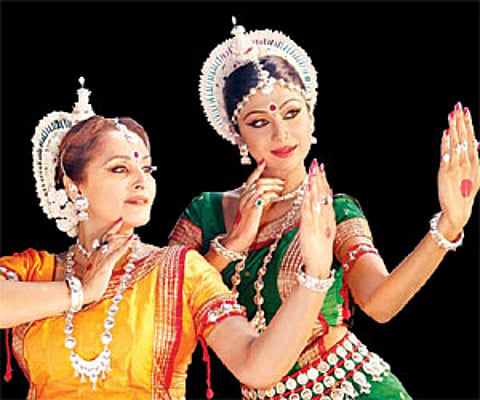

The only way to quell the chaos unleashed by desire is to yield to it - this age-old oriental philosophy forms the crux of ‘The Desire’, the first Indo- Chinese co-production helmed by R Sarath.
The film, a cross-country romance, has Shilpa Shetty and Chinese actor Xia Yu playing the leads. “As the title indicates, the film dissects the element of passion involved in dance, music, art, culture and emotions.
According to Buddhist philosophy there is no escape from desire.
Once you develop a desire, the only way to get rid of it is to yield to it.
That’s why staying away from desire becomes all the more important,” Sarath explains the core concept of the film.
T h e f i l m chronicles the journey of a danseuse as she braves through the many tempests in her life.
Gouthami, the character essayed by Shilpa Shetty, is an odissi dancer whose sole passion in life is her art.
During an overseas dancing tour she meets Jai Leang, a young Chinese artist and sculpturer of mixed parentage.
Despite her unwavering dedication towards d a n c i n g , Gouthami finds it difficult to cast aside Jai.
“The film follows the trials and tribulations of this love beyond borders during the course of which Gouthami covers the distance from a vivacious dancer to a saffronclad ascetic,” says the director who adds that the actress underwent a 2-month-long training session at Kelucharan Mohapatra dance school to perfect her steps for the film.
Xia Yu, a popular Chinese star, who is also the youngest to bag best actor award at the Venice Film festival, plays the role of Jai Leang.
The other key characters include Gouthami’s mother played by Jayaprada, Musui, a teenage boy, and Nalini, a lesbian who desires Gouthami.
Vikram Gokhale, Sheetal Menon, Nakul Vaid, Aasif Sheikh, Bikramjeet, Bijay Lakshmi, Shweta Khanduri, Vinayak Gananya and Anupam Kher are also part of the cast.
Shankar Ehsan Loy and Viswamohan Bhat have composed the music for the film shot in kerala, Ahmedabad, Nasik, Mumbai, Hydrebad,Shanghai and Malaysia.
Sarath says since the film deals with the Buddhist discourse of desire, he wanted the characters and settings completely in tune with the theme.
“India and China are two Asian countries who can easily connect to this concept and the nativity of the lead characters was fixed accordingly.” The film also explores the nuances of two different cultures and the Chinese art scene.
“The Buddhist painting tradition was superseded by modern and surreal forms when the communists came into power.
A lot of artists were excommunicated to Malaysia and Japan.
In the film, Jai Leang’s father is also an artist in exile.
So the film slightly touches upon some subtle and sensitive aspects too,” he says.
Though the film didn’t have a theatrical release in India, it was screened at a number of international festivals.
While the film bagged the award for best film at New Jersey and Geneva film festivals, Shilpa Shetty was adjudged as the best actress at JKFF and NJSAF festivals.
The film is expected to hit screens in India and China in May.
