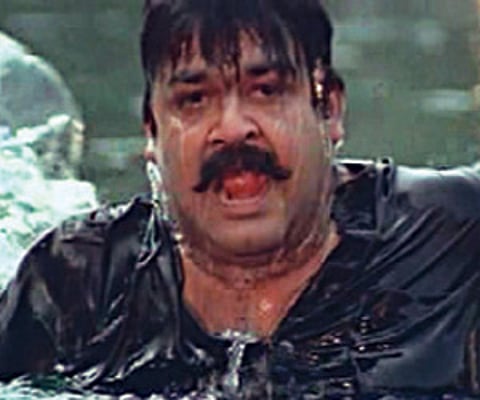

Here’s a love story. “I need a woman to kick when I come home drunk, to love during the monsoon nights, to have and raise my children and to cry hysterically at my death. If you are willing to be that, hop in (to his off-roader),” says the man. And the woman? She yelps with joy and throws her bags in. This is after months of cooing and wooing. She even survived being thrown into a pool to prove her love.
This is Narasimham, a Malayalam top-grosser in 2000. The hero (played by Mohanlal) was not a sadist nor the heroine (Aishwarya) a masochist, but the man was macho, unapologetically chauvinistic, along the lines of a prototype that was gaining favour among Malayalam filmmakers in the 1990s — a “superhero”, as one filmmaker said.
Just as Frankenstein needed thunder and lightning, the superhero too needed a few essentials to come to life — a problem to solve (a weighty one, like an unjust social order), the necessary rhetoric to drill a conscience into the audience and most problematically, a strong-willed woman to tame or command.
Hence, we had movies like Janadhipathyam (1997) in which the hero, Suresh Gopi, plays the role of an upright IPS officer. He verbally abuses his superior — a woman who is single — for being corrupt. But he does this by making nonsensical connections. According to him, she connived with the goons and compromised a hydroelectric project because she has not “known the heat of a man”. Boneheaded? Then you have The King (1995), a Mamootty-starrer. The hero whips himself up into frenzy when his subordinate, a feisty woman, is slow to process the pension application of a freedom fighter. After giving her a lecture on a “poor and needy India”, he says he has not hit her only because she is a woman. To quote him, “a mere woman”. Soon, she trades her trousers for a sari.
In Pathram (1999), after criticising the well-read heroine for her clichéd writings on men, the hero closes in on her and says, in a near-whisper, “your perceptions will change once you know a man more closely.” The cliche should have put her off the hero, but then she falls for him. As the movie progresses, she regresses to a weepy mess on his broad shoulders. Then there is a 1997 hit, Aaram Thampuran, in which an independent and smart woman who has lived her life in Mumbai proposes marriage to the hero. He refuses,
because he wants to “protect an orphan girl (by way of marriage)”. Instead of shrugging off the refusal or calling him a pompous ass, she leaves — head bent, defeated.
What were the filmmakers thinking of? The economics, says film expert C S Venkateswaran. In the 1990s, “TV became female and the cinema turned male.” Television took over the subjects that traditionally captured female audiences — familial troubles — and films were left with a predominantly male audience. So cinema started focussing on male aspirations and fantasies.
Machismo is not new to Malayalam cinema, says Ranjith, writer of Narasimham. “It was always there, even in the ’70s and ’80s.” There was a long break because after the late Jayan, there were no actors who could play them, he adds. Also, the machismo was part of Narasimham’s story. He cites this as a contrast to his earlier and the hugely successful Devasuram (1993). In this film, the protagonist, played by Revathi, is a strong woman.
Renji Panicker, scriptwriter for The King, explains his hero by saying that the writer merely reflects the reality in society. “If ordinary people talk like that, what prevents a hero from doing the same?” A successful director (who made Narasimham and The King) Shaji Kailas says that characters are popular
because they play out every man’s dream of breaking boundaries. “Don’t read too much into the gender portrayals.”
So will the superhero stay? Yes, according to Venkateswaran. “The TV channels are willing to buy these movies for one crore or more, since they have the Malayalam superstars.” Smaller stars will reduce the income by half. Since TV is a guaranteed income for the struggling industry, looks like John Rambo will stay awhile. Somebody pull the purse string.
— ashamenon@epmltd.com
