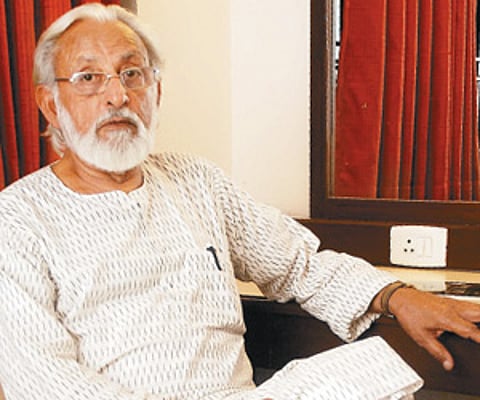

At 78, film and theatre director and set designer MS Sathyu discusses his film with a passion, it's hard to overlook. But having courted controversy as often as he has been crowned with glory, Sathyu is a seasoned speaker who knows his movie and its limitations too. The movie in question, Ijjodu, takes on the complex system of beliefs that people hold, rather beliefs that hold people.
''The dasi system is a blind belief in the urban context. But what does it mean to the dasi themselves whose families have looked up to it for their bread for generations together? Are they any different then from sex workers at all who do it for an economic need?'' Sathyu begins, and one then knows Ijjodu isn't just about any other film on the dasi system. The list of films on the dasi system are long, from Sringaram to Kanavu Mei Pada Vendum, and Sathyu affirms that his film treads on a different plane altogether.
And playing the dasi of his dream story is Meera Jasmine, yet another immensely talented and controversial star. Meera, in fact, began her career playing a dasi in her Malayalam film Soothradharan. ''She is a tremendously talented actress and I had faith in her capability to play the role. Now that the film is done, I can say that I have not regretted having chosen her,'' Sathyu explains, adding that the actress agreed to do the movie for a rate lesser than she charges otherwise.
Sathyu then acknowledges that the film, with its unusual theme, might not be a hit with the common man. ''This is not the genre that people want to see. I don't expect the 'common' man to watch the film because I need an audience that shares my sensitivities,'' he confesses, adding that Ijjodu is a film that will be popular in the film festival circuit. ''But they won't do. Film Festivals don't bring money. They're only an honour and don't satisfy me,'' says the filmmaker, whose Garam Hawa, interestingly, turned out to be the favourite for both critics and the common man. The film, which centred on the Hindu-Muslim riots following partition, was both a smashing hit and got him a national award.
Calling theatre an equally enjoyable and gratifying medium, Sathyu is fresh from the success of Girija Ke Sapney, a musical satire that has been launched in Delhi, Lucknow and Bombay. ''But obviously, theatre in Chennai isn't that vibrant. A newspaper states it as news that there will be plays for three consecutive days in the city. It happens all the time in other places,'' Sathyu says, with obvious surprise at the state of theatre here.
''To say the least, Chennai contributes very little like Hyderabad for the theatre scene in the country,'' explains the director, whose comments about theatre in Hyderabad have raised heckles earlier as well. ''I remember there used to be good theatre earlier, when TKS Brothers and Manohar's theatre groups were active. Even now, you do have some good street theatre. Koothupattarai is very good,'' he then elaborates, when asked about plays in the city.
Contemplating a new theatre production, and spiritedly completing post production work for his Ijjodu, Sathyu's age isn’t keeping pace with his zeal for work. One only hopes his audience share the same zeal for movie watching that he does for making it.
'I wanted Meera out of the sets once'
A claim any movie maker having worked with Meera Jasmine will vouch for, Sathyu says the actress did throw her tantrums. ''It was fine for most part but one day, I was so annoyed that I asked her to get out of the sets. I was prepared to do the movie again with any other heroine who would cooperate. She cried, and things later got sorted out,'' the director reveals. The director was peeved, apparently, because Meera Jasmine walked in to the sets one day with normal clothes and not what she was designated to wear.
His first venture after Ray's death
Photographer Nemai Ghosh is widely regarded as Ray's photographer — the reason being that he was photographer for almost all works of Sathyajit Ray. Besides, he was found in Ray’s company always, an association that led him to publish a book Sathyajit Ray: A vision of Cinema. It is widely reported that the photographer walked without a camera on only one occasion: when Ray died and he had gone to pay his last respects to his friend. Ghosh had apparently told people that there was no work for him and his camera with Ray
sharadha@epmltd.com
