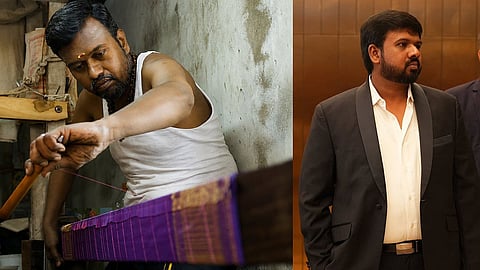

National Award-winning documentary Life in Loom was an unexpected detour for its producer, Francis Markus, and director, Edmond Ranson. With both nurturing ambitions in feature films, a documentary on India’s weavers was definitely not a part of their plans. What began in 2018 as an attempt to examine the impact of climate change on weaving soon unravelled into a much larger story encompassing livelihoods, socio-economic pressures and even geopolitics. The journey took the team across seven regions of India, as they successfully faced production challenges, the pandemic and dwindling resources. If the already arduous journey wasn't enough, even the appreciation came with a caveat: Do not make documentaries on 'dry subjects' like weaving.
The perseverance eventually paid off when Life in Loom won the National Award, bringing renewed attention to the people and craft. In a conversation with CE, producer Francis Markus, founder of Mark Studios, reflects on the film’s long journey, what it taught him about India’s weaving communities, and why documentary storytelling matters.
Excerpts:
Given that both you and director Edmond wanted to make a mark in films, why did you go with a documentary?
Honestly, no idea. I worked as an assistant director in Velayudham and Jilla, and Edmond, my college junior, worked as an AD in Aruvi. One day, he met me with this idea in 2018. He was so confident about portraying the problems faced by weavers across India. I too felt I had to back this project. Interestingly, we initially planned how climate change is impacting weavers, but as we got to know more about their lives, the documentary just branched out to more and more problems in their profession. From climate change we went to labour issues, geopolitical impact on the industry like wars and tariffs. After a point, we struggled not knowing how much to tell and where to restrict.
How did Life in Loom branch out, and what took this long for the documentary to be about?
Edmond first planned to shoot in four regions, then I extended it to more, and we fixed it at seven. I didn't want half-hearted efforts. I was in for a shock after Edmond returned after travelling across India, as the footage was episodic. Meaning, Tamil Nadu, Leh, Assam, etc...... They were impactful in isolation. But there was a risk of people stopping it with one episode/region. I did not want that. So I wanted a thread to tie all the stories together and package it as one project. I sent Edmond again on a trip, then Covid happened. Despite the pandemic and resources drying up, fortunately, we got what we wanted. Our original footage was over three hours long. We were able to make it crisper, and the run time came down to 100 minutes. The satisfying end product made us forget the hiccups we went through while making it.

Take us through your National Award journey.
The very day I decided to make this documentary, I came to terms with the fact that there is no way I will get any return on investment. The only takeaway from Life in Loom for me is the recognition. So I decided to take the film through the festival circuit. Screenings and accolades at IFFI Goa opened a lot of doors for me, and then the Mumbai International Film Festival. Not just appreciation, but advice too was unanimous. I was told weaving was a very dry subject with hardly any takers. Also, I was egged on to make a feature film next time. It was after the eye-opening conversations I had there with people that I decided to take the film to the National Awards. We did not make Life in Loom with any award in mind. But I take this opportunity to thank the jury and the people, as the National Award has suddenly turned the gaze towards our documentary.
Why do you think documentary filmmaking is necessary even after going through so much?
From theatre, the storytelling has morphed into the microdrama format today, and I have no idea what it will become in the future. Instead of helping increase people's attention span, the market is catering to their diminishing attention. So the habit of reading is also in decline. Documentary, I feel, has become the only way to impart information and to transfer our culture, stories, and struggles to the next generation. Important information coming out as a hero's punch line in a star vehicle only has the shelf life of a clap or a whistle. What stays with them is only the star-craze. That is why I feel documentary storytelling is imperative.
Your plans with Life in Loom after the National Award win?
The National Award win gives me an impetus to take the documentary to the masses. I am planning a screening soon. India is the global textile hub; we have such creative weavers here. Whenever a model or an influencer wears a saree, we admire their beauty. We don't think of the craft that went into it and the master craftsperson behind it. After you watch Life in Loom, you will begin appreciating the hardworking weavers. More than anything else, they are our people; if we don't tell their stories, then who will?