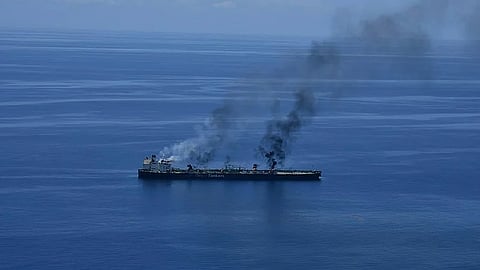

The ongoing US-Israeli war on Iran has brought into sharp focus an often-overlooked human cost of conflict: the vulnerability of seafarers who keep global trade moving.
The Strait of Hormuz, through which roughly a fifth of the world’s crude oil and gas normally passes, has become a particularly dangerous stretch of water. Since the conflict began on February 28, merchant vessels in and around the Strait have come under repeated attack. According to government data, 16 Indian nationals have died in conflict-related incidents, including 10 seafarers, while 75 Indians have been injured. The International Maritime Organization (IMO) has recorded 46 attacks on commercial shipping since the conflict began.
Indian seafarers have been disproportionately affected not because they are uniquely targeted, but because India has become one of the world’s largest suppliers of maritime manpower. With Indians now accounting for more than 12 percent of the global seafaring workforce, they are present on ships operating on virtually every major international route.
Timeline
19th–early 20th century: Indian sailors, known as Lascars, are recruited in large numbers aboard British merchant and naval ships, establishing India’s long association with international shipping.
Post-Independence: India develops a modern maritime training system, with institutions such as TS Dufferin and TS Rajendra, followed by the expansion of maritime education and training under the Directorate General of Shipping.
2015: India accounts for 5.2% of the global seafarer workforce, ranking fifth worldwide.
2021: India’s share rises to 6%, though it remains fifth among the world’s major suppliers.
February 28, 2026: The US-Israeli war on Iran begins, sharply increasing risks to commercial shipping in and around the Gulf.
During the conflict: Merchant vessels come under repeated attack in and around the Strait of Hormuz, with Indian seafarers among those killed and injured. The IMO records 46 attacks on commercial shipping since the conflict began.
2026: India becomes the world’s second-largest supplier of seafarers, with 311,936 maritime professionals, accounting for 12.16% of the global seafaring workforce, according to the BIMCO-ICS Seafarer Workforce Report 2026.
July 2026: The Directorate General of Shipping directs Indian shipowners, ship managers and recruitment agencies not to deploy Indian seafarers on vessels transiting the Strait of Hormuz until further orders.
August 2026: Despite the advisory, around 15,000 Indian seafarers are reported to remain stranded west of the Strait, underlining the difficulty of protecting crews already at sea.
Going forward: Under Mission 20%, India aims to raise its share of the global seafaring workforce from 12.16% to 20%.

Why are Indian seafarers among the biggest victims?
The principal reason is India’s enormous and rapidly expanding presence in the international maritime workforce.
According to the BIMCO-ICS Seafarer Workforce Report 2026, India now has 311,936 seafarers serving the global merchant fleet, giving it a 12.16 per cent share of the world’s seafaring workforce. India ranks second only to the Philippines and is ahead of China, Russia and Indonesia.
India’s strength is particularly evident among officers. The country supplies 140,718 officers, representing 13.41 per cent of the world’s officer workforce. It also supplies 171,218 ratings, accounting for 11.29 per cent of the global ratings workforce.
The numbers explain the exposure. Indian seafarers are employed across major international shipping routes. When a strategic waterway such as Hormuz becomes a conflict zone, a large Indian workforce is inevitably caught in the danger zone.
How much has India’s maritime workforce grown?
The growth has been dramatic. In 2015, India accounted for just 5.2 per cent of the world’s seafarers and ranked fifth globally. By 2021, its share had increased to 6 per cent. Over the past decade, however, India’s share has more than doubled to 12.16 per cent, making it the world’s second-largest supplier of maritime professionals.
The government attributes the increase to the expansion of maritime education and skilling, greater training capacity, modernisation of training infrastructure and the digitisation of certification and regulatory services through the Directorate General of Shipping. India has also strengthened compliance with the International Convention on Standards of Training, Certification and Watchkeeping for Seafarers, or STCW.
The Centre’s Mission 20% seeks to take India’s share of the global seafaring workforce to 20 per cent.
Why do international shipping companies prefer Indian seafarers?
Indian seafarers are valued for their English-language proficiency, technical skills and ability to work in multinational crews.
Most undergo training at institutions recognised by the Directorate General of Shipping, with courses covering navigation, marine engineering, safety and emergency response in accordance with international standards.
Cost is another factor. Indian seafarers are generally regarded as highly skilled while remaining relatively cost-effective compared with manpower from several other maritime labour markets. Their adaptability across different types of vessels and multinational crews has also strengthened India’s reputation.
The global demand for qualified seafarers is itself rising. BIMCO-ICS estimates that the world merchant fleet will require an additional 113,000-plus officers by 2030, underscoring the importance of countries such as India in meeting the industry’s manpower needs.
How did India acquire this reputation?
India’s maritime labour history predates Independence by more than a century.
During the 19th and early 20th centuries, Indian sailors, known as Lascars, were recruited in large numbers to work aboard British merchant and naval ships.
After Independence, India gradually developed a formal maritime education and training ecosystem. Institutions such as TS Dufferin and TS Rajendra trained generations of maritime personnel, while the Directorate General of Shipping subsequently became central to regulation, certification and training standards.
Over the decades, Indian officers developed a strong reputation in international shipping and became an important part of the workforce of major ship-management companies.
Why is the merchant navy such an attractive career?
For many young Indians, the merchant navy offers substantially higher earning potential than many comparable entry-level jobs on shore.
The profession is particularly popular in Kerala, Tamil Nadu and Maharashtra, but has also attracted recruits from states such as Punjab, Haryana and Uttar Pradesh.
Another attraction is the rotational nature of the job. Seafarers typically spend several months at sea followed by a period of leave. While aboard ship, accommodation, food and medical expenses are generally borne by the employer, allowing many to save a significant part of their income.
There can also be tax advantages depending on the number of days a seafarer spends outside Indian territorial waters and his or her residential status under Indian tax law.
But the financial benefits come with a price: long periods away from home and, increasingly, the possibility that the workplace itself could become a conflict zone.
Can seafarers refuse to enter a war zone?
Yes, subject to the applicable employment contract and collective bargaining arrangements.
International maritime labour protections provide safeguards for seafarers when vessels enter designated high-risk or war-risk areas. Seafarers can, in appropriate circumstances, exercise their right to refuse to proceed into a designated warlike operations area and seek repatriation.
Those who agree to sail into such areas may be entitled to additional compensation. Under applicable collective agreements, this can include a war-risk bonus equivalent to 100 per cent of basic wages for each day spent in the designated area, as well as enhanced compensation in the event of death or disability arising from warlike operations.
But exercising the right to refuse is not always easy.
Junior crew members may fear that declining an assignment could affect their future employment. For workers supporting families or servicing education and other loans, the prospect of losing a lucrative contract can make the decision particularly difficult.
What protection do seafarers receive if they enter a conflict zone?
Legitimate commercial vessels carry Protection and Indemnity (P&I) insurance as well as appropriate war-risk cover. Depending on the policy and contractual arrangements, these can provide protection for medical emergencies, evacuation, disability and death.
Seafarers who enter designated high-risk areas can also be entitled to war-risk bonuses and enhanced compensation under applicable employment and collective bargaining agreements.
What compensation is available to families of Indian seafarers killed in war zones?
The government provides welfare assistance in addition to compensation that may be available under employment contracts and insurance policies.
Under the DGMA Welfare Scheme of the Seafarers’ Welfare Fund Society, an ex-gratia payment of Rs 10 lakh is available to the next of kin of a seafarer killed in a war-zone incident, subject to verification.
Seafarers covered by collective bargaining agreements may also be entitled to additional compensation through their respective unions. Officers covered by the Maritime Union of India are eligible for Rs 12 lakh, while crew members represented by the National Union of Seafarers of India receive Rs 10 lakh.
The vessel’s P&I insurance can provide a further avenue of compensation. The Recruitment and Placement Service Licence agency that recruited the seafarer is responsible for pursuing the insurance claim with the vessel’s P&I Club or insurer.
What has the government done to protect Indian seafarers?
The Directorate General of Shipping has tightened the rules governing deployment in high-risk areas.
Under revised Standard Operating Procedures, manning and recruitment agencies must inform seafarers in writing if a vessel is scheduled to pass through a designated High-Risk Area before the employment contract is signed. Agencies that blacklist or penalise seafarers for refusing such assignments can face stringent regulatory action, including cancellation of their licences.
The government has also strengthened digital monitoring of Indian seafarers to verify their location, insurance coverage and compliance with war-risk regulations.
Most significantly, the Directorate General of Shipping has directed that Indian seafarers should not be deployed on vessels transiting the Strait of Hormuz until further orders, in view of the heightened security situation.
The advisory, however, cannot immediately help those already at sea.
Around 15,000 Indian seafarers are believed to remain stranded west of the Strait, according to reports, highlighting the practical difficulties involved in moving crews out of a conflict-affected maritime zone.
What does the crisis mean for India?
The West Asia conflict has exposed a paradox at the heart of India’s maritime ambitions.
India has successfully transformed itself into one of the world’s largest suppliers of skilled maritime manpower. That is a significant economic and strategic achievement. But the larger India’s presence in the global merchant fleet becomes, the greater the number of Indians exposed when shipping routes are disrupted by war, piracy or geopolitical confrontation.
The government’s Mission 20% envisages taking India’s share of the global seafaring workforce from 12.16 per cent to 20 per cent. The ambition will require more training, more officers and continued expansion of India’s maritime workforce.
But the crisis around Hormuz makes another requirement equally clear: India’s maritime expansion must be accompanied by stronger mechanisms to protect the people who make that expansion possible.
For Indian seafarers, the war in West Asia is not a distant geopolitical conflict. For those aboard ships navigating its most dangerous waters, the workplace itself has become the frontline.
(Inputs from: BIMCO-ICS Seafarer Workforce Report 2026; International Maritime Organization (IMO); Ministry of Ports, Shipping and Waterways/Press Information Bureau; Directorate General of Shipping; and Reuters)