
This May, cities across northern, central and eastern India repeatedly recorded some of the highest temperatures anywhere on Earth. An analysis of weather data shows that all of the world's 50 hottest cities in May were in India.
Cities in Odisha, Chhattisgarh, Punjab, Haryana and Uttar Pradesh also experienced prolonged periods above 45'C, with some enduring nearly an entire month above 40'C.
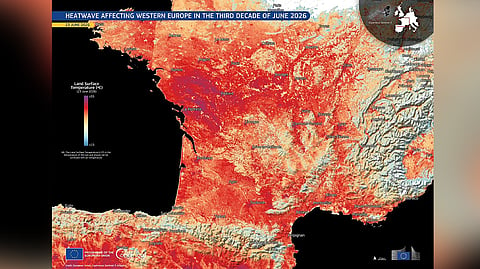
Europe, meanwhile, is battling its own climate emergency. Roads softened, railway tracks buckled, traffic signals malfunctioned, schools shut, and hospitals struggled to cope with heat-related illnesses, and deaths, as temperatures climbed above 40'C across Spain, France, Italy and Portugal.
Why are extreme heat events becoming more frequent, more intense and more widespread?
Imagine the Earth wrapped in a blanket. Normally, sunlight warms the land and oceans before some of that heat escapes into space. Greenhouse gases such as carbon dioxide, methane and nitrous oxide act like an increasingly thicker blanket, trapping more heat than before.
The Earth's average temperature has already risen by around 1.3'C since the Industrial Revolution. It may sound small, but climate scientists say even this increase dramatically raises the chances of extreme weather.
The Intergovernmental Panel on Climate Change (IPCC) has repeatedly warned that every fraction of a degree of warming increases both the frequency and intensity of heat extremes. Europe has warmed faster than the global average, while India has witnessed heatwaves becoming longer, more widespread and more frequent.
What exactly is a heatwave?
A heatwave is not simply a very hot day. It is a prolonged period of unusually high temperatures compared to what is considered normal for a particular region.
A temperature of 40 °C may be common in Rajasthan during summer, but the same temperature in Paris or London is an extraordinary event. That is why meteorological agencies use different thresholds. In India, the India Meteorological Department declares a heatwave when temperatures exceed specific limits or remain significantly above normal for consecutive days.
Heatwaves become dangerous because the human body constantly generates heat and must release it into the surrounding air. Sweating helps cool the body, but when the surrounding air is already extremely hot, that cooling system becomes less effective. Prolonged exposure can lead to dehydration, heat exhaustion and eventually life-threatening heat stroke.
What is El Niño, and why does everyone talk about it?
Think of the Pacific Ocean as one of Earth's biggest climate engines. Under normal conditions, trade winds push warm surface waters towards Indonesia and Australia while cooler water rises near South America.
During an El Niño event, these winds weaken. Warm water spreads eastwards across the Pacific, releasing enormous amounts of heat into the atmosphere.
Globally, El Niño tends to bring flooding to parts of western South America, drought to Indonesia and Australia, and contributes to higher global temperatures. In India, it often weakens the summer monsoon, increasing the risk of drought and hotter conditions. The powerful El Niño of 2023-24 contributed to making 2024 the hottest year ever recorded globally.
Is El Niño responsible for every heatwave?
No. This remains one of the biggest misconceptions. El Niño increases the likelihood of hotter years, but it is not the primary driver of the world's worsening heat extremes.

Climate change has fundamentally shifted the baseline. Even during years without El Niño, average temperatures are significantly higher than they were a few decades ago. Researchers from the World Weather Attribution initiative say many recent record-breaking heatwaves across Europe, North America and Asia would have been extremely unlikely without human-induced climate change.
What is wet bulb temperature, and why are scientists increasingly worried about it?
The human body cools itself mainly by sweating. When sweat evaporates, it removes heat from the skin, much like water cooling a clay pot. But evaporation works only when the surrounding air can absorb more moisture. Once humidity becomes very high, sweat no longer evaporates efficiently.
Wet bulb temperature combines air temperature and humidity into a single measure that indicates how effectively the human body can cool itself. This explains why a dry 42'C afternoon in Rajasthan can sometimes feel more tolerable than a humid 35'C afternoon in Chennai or Kolkata.
Scientists consider a wet bulb temperature of around 35 °C to be close to the upper limit of human survival, even for healthy adults resting in the shade with access to water. At such conditions, the body may no longer be able to cool itself, causing internal temperatures to rise dangerously.
This is why scientists say humidity deserves as much attention as temperature itself.
Why is Europe facing such an intense heatwave now?
Several factors have come together at the same time. The first is long-term climate change. Europe has warmed faster than any other continent over recent decades, making heatwaves more frequent and more intense.
The second factor is a persistent high-pressure system, often called a "heat dome". A heat dome acts like placing a lid over a cooking pot. The sinking air suppresses cloud formation, allowing uninterrupted sunshine to heat the ground while trapping hot air near the surface. As soils dry out, even more of the Sun's energy goes into heating the land instead of evaporating moisture, creating a feedback loop that further intensifies the heat.
The latest heatwave saw temperatures exceed 40'C across parts of Europe. Roads melted, railway tracks buckled and traffic signals malfunctioned. Rapid attribution studies by the World Weather Attribution initiative found that climate change made such extreme June heat several times more likely and around 3'C to 4'C hotter than it would have been in a pre-industrial climate.
Interestingly, meteorologists say a similar high-pressure system also contributed to India's prolonged heat during April and May, delaying rainfall and allowing temperatures to build relentlessly over large parts of the country.
Why do cities become much hotter than surrounding areas?
This phenomenon is known as the urban heat island effect. Cities are dominated by concrete, asphalt, glass and steel, which absorb heat during the day and slowly release it after sunset. Shade-providing trees are often fewer in number, while air conditioners dump heat outdoors and tall buildings restrict airflow.
As a result, city temperatures can remain several degrees warmer than nearby rural areas, particularly at night. While daytime heat grabs headlines, warmer nights prevent the body from recovering from heat stress, increasing health risks for the elderly, children, outdoor workers and people with existing illnesses.
Are heatwaves becoming the 'new normal' for India?
The scientific evidence increasingly suggests they are. Over the past decade, India has experienced heatwaves that arrive earlier, last longer, and affect larger geographical areas. Heatwave conditions are no longer confined to Rajasthan and northwest India. Central, eastern and even parts of southern India are witnessing more frequent episodes of extreme heat.
The May 2026 heatwave illustrated this changing pattern. Along with Rajasthan and Uttar Pradesh, cities in Odisha, Punjab, Haryana and Chhattisgarh recorded temperatures close to or above 48'C, while several locations spent weeks above 40'C. This points not just to isolated temperature spikes but prolonged exposure to dangerous heat.
Can we protect ourselves from extreme heat?
There is much that can be done. Individuals can reduce their risk by staying hydrated, avoiding strenuous outdoor activity during peak afternoon hours, wearing light-coloured clothing and recognising the early signs of heat exhaustion before they become life-threatening.
Governments also have an important role. Heat Action Plans, early warning systems, increased tree cover, shaded public spaces, cool roofs, improved building design and better access to drinking water have all proved effective in reducing heat-related deaths.
Air conditioners provide temporary relief but also increase electricity demand and release additional heat outdoors. Ultimately, reducing greenhouse gas emissions remains the only long-term solution.