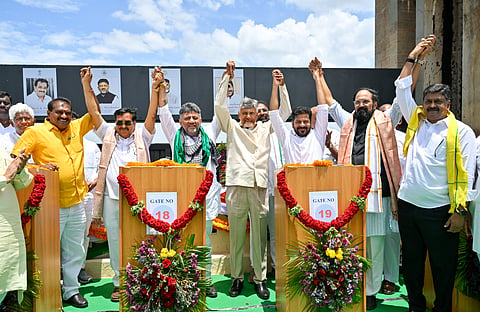

The inauguration of the 33 newly installed crest gates at the Tungabhadra Dam on June 25 marked more than a routine irrigation milestone. The ceremony, attended by the Chief Ministers of Karnataka, Andhra Pradesh and Telangana, along with the Union Jal Shakti Minister, symbolised rare political and administrative cooperation over a shared river.
Andhra Pradesh Chief Minister N. Chandrababu Naidu described the occasion as “history in the making”, saying the completion of the crest gate replacement marked a new era of cooperation in India’s river management. The event came nearly two years after one of the crest gates was washed away during the August 2024 floods, triggering anxiety among lakhs of farmers dependent on the reservoir.
Why is the Tungabhadra Dam so important?
The Tungabhadra Dam, situated near Hosapete in Karnataka, is one of India’s largest multipurpose river valley projects. Built across the Tungabhadra River, it provides irrigation, drinking water, hydroelectric power and industrial water supply.
The reservoir is the lifeline of the drought-prone districts of Ballari, Vijayanagara, Koppal and Raichur in Karnataka, while also irrigating vast stretches of farmland in Andhra Pradesh and Telangana through an extensive canal network.
Its importance extends beyond agriculture. The reservoir supports fisheries, groundwater recharge, biodiversity and tourism. It also sustains industries around Ballari and Vijayanagara, making it a key economic driver for the region.
For more than seven decades, the dam has supported food security for millions by enabling the cultivation of paddy, cotton, sugarcane, chilli, pulses and horticultural crops. Any disruption to its operations immediately affects farming, drinking water supplies and industrial production across the three states.
What is the dam’s history?
The idea of constructing a dam across the Tungabhadra River dates back to the pre-Independence period. It was jointly conceived by the then Madras Presidency and the Hyderabad State to harness the river’s irrigation potential.
Construction began soon after Independence, and the dam was commissioned in 1953. It became one of the first large-scale river valley projects in independent India.
The reservoir transformed the dry Deccan Plateau by bringing assured irrigation to previously drought-affected regions. Over the decades, the Tungabhadra Board was established to jointly manage the reservoir between Karnataka and the undivided Andhra Pradesh. Following the bifurcation of Andhra Pradesh in 2014, Telangana also became a stakeholder in its management.
The dam has since remained a symbol of inter-state cooperation despite periodic disputes over water sharing. The replacement of the 33 crest gates further strengthens its long-term operational safety and ensures reliable water storage for future generations.
Was replacing all 33 crest gates necessary?
The crest gates regulate water storage and releases from the reservoir. Most of the original gates had been in service for more than 70 years, far exceeding their intended design life.
Concerns intensified after one of the gates was washed away during heavy floods in August 2024, forcing authorities to release large volumes of water and raising fears among farmers about storage losses.
Following technical assessments, authorities decided to replace all 33 gates with modern steel radial gates equipped with improved operating mechanisms and greater structural strength.
The project restores the dam’s designed storage capacity and significantly improves operational safety during floods and droughts. Engineers believe the new gates will allow more efficient water regulation while reducing maintenance requirements for decades.
The new gates are expected to help conserve the maximum possible volume of water within safe operating limits, boosting farmers’ confidence ahead of each monsoon.
How did Karnataka, Andhra Pradesh and Telangana work together?
The crest gate replacement became a rare example of cooperative federalism. Since all three states depend on the Tungabhadra reservoir, the exercise required coordinated planning, financial participation, technical approvals and continuous monitoring.
The states worked jointly through the Tungabhadra Board and the Union Ministry of Jal Shakti to ensure the project’s uninterrupted execution.
Political differences were largely set aside in favour of protecting farmers’ interests. The presence of the three chief ministers on the same stage underscored the shared responsibility for managing one of southern India’s most important irrigation projects.
The project demonstrates that inter-state river management can succeed when states prioritise scientific planning and common agricultural interests over political differences.
How much agricultural land depends on the dam?
The project irrigates nearly 15 lakh acres across the three states through the Left Bank Canal, Right Bank Low Level Canal and High Level Canal systems.
In Karnataka, large parts of Ballari, Vijayanagara, Koppal and Raichur districts rely heavily on reservoir releases. Andhra Pradesh benefits through the Tungabhadra High Level Canal, which serves Anantapur and neighbouring regions, while Telangana receives irrigation benefits in parts of the Krishna basin.
Beyond irrigation, reservoir releases recharge groundwater, sustain tanks and lakes, and improve drinking water availability in rural areas.
The command area contributes significantly to food-grain production, making the project indispensable to regional food security and rural livelihoods.
Desilting the reservoir: How will it benefit farmers?
Over the decades, enormous quantities of silt have accumulated in the reservoir, reducing its effective storage capacity.
Desilting removes deposited sediment, increasing the volume of water that can be stored without raising the height of the dam. Greater storage means more water remains available during delayed monsoons and the summer months.
Water availability improves for both Kharif and Rabi crops, irrigation becomes more reliable during drought years, groundwater recharge increases, and canal supplies remain more consistent.
The removed silt is also nutrient-rich and can improve soil fertility when applied to agricultural fields, reducing dependence on chemical fertilisers.
Experts believe that systematic, scientific desilting, combined with catchment-area treatment, can substantially improve reservoir efficiency while extending the dam’s operational life.
How much additional water can be saved through desilting?
The exact quantity will depend on detailed hydrographic surveys. The dam has a total storage capacity of 133 TMC, but siltation has reduced its effective storage to about 102 TMC. If large-scale scientific desilting is undertaken, a substantial portion of this lost capacity could potentially be restored. Even that would provide irrigation for thousands of additional acres while improving drinking water security.
Experts caution that desilting should be prioritised in areas where it is technically feasible and economically viable. Modern bathymetric surveys, sediment mapping and environmental studies are essential before undertaking large-scale operations.
The Union Jal Shakti Minister has already announced support for scientific studies on reservoir desilting, raising expectations among farmers across the command area.
Isn’t building the Navali Reservoir a better option than desilting?
Hydrologists generally view the two projects as complementary rather than competing options. Desilting improves the storage efficiency of the existing Tungabhadra reservoir and enhances the performance of the existing canal network without requiring major new infrastructure.
The proposed Navali Reservoir, by contrast, would create additional storage capacity, help regulate floodwaters and improve long-term water availability to meet future demand.
From a water-management perspective, the most effective strategy is to pursue both approaches through integrated basin planning. Restoring lost storage through desilting while creating additional storage with new reservoirs would improve resilience to climate variability and rising water demand.
