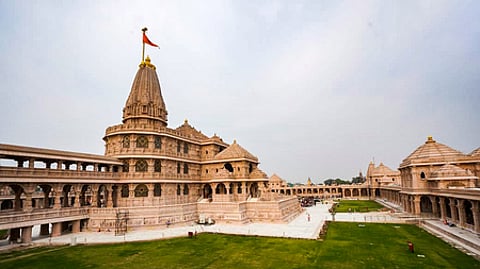

Around the time the Ayodhya Ram temple donation scam unfolded, another major temple was on a diametrically opposite plane, taking its security systems to the next level. The Tirumala Tirupati Devasthanams (TTD), which manages the Sri Venkateswara temple in Tirupati — the richest Hindu temple in the world — tasked the Institute of Chartered Accounts of India with creating a robust framework to strengthen its accounting and audit system. With an annual budget of around ₹5,500 crore, the Balaji temple uses an ERP system, which it wants to improve so as to track every rupee that comes in, all the way to how it is spent or how it changes hands.
Could the Ayodhya temple have prevented the multi-crore donation theft by adopting the ‘TTD model’, as suggested by former principal secretary to Prime Minister Narendra Modi and Ram Mandir construction committee chairman Nripendra Misra? The answer may lie not in robust technology but in effective administration. While the Ayodhya temple is run by Shri Ram Janmabhoomi Teerth Kshetra Trust, which comprises mostly religious leaders and prominent citizens, the Tirupati temple is administered by an IAS officer as CEO, who is assisted by joint executive officers and vigilance, security and accounts officials.
The Ram temple Trust, constituted primarily to oversee the temple construction work, was volunteer-run and not upgraded to bring in professionals to effectively manage public offerings after the consecration, when large on-spot donations shot up. Misra admitted that a TTD-style professional management model — including a full-time CEO who understands Uttar Pradesh — should have been put in place in Ayodhya for transparency and accountability.
What is the TTD model?
The TTD operates professionally as a massive conglomeration that oversees the administration, finances, and operational logistics of the Lord Venkateswara Temple in Tirumala alongside 11 other sub-shrines. The Tirupati temple manages crowds in the range of 65,000-70,000 people every day, which could peak at around 100,000 on auspicious days like Vaikuntha Ekadasi. To streamline the flow of devotees, the TTD has built queue complexes, where the pilgrims can rest and then proceed to the temple in an orderly way. The TTD is also one of the early adopters of technology, including barcodes and online tickets to manage inflow of visitors.
The Ram Janmabhoomi temple in Ayodhya has an average footfall of 80,000, which goes up to over 2 lakh on special days. A TTD delegation visited the Ram temple in February 2024 to explain how crowds are managed at Tirupati. A detailed report was also submitted to the Trust on how to replicate the system in Ayodhya to ensure minimum inconvenience to devotees.
However, the Ram temple’s association with TTD was limited to crowd management and did not include the other vital aspects like finance, vigilance, and security. Had the TTD model been adopted, the Trust’s role would have been limited to pilgrims’ welfare while the day-to-day operations would be run by a CEO with the financial management left to automated daily counting systems. That would have left little scope for gross financial violations.
What went wrong in Ayodhya?
The donation theft lays bare the Ram temple’s poor surveillance and vigilance systems. The CCTV footage in donation rooms are automatically deleted to make room for new recording every 45 days. The vigilance protocol for cash counting seems to have been completely ignored. According to rules, those entering the counting rooms can’t wear clothes with pockets and must be frisked thoroughly while leaving temple premises; both norms were flouted.
Curiously, the lapses extended to other important stakeholders, including the State Bank of India. Inexplicably, the bank failed to deploy its permanent staff to supervise the 44-member cash-counting team employed by the Shri Ram Janmabhoomi Teerth Kshetra.
How the scam exploded?
On June 7, former Samajwadi Party MLA from Ayodhya, Pawan Pandey, alleged embezzlement of donations at the Ram temple to the tune of `7.5 crore. The claim was amplified by SP chief and former Uttar Pradesh chief minister Akhilesh Yadav, who demanded a judicial probe.
On June 8, the Trust's general secretary Champat Rai rubbished the charges. The controversy, however, deepened with several people, including former employees of the Trust, flagging financial irregularities. The temple management now faces allegations of multi-crore financial misappropriation, voucher tampering, missing silver bricks, and insider corruption.
When was the first FIR filed?
On June 13, Uttar Pradesh Chief Minister Yogi Adityanath set up a three-member special investigation team (SIT) to probe the allegations. The SIT, led by Lucknow divisional commissioner Vijay Vishwas Pant and comprising Lucknow range IG Kiran S and Neelratan Kumar, special secretary in the finance department, as members, was given a 15-day deadline to crack the case.
The SIT spent a week in Ayodhya and questioned the Trust members, counting staff, bank officials, 150 temple volunteers, and others. The team submitted its report on June 23. Two days later, the first FIR was lodged against eight persons — Ramashankar Yadav alias Tinnu, Anukalp Mishra, Avinash Shukla, Karunesh Pandey, Manish Yadav, Lavkush Mishra, Ram Shankar Mishra and Subhash Srivastava. Yadav is a long-time associate of Champat Rai while Srivastava was the supervisor of cash counting operations.
How is cash handled at the Ram temple?
According to estimates, the daily collections range between ₹8 lakh and ₹13 lakh, touching ₹50-60 lakh on festival days. Donations are collected in 40 boxes kept on the temple premises. Protocol demands that these boxes be opened in the presence of Trust representatives, SBI personnel, and process-support staff. The Trust has engaged SBI for the cash handling process. The cash is first shifted to locked iron containers before being transported to the counting centre — the Teerth Yatri Seva Kendra.
The basement of this centre has a counting hall where 44 counting staff, sourced from a third-party agency, work in two shifts. Cash is manually sorted, counted, packed, and sealed before being sent to the SBI branch for deposit. Staff can’t leave the hall before the shift ends — except during controlled breaks. Also, their dress code mandates them to wear clothes that don’t have pockets.
According to some reports, the SBI had suspected siphoning of donations and sought replacement of the cash-counting staff. However, the move was allegedly stalled by some members of the Trust.
Why was the Trust formed?
While deciding the Ram Janmabhoomi-Babri Masjid title suit on November 9, 2019, the five-judge bench of the Supreme Court ordered that the disputed 2.77 acre land be handed over to a Trust to be created by the Government of India to build the Ram temple. Thus, the Shree Ram Janmabhoomi Teerth Kshetra Trust was established in February 2020 with 15 members onboard.
At its first meeting in Delhi, Mahant Nritya Gopal Das was elected the Trust’s president, VHP vice-president Champat Rai general secretary, and Govind Giri Dev as treasurer.
Later, Nripendra Mishra was appointed chairman of the temple construction committee. The other trustees included senior Supreme Court advocate K Parasaran, who successfully represented the Hindu side in title dispute; Swami Vasudevanand
Saraswati Ji Maharaj from Prayagraj; Swami Vishwaprasannatheertha Ji Maharaj from Pejawar Math, Udupi; Yugpurush Paramanand Giri Ji Maharaj from Haridwar; Mahant Dinendra Das from Nirmohi Akhara; Vimalendra Mohan Pratap Mishra, a representative from the royal family of Ayodhya; Dr Anil Mishra, an Ayodhya-based homeopathic doctor; and Kameshwar Choupal from Patna, representing the Dalit community.
Government officials and ex-officio members are Prashant Lokhande (IAS), joint secretary, MHA, representing the Centre; Sanjay Prasad (IAS), additional chief secretary (home), representing the UP government, and Shashank Tripathi (IAS), district magistrate, Ayodhya.
Vimalendra Mohan Pratap Mishra and Kameshwar Chaupal have since passed away. Chaupal has been replaced by Krishna Mohan while Mishra's position continues to remain vacant.
After the donation theft controversy hit the roof, Champat Rai and Dr Anil Mishra resigned from Trust, which is yet to formally accept their resignations.
