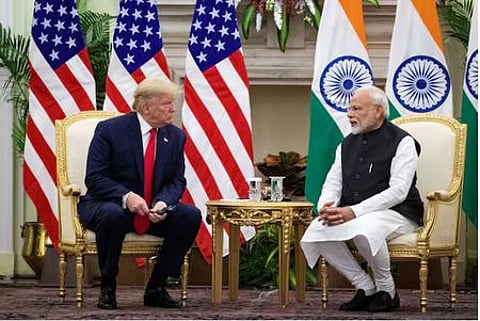

While New Delhi has rapidly finalized Comprehensive Economic Partnership Agreements (CEPAs) with the UAE and Australia, and a historic pact with the EFTA (European Free Trade Association) bloc, the US deal remains agonizingly slow.
How near, how far? That is the billion-dollar question that begs an answer. When Donal Trump announced after he came to office the second time, India was expected to be amongst the first few countries to sign the bilateral trade deal. The negotiations, however, didn’t follow the script. Trump identified India as a nation that levied high tariffs leading to a significant trade surplus in India’s favour. India responded saying while it valued America as a strategic partner it didn’t wish to compromise on securing interests of local business and local farmers. This led to frosty exchange of barbs between the two establishments. The two sides engaged in yet another round of deliberations last month-end with hope to close the deal soon but without committing a date.
Here is an explainer that decodes the many twists and turns that have held back the India-US trade agreement. The explainer raises five key questions: a) Why the deal is stuck? b) How many times the deadline has been missed? c) Why is India’s trade surplus declining? d) What is the significance of July 24 timeline and e) Has India invested billions in US as claimed by Donald Trump?
Q1: Why the Trade Deal Remains Unsigned?
There is no official explanation since both sides stick to the promise to make it happen. The deal is stuck because the US and India both want to protect their domestic economic interests.
Commerce and Industry Minister Piyush Goyal and US Trade Representative Jamieson Greer last met on June 23 in New Delhi to push forward the first phase of the proposed deal. “India-US Trade deal nears finish line, final 1% hurdle remains, said Goyal last week. India wants a clear competitive advantage over rival exporters in the American market.
United States Trade Representative (USTR) Jamieson Greer has made it clear that Washington is focused singularly on securing a "fair and reciprocal trade deal that expands market access for American exporters." While the US frequently acknowledges India's strategic importance in the Indo-Pacific, the USTR is explicitly demanding that India dismantle its historical protectionism—particularly in agriculture.
The Trump administration views trade as a zero-sum economic balance sheet. Modi on his part has said he would never allow genuine interests of Indian farmer to be compromised and that exporters from India should get incentivised over their peers.
Q2: How many deadlines have been announced and missed?
It has been an arduous journey of intent not matching outcome.
Targeting Fall 2025, Feb 13, 2025
Narendra Modi & Donald Trump: Through a joint statement aimed at deepening trade ties, the leaders announced plans to negotiate the first tranche of a Bilateral Trade Agreement (BTA) by the fall of 2025.
Working to Close 'Quickly'
Jan 31, 2026
Commerce Minister, Piyush Goyal stated that India was working toward closing what he called the "father of all deals" with the US "quickly," citing that positive negotiations were underway.
Agreement Reached; Details Imminent
Feb 2–3, 2026
After a phone call with PM Modi, President Trump announced an initial agreement to bring down reciprocal tariffs. The following day, Goyal confirmed the deal was in the "final stages of detailing" and promised that a joint statement would be inked and shared "shortly."
Interim Framework Finalized
Feb 7, 2026
Joint Statement: Both sides officially finalized the framework for the first phase (interim) of the Bilateral Trade Agreement, setting the stage for legal detailing.
Mid-July Conclusion Expected
Jun 2–5, 2026
Goyal announced that most elements of the first phase were finalized down to the "commas and full stops," predicting that outstanding issues would be resolved to conclude the pact by the middle of July.
Substantial Progress Noted
June 17, 2026
US President Donald Trump said on June 17 that the two countries are "very close" to finalising the agreement.
Jun 24–25, 2026
Following two days of high-level talks in New Delhi ahead of a July tariff deadline, a joint statement highlighted "substantial progress" on an interim deal but refrained from setting a concrete deadline. However, a senior US official emphasized that the two sides were "very, very close."
Talks in Final Stage
Jul 2, 2026
Piyush Goyal reaffirmed that negotiations had entered their final stage, noting that "concessions and other elements have largely been finalized" and that he foresaw no major hurdles in officially concluding the agreement.
No, final date yet
But even after such protracted negotiation, there is no commitment to a date on either side.
Q 3: Why is India’s trade surplus with US shrinking?
United States yet remains India's largest export destination. However, imports from America are rising much faster than exports, causing India's trade surplus to narrow sharply.
According to data from the Ministry of Commerce and Industry's TradeStat portal, India's exports to the US rose marginally to $87.31 billion in 2025-26 from $86.51 billion in 2024-25.Import from the US, however, surged to $53.48 billion from $45.62 billion during the same period. As a result, India's merchandise trade surplus with America declined to $33.83 billion from $40.89 billion, a fall of more than 17%.
The trend has continued into the current financial year. Country-wise trade figures released by the Department of Commerce on June 15 show India's exports to the US during April-May 2026-27 stood at $17.29 billion, only 0.5% higher than the corresponding period a year earlier.
Energy purchases have emerged as one of the biggest drivers of the widening import bill.India turned to US raising its imports of crude oil and liquefied natural gas (LNG). This in turn contributed to the reducing surplus.Official data shows that imports of mineral fuels, oils and related products from the US increased from $14.37 billion in 2024-25 to $17.32 billion in 2025-26.
Imports of electrical machinery and equipment rose to $5.56 billion, while imports of precious stones and metals climbed to $6.85 billion. Aircraft and aircraft parts imports increased to $1.91 billion.
This energy pivot is New Delhi’s strongest bargaining chip, proving it is willing to align its massive procurement budget with Washington's geopolitical preferences.
Q 4: What is July 24 deadline and what it means to India Inc?
Late 2025, unhappy with India's tariff structures and its continued purchase of Russian crude oil during the Ukraine conflict, the US imposed a staggering effective tariff of 50% on Indian goods (comprising a 25% reciprocal tariff and a 25% punitive duty).
The February initial agreement envisaged the US to slash tariffs on Indian industrial and consumer goods to 18%. In return, India agreed to halting Russian oil purchases, eliminating digital services taxes, and significantly reducing tariffs on select US agricultural products. These include dried distillers' grains (DDGs), tree nuts, and fresh fruit—as well as industrial and medical goods.
Following the US Supreme Court decision to strike down sweeping 50% global tariffs earlier this year, Washington imposed a temporary 10% tariff regime. The temporary measure ends on July 24, 2026.
Accordingly, if the India US Bilateral Trade Agreement Deal is not signed by then, Indian goods might possibly again face highly punitive tariffs. But if Trump sticks to intended 18% tariff, India might get a competitive edge over Vietnam and Bangladesh (both facing ~20% tariffs) and China (facing upwards of 30-35%).The big likely gainers: textiles and apparel, gems and jewellery, and pharmaceuticals.
Q 5: How correct are Donald Trump's Claims on Indian Investments?
“PM Modi is building a lot in the United States. He is spending a lot of money in the US. I just want to say he has been my friend for a long time,” Trump said at the recent G7 meeting.Earlier in May, US ambassador to India Sergio Gor took to X and said that Indian companies are planning to invest over $20.5 billion in the United States across multiple sectors.
There, however, are no details available on these investments. What we know officially is that Trump has announced a $300 billion partnership with India's Reliance Industries Ltd. The massive deal centers on building "America First Refining" at the Port of Brownsville, Texas.
Key Takeaway
If New Delhi and Washington can close the deal before July 24, it will firmly position India as the primary, long-term alternative to regional leaders -existing and emerging. If they fail, both nations risk forgoing billions of dollars—and a critical strategic opportunity—on the table. And, India’s trade advantage, too will run the risk of becoming a casualty.
