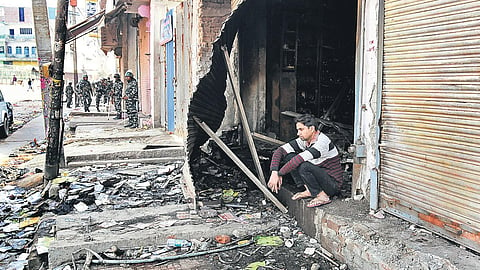

More than six years after the 2020 northeast Delhi riots, a Delhi court has delivered the first conviction for murder in the cases arising out of the violence. On July 14, former AAP councillor Tahir Hussain and four others were convicted for the murder of Intelligence Bureau officer Ankit Sharma. The verdict comes even as dozens of other murder trials continue, with several ending in acquittals over concerns about the quality of investigation and evidence. Here is what the verdict means and where the wider prosecutions stand.
The conviction of Tahir Hussain and others is the first conviction for murder in the 2020 northeast Delhi riots cases. The riots, which broke out in February 2020, left 53 people dead and more than 500 injured and caused property damage worth crores. Over 700 FIRs were registered for offences including murder, rioting, conspiracy, arson and vandalism.
The judgment has renewed attention on the pending cases relating to the remaining 52 deaths. Until this verdict, only one person had been convicted in a riot-related death case, under Section 304 (culpable homicide not amounting to murder), in 2024.
Most murder trials arising out of the riots have ended in acquittals at the trial court stage for want of watertight evidence. Across several acquittals, the special riots courts have repeatedly criticised the quality of investigation, referring to "artificial" witnesses and allegedly "fabricated" evidence.
On June 2, a Delhi court acquitted the accused in a murder case in Shiv Vihar, Karawal Nagar, holding that the prosecution's key witness lacked credibility because he appeared very late as a witness. In April, another court acquitted 12 accused, pointing to significant inconsistencies in witness accounts about where the deceased was assaulted and how they witnessed the incident. In another case, the court held that the prosecution had produced only "fragments and pieces of evidence" as circumstantial proof.
Among the major pending cases is the prosecution relating to the death of Head Constable Ratan Lal, who died while on duty in Maujpur during the violence. Two designated courts are hearing the riots cases, and charges have now been framed in all the murder prosecutions.
The case relates to the killing of Intelligence Bureau officer Ankit Sharma during the violence in northeast Delhi. According to the prosecution, demonstrations had been taking place at Chand Bagh bridge on the main Karawal Nagar Road from February 23, 2020. The area witnessed clashes involving stone-pelting, brick-batting, arson, firing and vandalism.
Ankit Sharma returned home from work on February 25 and stepped out around 5 pm to buy household items. Prohibitory orders under Section 144 of the CrPC were in force across northeast Delhi, including Chand Bagh. When he did not return, his father searched for him before lodging a missing person's report at Dayalpur police station. His body was later recovered from the Chand Bagh drain. The post-mortem recorded multiple injuries, prima facie caused by sharp weapons, and an FIR was registered.
On February 28, a Special Investigation Team searched Tahir Hussain's house in Khajuri Khas. According to the investigation, debris, stones, bricks, broken bottles, bullets and burnt articles were found from the house up to Chand Bagh Pulia. Police also recovered stones, bricks, a catapult, glass bottles containing petrol with cloth stuffed into their necks and other materials from the third floor and terrace of the building. The police concluded that the premises had been used for stone-pelting and for throwing petrol bombs and acid bombs during the violence.
Investigators recovered a mobile phone video that allegedly showed three persons throwing a body into the Khajuri drain near Chand Bagh bridge. Witnesses were also shown photographs of persons arrested in other riot-related cases. According to the prosecution, some witnesses identified Hussain and others as being involved in the incident.
The court held that between 4 pm and 5.30 pm on February 25, Ankit Sharma was surrounded by an armed mob, assaulted with lathis, sticks and sharp weapons for several minutes, and died during the attack. It found that his body was dragged towards Chand Bagh Pulia. After an unsuccessful attempt to push it into the drain, it was eventually thrown into the drain from across the wall running parallel to it.
The court held that the assembly was armed with stones, petrol bombs, iron rods, sticks, knives and other sharp weapons, with some members wearing helmets. It found that the assembly was engaged in rioting, looting and arson while clashing with another assembly. The court held that they would have known that death was a likely consequence of pursuing those common objects.
The court held that the prosecution proved its case beyond reasonable doubt against Hussain under several IPC provisions, including Sections 302 (murder), 147 (rioting), 148 (rioting while armed with a deadly weapon), 365 (kidnapping or abduction with intent to wrongfully confine), 153A (promoting enmity between different groups) and 188 (disobedience to an order promulgated by a public servant), all read with Section 149 (offence committed in prosecution of the common object of an unlawful assembly).
How was Hussain convicted if the court found he was not physically present at the killing?
The court held that the prosecution failed to prove Hussain’s physical presence at the exact spot where Ankit Sharma was killed. However, it found that he had facilitated and abetted the unlawful assembly by making his premises available and supplying materials allegedly used during the violence. Applying the principle of vicarious liability under Section 149 IPC, the court held him criminally liable for offences committed in prosecution of the assembly’s common object.
The judgment observed that CCTV cameras in the area had been damaged, covered or turned away, suggesting preplanning and indicating that a conspiracy might have existed. However, it held that the prosecution had failed to produce evidence showing when, where or how such a conspiracy was formed or who its participants were. As a result, the court declined to convict any of the accused under Section 120B (criminal conspiracy) of the IPC.
No. The court acquitted Haseen, Firoz, Gulfam, Shoaib Alam, Sameer Khan and Muntazim of all charges, holding that there was insufficient evidence against them.
The convicted accused face punishment for offences that include murder. The law provides for a minimum sentence of life imprisonment, while the maximum punishment can extend to the death penalty.
