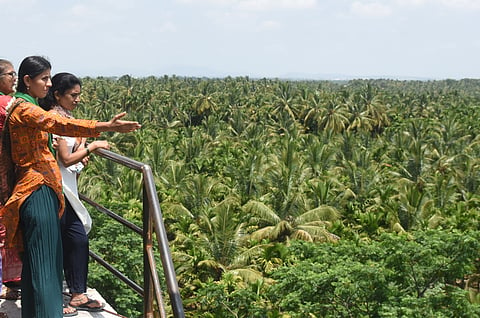

Bengaluru's rapid expansion has strained roads, housing, water supply and civic infrastructure, prompting the Karnataka government to revive the Greater Bidadi Integrated Township (GBIT). Planned along the Bengaluru-Mysuru corridor, the project is envisioned as India's first AI-powered integrated township and a second major urban centre for the region.
The 7,431-acre mixed-use township with housing, industries, offices, schools, hospitals, parks and public infrastructure, will have about 2,000 acres of land reserved for AI industries and allied sectors.
History and timeline
2006: Karnataka proposes five satellite townships around Bengaluru, including Bidadi.
2007: DLF Ltd., is approved as development partner under a PPP model. However, the project gets stalled after DLF decided to withdraw, and successive governments fail to move it forward.
2023: Deputy Chief Minister D.K. Shivakumar, who headed the Urban Development portfolio in the Siddaramaiah government, then revived the Bidadi Township proposal.
2025-26: Government announces the revived plan for a 7,431-acre AI-powered integrated township, issues final land acquisition notification for over 5,000 acres, and offers compensation and rehabilitation benefits.
While the government says the project will generate jobs and ease pressure on Bengaluru, the proposal has also sparked protests from farmers over land acquisition and the loss of livelihoods. As the protests continue, the government has proposed setting up a committee to review legal and related issues and submit a report within two to three months.

Why is Bengaluru getting another township?
GBIT is intended to create another urban centre where people can live, work and access services, reducing pressure on the city. The project aims to address traffic congestion, uneven urban growth, groundwater stress and flooding through integrated planning, transport, utilities and civic infrastructure developed from the outset.
Why was Bidadi selected?
Located 35-40 km from Bengaluru, Bidadi is connected by the Bengaluru-Mysuru Expressway, railway network and NICE Road. It also has industrial activity and large contiguous land parcels.
How is GBIT different from earlier satellite towns?
Unlike earlier satellite townships that depended on Bengaluru for jobs, the current project is planned as a self-sustaining city with employment, housing and public services at one place.
Why does it need over 7,400 acres?
It’s planned as an integrated city—not merely a housing project—with space for residential neighborhoods, industry, institutions, transport, utilities, green spaces and future expansion.
What makes it an 'AI-powered' township?
AI is proposed both as an industry focus and as a tool to manage urban services such as traffic, water, power, waste management, environmental monitoring, public safety and digital governance.
How does it compare with other planned cities?
Designed to ease pressure on an existing metropolis, the project is modelled on Navi Mumbai, according to officials. Unlike Amaravati, it is not a capital city, and unlike GIFT City, it is not a specialised financial hub..
How is it funded and what economic benefits are expected?
The estimated project cost is Rs 18,133 crore. Funding is proposed through HUDCO loans, a Rs 7,500-crore bank guarantee, Rs 2,000 crore from the BDA and other government resources.
The government expects that the township could create 5-6 lakh direct and indirect jobs while attracting investment and generating revenue.
Whose land will be acquired?
The project covers 7,431 acres across nine villages, affecting about 5,704 farmers. Around 830 acres are government land, and roughly 6,651 acres belong to private landowners.
What compensation has been offered?
The package includes a land price of Rs 2.07-2.55 crore per acre, annual rehabilitation payments, benefits for landless families, education and employment reservations, and skill development support.
Why are some farmers protesting?
Opponents say the project will acquire productive farmland that supports agriculture and dairying. They also allege inadequate consultation and fear the long-term loss of livelihoods and land value.
Current status?
The government says the land already acquired for the project will not be denotified. However, it has promised that any future land acquisition will be based on the consent of landowners, while a committee headed by a retired judge will examine the legal and related issues and submit its report within two to three months.