
India’s first river interlinking project is back in the spotlight following protests by families facing displacement by it and the state government’s two other irrigation projects — Runjh and Majhgaon — in Panna district. The Ken-Betwa River Link project also faces a political storm over allegations of irregularities in rehabilitation and compensation. While the Centre and the state governments describe it as a game changer for the drought-prone Bundelkhand region, affected villagers are demanding better rehabilitation and compensation before they are relocated.
Bundelkhand has suffered from erratic rainfall, droughts, groundwater depletion and poor irrigation coverage. Agriculture remains heavily dependent on the monsoon, resulting in repeat crop failures and seasonal migration. Despite the protests, the project enjoys support from many farmers and residents of Bundelkhand. They believe assured irrigation, improved drinking water supply and better agricultural productivity could transform the region’s economy and reduce seasonal migration. They argue that local water conservation measures alone cannot address Bundelkhand’s chronic water scarcity.
However, environmentalists continue to question the ecological impact of constructing a major dam inside the Panna Tiger Reserve. The renewed protests have revived the larger debate over balancing development with the environment.
What is the Ken-Betwa river link project?
It is India’s first major inter-basin river-linking project, which proposes to transfer water from the Ken River in Madhya Pradesh to the water-deficit Betwa River through the Daudhan Dam, a 221-km canal and associated infrastructure. Estimated to cost about ₹44,600 crore, the project is expected to irrigate over 10 lakh hectares, supply drinking water across at least 13 districts of Bundelkhand region in MP and UP and generate hydropower. It is being implemented by the National Water Development Agency with the participation of the governments of Madhya Pradesh and Uttar Pradesh.
The project consists of two phases. Phase-I includes construction of the Daudhan Dam on the Ken, a 221-km-long Ken-Betwa Link Canal, tunnels, power houses and associated infrastructure. Phase-II includes the Lower Orr Dam, Bina Complex Multipurpose Project and Kotha Barrage to further expand irrigation benefits.
Why did it take nearly four decades to kick off?
The proposal dates back to the early 1980s but remained stalled because of prolonged disputes over water sharing between Madhya Pradesh and Uttar Pradesh, environmental and wildlife clearances, land acquisition, rehabilitation planning and legal scrutiny. The project finally moved forward after an agreement between the two states in 2021, followed by the Union Cabinet’s approval.
What are the main allegations made by protesters?
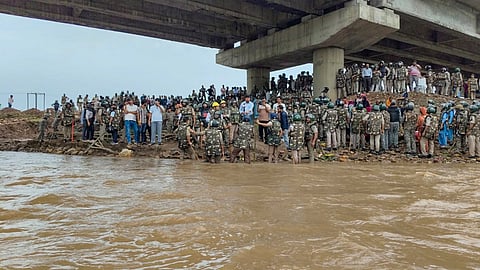
The current agitation is led by former AAP leader and social activist Amit Bhatnagar and supported by several affected villagers. Dubbed as the Sonam Wangchuk of Bundelkhand, Bhatnagar, who was forcibly taken by local police to hospital on the 14th day of his hunger protest on July 19 (while other protesters were taken in buses to their villages, mostly in Panna district) was protesting at Kupi village on the banks of river Barana in Chhatarpur district along with families (mostly tribals from adjoining Panna district) affected by the Ken-Betwa River Link project and state government’s Runjh and Majhgaon irrigation projects. On July 23, he reportedly ended his fast, though he claims he has merely postponed his agitation after assurances by local administration to conduct detailed investigations into his and affected families’ allegations on the ground.
The protesters say they are not opposing development, but are demanding that rehabilitation be completed lawfully and transparently before displacement. Their principal allegations include:
Irregularities in compensation: They allege that genuine project-affected families have either received inadequate compensation or have been left out altogether.
Faulty rehabilitation surveys: Protesters claim that several eligible families were omitted during the initial surveys.
Questionable Gram Sabha proceedings: Bhatnagar alleges that records of Gram Sabha meetings in several villages contain identical entries and raise doubts about whether statutory consultations were conducted properly.
Payments to allegedly ineligible beneficiaries: Bhatnagar claims that compensation running into crores of rupees was sanctioned to people who were either not residents of the affected villages or were otherwise ineligible.
Incomplete rehabilitation before construction: Protesters argue that project work is progressing on Daudhan Dam, despite rehabilitation not being fully completed, contrary to environmental clearance conditions.
Opposition Congress too has come out in open support of the protesters. During the recent Vidhan Sabha session, Leader of Opposition Umang Singhar alleged large-scale irregularities in compensation, rehabilitation surveys and Gram Sabha proceedings.
Both Bhatnagar and Singhar have alleged a major scam running into around Rs 400 crores in compensation and associated aspects. Bhatnagar has been alleging that he was shifted forcibly from the protest site to the hospital in Bijawar by police and authorities, to prevent him from releasing documents that would have revealed large-scale corruption.
How has the government responded?
The Madhya Pradesh government has rejected charges of corruption. Revenue Minister Karan Singh Verma told the assembly that compensation and rehabilitation packages have been sanctioned for almost all eligible families. He acknowledged that complaints had been received regarding omissions and compensation disputes but said fresh surveys had been conducted, resulting in additional eligible families being included.
As per the minister, in Panna district, under the Ken-Betwa project, 1,321 families from seven villages were displaced, and a total of 644 landholders (land belonging to 1,699 farmers) from eight villages were affected by land acquisition. In Chhatarpur district, under Bijawar subdivision, 14 villages and 3,718 families have been affected due to displacement, land acquisition or the submergence area.
In Panna district, all 1,321 affected families have been approved for the rehabilitation package, and compensation has been approved for the acquisition of land belonging to 644 landholders (1,699 farmers). No family has been deprived of these benefits. In Chhatarpur district, all 3,718 families have been sanctioned the benefits due to them, he said.
The minister admitted that in Panna district, project-affected families submitted complaints regarding the omission of eligible persons from the rehabilitation list, errors in compensation assessment, and irregularities in the distThe ambitious project could become a benchmark for how the country balances development, environmental conservation and the rights of affected communitiesffected person had been left out. Compensation was determined in accordance with the provisions of the Right to Fair Compensation and Transparency in Land Acquisition, Rehabilitation and Resettlement Act, 2013. No errors were found in the compensation assessment, and no irregularities were found in the distribution of rehabilitation benefits.
As for Chhatarpur district, project-affected families submitted complaints seeking the inclusion of families omitted from the rehabilitation list. To address these complaints, village-wise survey teams were constituted on April 15, 2026 and surveys conducted. Earlier, the prescribed benefits had been sanctioned to a total of 3,080 families. After the survey teams submitted village-wise reports, the prescribed amount has now been sanctioned to an additional 638 eligible families.
The Chhatarpur administration rejected allegations of fabricated Gram Sabha proceedings and maintains that rehabilitation is being carried out according to approved policy. Officials have instead charged that most participants in the agitation are not directly affected by the Ken–Betwa project, but by two irrigation projects – Runjh and Majhgaon projects in Panna district, who too have been approved for rehabilitation package on the lines of the Rs 12.50 lakh per acre official compensation rate set for those affected by the Ken-Betwa project.
According to Chhatarpur district collector Parth Jaiswal, till date Rs 750 crore have been sanctioned to 4,000-plus families affected by the Ken-Betwa River Link project and the protesters led by Amit Bhatnagar, have been assured that all their complaints will be investigated on the ground.
Why has the project remained controversial beyond rehabilitation?
The project represents one of India’s biggest development-versus-conservation debates. The Daudhan Dam will submerge part of the Panna Tiger Reserve, raising concerns over forest loss, fragmentation of wildlife habitat and impacts on tigers, vultures, gharials and other protected species. Environmentalists also question whether the Ken River will continue to have surplus water under changing climatic conditions. They have questioned whether the Ken River actually has surplus water in all years. They argue that climate variability and changing rainfall patterns could reduce future water availability. Altering natural river flows may also affect downstream ecosystems. However, the government maintains that environmental safeguards, wildlife management plans and compensatory afforestation have been incorporated into the project design.
