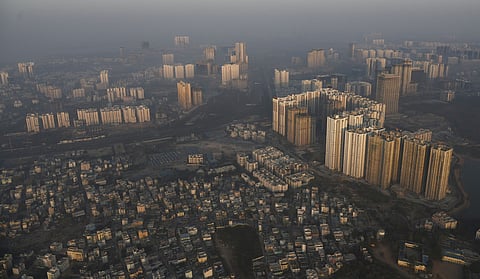

Growth in GCCs, infrastructure expansion and strong employment have transformed Hyderabad’s housing market, with genuine homebuyers increasingly replacing investors. But as prices rise faster than incomes, the city’s challenge is to sustain growth without eroding affordability.
At a glance
From affordable homes to rising prices
Homebuyers replacing investors
Jobs continue to drive demand
Growth spreading to new areas
Affordability is under pressure
Growth expected to become steadier
Has Hyderabad's real estate market entered a new phase?
Yes. Five years ago, Hyderabad was known for offering bigger homes at relatively affordable prices. A growing IT sector, lower land prices, and better value than Bengaluru, Mumbai, and Delhi-NCR attracted both homebuyers and investors.
Hyderabad has become one of India's most established housing markets. Home prices rose nearly 13% year-on-year in Q3 2025. In October 2025, the city recorded 6,194 property registrations, 5% more than a year earlier. Average prices are now Rs 6,700-Rs 8,200 per sq ft, with premium areas costing much more.
What is the biggest change in the market?
The biggest change is in who is buying homes. According to Sreedhar Reddy Koppula of NAREDCO Telangana, nearly 68% of homes bought in Q1 2026 were purchased by people planning to live in them. This is the highest share in almost 10 years. Unlike earlier, when investors drove demand, Hyderabad's housing market is now mainly supported by genuine homebuyers.
Why have property prices risen so much?
Experts say the price rise is being driven by strong economic growth, not speculation. Buyers are choosing bigger homes with better amenities, integrated townships and improved infrastructure. Demand has also stayed strong as employment continues to grow.
Is Hyderabad still worth investing in despite higher prices?
Industry experts say the city continues to offer strong growth in property value, steady rental income and better infrastructure, making it one of the most attractive real estate markets today.
This is especially true for luxury homes. Properties priced above Rs 2 crore made up nearly 38% of new launches in Q1 2026, while rental returns remain strong in major IT hubs.
Has demand remained strong despite global uncertainty?
Yes. Despite global economic uncertainty and cautious hiring by some technology companies, Hyderabad recorded 19,249 residential sales in H1 2026. Office leasing also touched a record 7.5 million sq ft, supported by the expansion of GCCs.
Why has the market remained resilient?
According to Rajasekhar Reddy Allipuram of PropGo Realty, housing demand is being supported by employment generation rather than speculative buying. This has made the market less vulnerable to panic selling than in previous cycles.
Is Hyderabad still dependent mainly on the IT sector?
No. The city's economy has expanded beyond traditional IT services. Employment is now supported by GCCs, engineering, pharmaceuticals, life sciences, BFSI and manufacturing.
Has Hyderabad become less affordable?
Certainly. Households now spend about 41% of their monthly income on home-loan EMIs, compared with 26-28% five years ago. Hyderabad has become the third least affordable housing market among India's top eight cities.
Why has affordability become a challenge?
Residential prices have increased faster than incomes, especially in western and central growth corridors. So, many middle-income buyers are moving to emerging suburbs connected by the Outer Ring Road, where prices remain relatively accessible and infrastructure is improving.
What has happened to affordable housing?
Affordable housing within the city has shrunk sharply. Less than 15% of sales account for homes under ₹50 lakh.
Is Hyderabad facing oversupply?
Experts do not think so.
More homes have been launched than sold recently, but experts say this is only a temporary phase and not an oversupply. The number of unsold built or launched homes in the first half of 2026 stood at 56,095. At the current sales pace, it would take about six quarters (around 18 months) to sell them if no new projects are added. But experts say the unsold stock is not excessive.
What is the price range of the unsold homes?
Nearly 70% of unsold homes are priced between Rs 50 lakh and Rs 2 crore. This remains the price segment that attracts the largest pool of IT, BFSI and GCC professionals.
Which housing segment is seeing the strongest demand?
Demand has shifted towards premium housing. Sales of homes priced above Rs 1 crore continue to grow, and developers increasingly focus on higher-value projects.
Why haven't property prices fallen?
Developers cite rising project costs as the reason. Construction now costs Rs 2,100-Rs 2,800 per sq ft for standard residential projects, while premium developments cost much more. Land prices in Kokapet, Financial District and other western corridors have also risen sharply over the past few years.
How are developers responding instead?
According to M Jaideep Reddy, president of CREDAI, Hyderabad's market is now dominated by larger, financially stronger developers who can hold inventory rather than resort to distress sales. Rather than reducing prices, many are offering flexible payment plans, phased launches and additional amenities while maintaining headline prices.
Which parts of Hyderabad are likely to drive the next growth cycle?
The western corridor continues to be the city's premium housing destination. Kokapet, Neopolis, Tellapur and Financial District remain key centres for residential and commercial investment.
At the same time, Shamshabad and Adibatla are benefiting from airport-led development, aerospace industries and manufacturing investments, while Uppal and eastern Hyderabad continue to gain from Metro connectivity and expanding employment centres.
Where are first-time buyers looking?
Experts point to Kollur, Patancheru and several suburbs linked to the ORR. These locations are attracting buyers because land is relatively affordable and connectivity is improving.
What are the biggest risks to the market?
If property prices continue to rise faster than salaries, younger buyers may postpone buying homes.
Experts also warn that some areas on the city's outskirts could end up with more homes than buyers. Delays in infrastructure projects, rising construction costs and slower hiring by global technology companies could also affect demand for premium homes.
What policy changes could improve affordability?
Affordability can improve through policy support rather than price corrections. Suggested measures include faster project approvals, lower development charges, rationalised taxes and stamp duties, incentives for affordable housing, higher FSI, better public transport, improved connectivity and expanding serviced land through infrastructure projects.
What lies ahead?
Most analysts expect Hyderabad to remain among India’s strongest residential markets over the next decade, supported by GCC expansion, infrastructure development and employment growth. However, future gains are expected to be steadier than the rapid appreciation seen over the past five years, with affordability likely to remain the key challenge.
