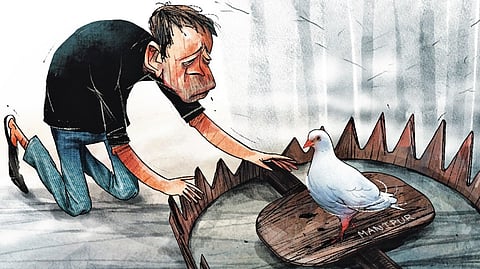

Former Manipur police officer Thounaojam Brinda recently declared her candidature, effectively setting the stage for the Assembly elections due early next year. But is the violence-scarred state ready for the polls? Once known for its diverse social fabric, Manipur today stands deeply divided, with security forces heavily deployed across sensitive districts.
A government is in place, but mistrust remains pervasive. Questions persist over the prospects of a free and fair election. At the same time, an electoral exercise could bring politicians back to the ground and into direct engagement with people.
What is Manipur’s demography?
Bounded by Myanmar, Nagaland, Assam and Mizoram, Manipur is home to 36 communities, with the Meiteis, Nagas and Kukis being the largest. The hills, accounting for nearly 90% of the state’s geographical area, are inhabited largely by tribal communities. Land in the hills is protected for Scheduled Tribe (ST) communities.
The Meiteis, a non-tribal community, are concentrated mainly in the Imphal Valley.
What is the genesis of the conflict?
The violence began on May 3, 2023, after a tribal solidarity march protesting a Manipur High Court order directing the state government to consider including the majority Meitei community in the ST list. The directive is widely seen as the trigger for the ethnic conflict. In February 2024, the High Court modified its order and directed the removal of the controversial paragraph.
Where are the displaced people?
An estimated 250 people have been killed and around 60,000 displaced in the ethnic violence that has effectively partitioned the state. While some displaced families have been rehabilitated, a large number continue to live in relief camps, facing uncertain futures and difficult living conditions.
How did Nagas get drawn into the conflict?
The Nagas remained largely neutral during the Kuki-Meitei conflict until they found themselves embroiled in tensions with Kukis earlier this year.In February, the alleged assault of a Naga villager by a group of Kuki miscreants pushed the Naga-majority Ukhrul district to the brink. The situation was marked by civilian killings, arson and road blockades. Over time, the violence spread to other hill districts, leading to more deaths and destruction of property.
What led to the abduction of 48 Kuki and Naga civilians?
On May 13, three church leaders from the Thadou community were killed and four others injured in an ambush by suspected militants in Kuki-majority Kangpokpi district. Kukis and Nagas blamed each other for the attack.Later that day, 20 Naga and 28 Kuki civilians were abducted from different parts of the state. On May 15, Nagas released 14 Kuki civilians and Kukis freed 14 Nagas. On June 9, the remaining 14 Kukis were released.
On June 12, after nearly 24 hours of search operations by security forces, the mortal remains of the remaining six Nagas were recovered, triggering fresh violence.
What is the ground situation?
The state remains heavily militarised and the situation continues to be fragile. The fighting between Meiteis and Kukis has largely ceased for now, but clashes between Kukis and Nagas continue intermittently. Meiteis and Kukis still cannot freely pass through each other’s areas. Similarly, movement between Kuki and Naga-dominated areas remains restricted. Many Kukis and Nagas are forced to take long detours to travel out of the state by road. For many Meiteis, air travel from Imphal remains the only practical option.
Are there any peace efforts?
President’s Rule was revoked on February 4, 2026, after nearly a year, and Yumnam Khemchand Singh was appointed Chief Minister. Over the past five months, Singh has taken the lead in reconciliation efforts, travelling across the state and appealing for peace. Recently, he said there were signs of normalcy returning, claiming that Kukis had begun travelling to Imphal to board flights and that several groups had met him to discuss ways to restore peace.
Can Manipur have free and fair polls?
Given the depth of the divide and the fragile ground reality, many people believe conducting a genuinely free and fair election will be difficult.
“Election will definitely be conducted, but it may not be free and fair considering the ground situation. Restoring peace is the prerogative. However, there are a lot of issues that need to be resolved first. I feel the time is too short for the government to resolve them before the state goes to polls,” says Naga leader Mangang Raman.
Will elections bring peace?
According to Ginza Vualzong, spokesperson of the Kuki-Zo Council, Manipur continues to face a difficult phase as the three major communities—Meitei, Naga and Kuki-Zo—remain at odds. He also pointed to the government’s difficulties in functioning effectively, citing its inability to expand the Cabinet.
“The BJP government may do everything possible to hold the next election. However, I believe election alone will not bring peace to Manipur. No matter which party comes to power, the state will continue to face problems unless the root issues are addressed. What Manipur needs is a political solution, not just a change of government,” Vualzong said.
Could the election be postponed?
Imphal-based political scientist and Editor of Imphal Review of Arts and Politics, Pradip Phanjoubam believes holding the election will be challenging given the prevailing law-and-order situation.
“Combing operations are going on and there are peace initiatives. People are tired of violence and want some sort of resolution. But all communities must understand that they have to learn to live together, whether one likes it or not,” he said.
Phanjoubam feels the Census exercise could overlap with the election schedule, making a postponement possible. At the same time, he believes advancing the election would be equally difficult given the prevailing conditions.
Why is there a call for Kuki legislators to resign?
No Kukis contested the 2024 Lok Sabha elections following calls from various organisations. Now, a Kuki organisation, Kuki History & Identity Protection Community, has urged all Kuki legislators to resign and stand with their people.
“Their presence in the Manipur government is untenable when that government, backed by the Centre, blocks people’s demand and deepens internal divisions,” the organisation said.
What are the key demands of Kukis and Meiteis?
Kuki groups continue to press for a “separate administration” or a Union Territory with a legislature. Among the key demands of Meitei groups is the updation of the National Register of Citizens (NRC) to identify and deport illegal immigrants from Myanmar. For now, these competing political aspirations remain at the heart of Manipur’s continuing crisis, raising questions about whether an election can bridge the divide—or merely reflect it.
