
The biennial election to Rajya Sabha is over, but the controversy surrounding it refuses to die. Amid horse-trading charges, cross-voting marked the polls in three out of the 10 states which elected 37 members to the Upper House of Parliament.
In Bihar, where the NDA walked away with all five seats, the Congress has slapped show-cause notices on three of its MLAs who abstained from voting, along with a Rashtriya Janata Dal legislator. Their absence led to the defeat of A D Singh, the Mahagathbandhan candidate.
Haryana witnessed a seesaw battle, with the Congress and the BJP winning one seat each, but cross-voting made it a tense affair.
An almost identical story played out in Odisha. Three Congress and eight BJD MLAs cross-voted for BJP-backed candidate Dilip Ray, giving the 72-year-old former Union minister a second Rajya Sabha stint, 25 years after he fashioned a similar victory in 2002.
A stung BJD issued show-cause notices to six MLAs (two others are already under suspension), while the Congress went a step further. First, it suspended three legislators and, a day later, sought disqualification of two of them as members of the Odisha Legislative Assembly. The Congress invoked the Tenth Schedule to the Constitution, seeking their disqualification.
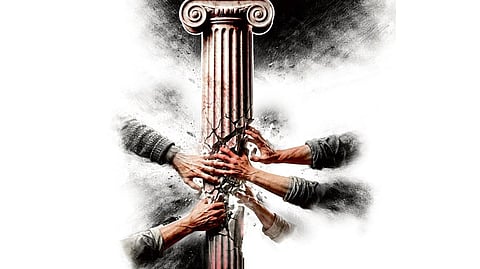
The Rajya Sabha election has, once again, thrown up the big question of defection and the existing legislative and legal frameworks, which work in different ways.
Anti-defection law
Post-Independence Indian politics was marked by rampant defections in the decades of the 1960s and 1970s, which led to the introduction of the Tenth Schedule, a legislation that dealt with the crisis political parties faced as elected representatives switched loyalty. It was added by way of the Constitution (52nd Amendment) Act in 1985 and went on to be known as the anti-defection law.
As per the law, there are two grounds on which a member can be disqualified. One, if the member has ‘voluntarily given up membership’ of the political party he or she belongs to. Second, if he/she votes or abstains from voting in contravention of the direction issued by the party to which the member belongs. This applies both to Parliament and state legislatures. In the case of the latter, the party can condone the voting or abstention within 15 days.
However, exemptions are in place. If two-thirds of the legislators of a party merge with another outfit, it would not attract the defection law. In such a scenario, neither group would be at risk of disqualification as members of the House. The decision to adjudicate the disqualification, as per the law, is vested in the presiding officer of the House — the Chairman or Speaker, in this case.
“If any question arises as to whether a member of a House has become subject to disqualification under this Schedule, the question shall be referred for the decision of the Chairman or, as the case may be, the Speaker of such House, and his decision shall be final,” the law says. The Chairman of the House or the Speaker acts as a tribunal under the anti-defection law.
The Tenth Schedule also specifies that no court will have any jurisdiction in respect of any matter connected with the disqualification of a member, making the Chairman’s or Speaker’s decision final.
However, the scope of the anti-defection law came under judicial review in the subsequent decades, and the interpretation has widened ever since.
‘Voluntarily giving up membership,’ the ground for disqualification for defection, was initially linked to resignation by a member, but Supreme Court orders have given it a much broader perspective. Instead of limiting it to resignation, the court has held that the conduct and actions of the member could also be deemed as voluntarily giving up membership. In 2017, the disqualification of Sharad Yadav, former member of Rajya Sabha, by the then Chairman of the Upper House, Venkaiah Naidu, was a case in point.
The JD(U) MP had fallen out with Bihar Chief Minister Nitish Kumar (now elected to the Rajya Sabha) after the latter decided to partner with the BJP by breaking away from the Mahagathbandhan allies. Yadav went on to attend RJD meetings and voiced his dissent against Nitish in public. The Bihar CM submitted a petition to the RS Chairperson and sought Yadav’s disqualification on the grounds that he was involved in anti-party activities.
That’s what the Odisha Congress cites in its letter seeking disqualification of two of its members. “In this context, reference may be made to the case concerning Shri Sharad Yadav, former Member of Rajya Sabha, where the Hon’ble Chairman of the Rajya Sabha held that by his conduct, public statements and actions against the party’s decisions, he had voluntarily given up the membership of the political party on whose ticket he was elected. The Hon’ble Supreme Court has also held that the expression ‘voluntarily giving up membership’ has a wider connotation and that even in the absence of a formal resignation, such an inference can be drawn from the conduct of a member,” the party’s petition to the Speaker of the Odisha Legislative Assembly said.
However, the law has been put to the test in a myriad of ways. In March–April 2024, 10 Bharat Rashtra Samithi (BRS) legislators joined the Congress, prompting the former to seek the MLAs’ disqualification under the Tenth Schedule. Aggrieved by the Speaker’s alleged delay, the BRS knocked on the High Court’s doors, and later, the matter ended up with the Supreme Court which, in July 2025, directed Speaker Gaddam Prasad Kumar to decide the disqualification petitions within three months.
In the Telangana case, the court held that the Speaker did not enjoy constitutional immunity in deciding the disqualification petitions. It also stated that the objective of vesting tribunal powers with the Speaker was to avoid delay and ensure expeditious decisions. Citing Kihoto Hollohan v Zachillhu (1992), the SC ruled that the Speaker, as a tribunal, was bound to decide within a reasonable period. In view of instances of Speakers delaying decisions on disqualification petitions, the top court had recommended that Parliament revisit the provisions of the anti-defection law.
Cross-voting ground for disqualification?
However, Rajya Sabha cross-voting presents a different scenario. In the case of Sharad Yadav, it was his conduct and actions against party decisions which led to the disqualification. The current scenario of cross-voting can be seen from different prisms, one of which is the open ballot system of voting which came into being in 2003.
In fact, after the Rajya Sabha polls in Maharashtra in 1998, the Ethics Committee of the Upper House, headed by S B Chavan, deliberated on the matter and submitted three reports. The panel eventually recommended switching to the open ballot system in Rajya Sabha elections. The Atal Bihari Vajpayee-led government at the Centre accepted the recommendation, and the new voting system came into force.
However, when it was challenged before the Supreme Court in Kuldeep Nayar vs Union of India, the bench held: “Yet, in view of the law laid down in Kihoto Hollohan v. Zachillhu (supra), it is not correct to contend that the open ballot system tends to expose the members of the Legislative Assembly to disqualification under the Tenth Schedule since that part of the Constitution is meant for different purposes.”
In 2012, the Election Commission of India issued a clarification ahead of the Presidential election. The objective was to bring clarity on two issues: one, if a legislator voting in defiance of the party direction would invite disqualification on the grounds of the Tenth Schedule; and two, whether the political party issuing such whips would be liable for penal action.
The EC cited the ‘electoral right’ of a voter as defined in Section 171A(b) of the Indian Penal Code, which gives a person the right to vote or refrain from voting in an election. “Thus, every elector at the Presidential election has the freedom of making a choice to vote for any of the candidates or not to vote in the election, as per his free will and choice. This will equally apply to the political parties, and they are free to canvass or seek votes of electors for any candidate or request or appeal to them to refrain from voting,” the election panel said.
It also made it amply clear that political parties cannot issue directions or whips to their members to vote in a particular manner or not to vote, leaving them with no choice. Such action would amount to the offence of undue influence within the meaning of Section 171C of the IPC, it added.
“A question arose before the Hon’ble Supreme Court in Kuldip Nayar v Union of India (AIR 2006 SC 3127) whether the provisions of the Tenth Schedule to the Constitution would be attracted in the case of the election to the Rajya Sabha if a member of a State Legislative Assembly votes for a candidate in defiance of the party’s directions, where the votes are now given by the system of open voting. The Hon’ble Supreme Court held that an elector would not attract the penal provisions of the Tenth Schedule for having so voted in the Rajya Sabha election,” read the EC’s note.
Citing the Supreme Court’s observations in Pashupati Nath Sukul v Nem Chandra Jain, the EC also clarified that elections to the Rajya Sabha by members of state legislative assemblies are a non-legislative activity and not a proceeding within the state legislature. This also explains why the Odisha Congress has not sought disqualification of its members on the basis of cross-voting. Also, the fact that the BJD legislators who were slapped with show-cause notices have rejected them and threatened to take legal action, calling the party’s move ‘illegal, arbitrary and unconstitutional.’
