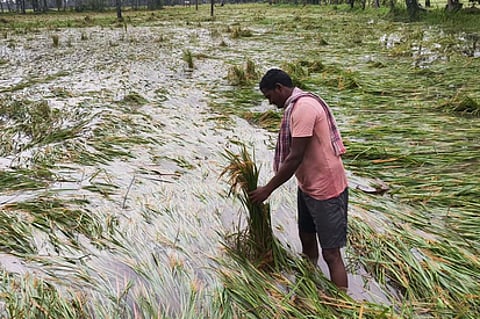

For generations, the Godavari delta, covering the fertile regions of East Godavari, West Godavari and Konaseema, has been known as the “Annapurna of the South” and the rice bowl of Andhra Pradesh. The irrigation system built around the Sir Arthur Cotton Barrage at Dowleswaram helped make the region one of the state's most important agricultural centres. Its fertile land and abundant water supported multiple paddy crops and contributed significantly to India's food security.
However, the agricultural landscape of the Godavari delta is changing. Farmers are grappling with rising cultivation costs, shrinking profit margins, inadequate irrigation and drainage facilities, and the growing conversion of agricultural land into aquaculture ponds. Tenant farmers and agricultural labourers are among those most severely affected.
Farmers in parts of Dr B.R. Ambedkar Konaseema district have once again brought these concerns into focus by deciding not to cultivate paddy during the 2026 Kharif season. Here we examine the underlying factors behind this decision and explores what it reveals about the changing agricultural realities of this fertile region.
Why have farmers in Konaseema declared a crop holiday?
Paddy farmers in Thadikona village of Allavaram mandal in Dr B.R. Ambedkar Konaseema district declared a crop holiday on 210 acres during the 2026 Kharif season. They took this decision to protest against the long-standing neglect of the Peekaleru irrigation drain.
According to the farmers, the drain has become heavily blocked because of encroachments and inadequate desilting. Poor drainage management has resulted in waterlogging in agricultural fields, making paddy cultivation difficult.
Farmers are also worried about the increasing number of aquaculture units in the surrounding areas. They fear that saline water from these farms could enter agricultural fields and damage standing paddy crops.
Following the protest, District Collector R. Mahesh Kumar deputed a team of officials to inspect the affected areas. The authorities assured farmers that their demands, particularly the widening and complete desilting of the drain, would be examined.
The problem is not limited to Thadikona. Agricultural lands in the coastal areas at the tail end of the Godavari delta frequently face difficulties in draining excess rainwater and floodwater.
Did they resort to this form of protest in the past as well?
The crop-holiday issue has surfaced repeatedly over the past 15 years, with major episodes or threats reported in 2011, 2016, 2021-22 and 2026. The biggest historical episode occurred in 2011, when approximately 85,761 acres to more than one lakh acres were left uncultivated in the Godavari region. In 2016, around 5,000 acres in five villages faced a crop-holiday threat, while nearly 800 acres were affected by drainage-related problems in 2021. In 2022, farmers in parts of Konaseema again raised the crop-holiday demand.
What has been the government response?
Recognising the seriousness of the problem, Chief Minister N. Chandrababu Naidu recently assured farmers during his visit to the Narasapuram area of West Godavari that the government would improve the entire drainage network across the Godavari delta. The government has proposed allocating Rs 3,000 crore for this purpose.
In the past, the government responded to the 2011 Godavari delta crop holiday by appointing a high-level committee headed by former Chief Secretary Mohan Kanda. Accepting most recommendations, it promised canal and drainage modernisation, annual canal closure from April 15 to May 15, improved paddy procurement, additional storage facilities and efforts to secure higher MSP from the Centre. However, several recommendations remained poorly implemented, with farmers raising similar concerns during the 2022 crop holiday. The problem has been persistent since.
How important is the Godavari delta irrigation system?
The Sir Arthur Cotton Barrage at Dowleswaram is the main source of irrigation for the Godavari delta. Its canal network irrigates approximately 10.13 lakh acres across the erstwhile East and West Godavari districts.
The irrigation system has three main canal networks:
Eastern Delta: 2.76 lakh acres.
Central Delta: 2.04 lakh acres.
Western Delta: 5.20 lakh acres.
Together, these canals serve an ayacut of approximately 10.13 lakh acres and support large-scale paddy cultivation.
How is the land use pattern changing?
An increasing area of paddy land is being converted into aquaculture ponds and used for other purposes.
According to the Coastal Aquaculture Authority's registration data for 2025, registered coastal aquaculture areas are:
West Godavari: 0.051 lakh acres.
Konaseema: 0.126 lakh acres.
Kakinada: 0.043 lakh acres.
These registered figures are considerably lower than local estimates of the actual area under aquaculture. According to local estimates, around 90,000 acres in the erstwhile East Godavari district and 1.50 lakh acres in the erstwhile West Godavari district are being used for aquaculture.
Data from the West Godavari Fisheries Department and the Collectorate also show the extent of this change. Between 2016 and 2020, aquaculture ponds expanded by 3,988 hectares, or approximately 9,854 acres. During the same period, the total cropland area declined by 10,848 hectares because agricultural land was converted into aquaculture farms and urban areas.
Why are irrigation and drainage facilities deteriorating?
The irrigation and drainage systems of the Godavari delta have suffered from years of inadequate maintenance, delayed desilting and insufficient investment in modernisation.
Several problems have contributed to their deterioration.
Silt accumulation and encroachments: Many canals and drains are blocked by accumulated silt, dense vegetation and illegal encroachments. This affects the movement of irrigation water and prevents excess water from flowing out of agricultural fields.
Changes in natural drainage: The expansion of commercial aquaculture ponds has altered natural drainage routes, particularly in low-lying coastal areas. This makes it difficult for rainwater and floodwater to drain away.
Saline water intrusion: Farmers in the tail-end areas of Konaseema are particularly vulnerable to saline water entering agricultural fields because of tidal movements and seepage. This threatens soil quality and paddy cultivation.
Heavy rainfall and floods: Unpredictable rainfall and frequent floods put additional pressure on the already ageing irrigation and drainage network.
Farmers also complain about poor coordination between government departments and delays in carrying out repairs. As a result, both the supply of irrigation water and the discharge of excess water remain affected.
Is paddy cultivation still economically viable?
Paddy cultivation in the Godavari delta involves considerable expenditure, while the income farmers earn after meeting cultivation costs remains relatively low.
According to agricultural officers and local farmers, the average cost of conventional paddy cultivation is around Rs 35,000 to Rs 40,000 per acre. Agricultural labour accounts for a major share of this expenditure.
The average yield is around 25 to 30 quintals per acre. At prevailing procurement prices, farmers generally earn a net income of approximately Rs 10,000 to Rs 20,000 per acre after meeting cultivation expenses.
The situation is more difficult for tenant farmers. In addition to cultivation expenses, they must also pay fixed lease rents to landowners. This reduces their earnings considerably and increases the risk of losses when crops are damaged or yields decline.
Thus, even though the Godavari delta is known for its fertile agricultural land and high paddy production, cultivation is becoming less attractive because of rising costs and limited returns.
What is the Minimum Support Price for paddy, and how does procurement work?
For the 2026–27 Kharif marketing season, the Minimum Support Price (MSP) for common paddy varieties has been fixed at Rs 2,441 per quintal. This is an increase of Rs 72 per quintal compared with the previous year.
The government has also introduced streamlined administrative procedures to speed up paddy procurement payments. Under these arrangements, the money is credited directly to farmers' bank accounts within 24 hours.
Timely procurement and payment are important because they help farmers recover their cultivation expenses and avoid financial difficulties after harvesting.
However, an increase in MSP alone may not be enough to improve farm incomes when cultivation costs, labour expenses, and lease rents continue to rise.
How is the growth of aquaculture changing the Godavari delta?
The expansion of aquaculture has brought major changes to the agricultural landscape of the Godavari delta over the past three decades.
Satellite-based land-use studies conducted by researchers at Andhra University show a sharp decline in agricultural land between 1996 and 2016.
During this period:
Agricultural land declined from 462.6 sq. km (46,260 hectares) to 213 sq. km (21,320 hectares).
Land under aquaculture and water bodies increased from 164.6 sq. km (16,440 hectares) to 418.6 sq. km (41,820 hectares).
These figures indicate that nearly 62,850 acres were converted into aquaculture, while approximately 61,680 acres of agricultural land were lost.
Aquaculture, particularly shrimp farming, offers higher returns in suitable coastal areas. This has encouraged many landowners to shift from paddy cultivation to fish and shrimp farming.
However, the large-scale conversion of agricultural land raises concerns about the future of paddy cultivation, the availability of farmland and the long-term sustainability of the delta's agricultural economy.
What problems are rice millers facing?
Rice millers in the Godavari region are also facing increasing financial and operational difficulties.
The cost of running rice mills has increased because of higher paddy procurement prices, rising electricity tariffs, increased labour wages and higher transportation expenses. These rising costs have reduced their profit margins.
Another major problem is the delay in the movement and disposal of custom-milled rice (CMR). When the government does not move or dispose of this rice on time, millers' working capital remains blocked.
This leaves them with less money to purchase paddy and meet their seasonal operating expenses.
Unpredictable paddy arrivals also make it difficult for millers to plan their operations efficiently. Together, these problems are putting pressure on the rice milling industry.
How are tenant farmers and agricultural labourers affected?
Tenant farmers form a large part of the agricultural workforce in the Godavari region. According to Agriculture Department data, their numbers in the erstwhile Godavari districts are:
Erstwhile East Godavari: 2,43,742.
Undivided West Godavari: 3,55,716.
Combined total: 5,99,458 tenant farmers.
These farmers face several financial difficulties. They must pay fixed lease rents to landowners and meet rising costs for seeds, fertilisers, pesticides, labour, and other agricultural inputs.
Access to institutional credit is another major problem. Formal bank loans are largely provided to landowners, leaving tenant farmers with limited access to affordable credit. As a result, many tenants depend on private moneylenders and have to borrow at higher interest rates.
Agricultural labourers are also facing growing uncertainty. Mechanisation has reduced the need for manual labour in several farming operations. In addition, the conversion of paddy fields into aquaculture ponds has reduced the area available for agricultural employment.
Consequently, labourers are getting fewer days of farm work, while daily wages have remained largely stagnant. This affects the livelihoods of families that depend on agriculture for their income.
Can aquaculture and alternative crops replace paddy cultivation?
Aquaculture, particularly shrimp farming, and horticulture can provide higher incomes in suitable areas of the Godavari delta.
However, agricultural experts point out that these activities can only supplement paddy cultivation and cannot completely replace it.
Paddy remains important because of the region's role in food production and food security. Moreover, not all agricultural lands are suitable for aquaculture or alternative crops. Local soil conditions, water availability, and ecological factors also influence which crops or activities can be adopted.
Therefore, the future of the Godavari delta cannot depend entirely on expanding aquaculture. A balance is needed between paddy cultivation, alternative crops and other suitable agricultural activities.
What steps are needed to protect agriculture in the Godavari delta?
Farmers' organisations and policy experts believe that the government must address the region's infrastructure and economic problems to make agriculture viable.
The important measures include:
Modernise irrigation and drainage systems: The government should repair and modernise the existing canal and drainage networks. Regular, timely desilting should be carried out to ensure the smooth flow of water.
Ensure reliable irrigation and procurement: Farmers should receive an uninterrupted supply of irrigation water. Paddy procurement should take place on time, and payments should reach farmers without delay.
Protect tenant farmers: Tenant farmers need better access to institutional credit, government support and legal protection. Their financial and farming needs must be recognised in agricultural policies.
Provide support for cultivation costs: Targeted subsidies on agricultural inputs and the promotion of affordable farm mechanisation can help reduce cultivation expenses.
Regulate aquaculture expansion: The government should strictly regulate the conversion of agricultural land into aquaculture ponds, particularly where such conversions affect natural drainage systems and the long-term availability of farmland.
These measures are essential to protect farmers' livelihoods and maintain the agricultural importance of the Godavari delta.
How has paddy production changed despite the decline in agricultural land?
An interesting feature of the Godavari delta is that paddy production has remained strong over the years, even though the area under cultivation has declined.
The production figures for the erstwhile East and West Godavari districts show this trend.
During 2010–11:
East Godavari produced approximately 13.07 lakh tonnes of paddy.
West Godavari produced approximately 14.90 lakh tonnes.
During 2016–17:
Paddy production increased to approximately 25 lakh tonnes in each district.
During the 2025–26 Kharif season:
Erstwhile East Godavari produced 15.94 lakh tonnes.
Erstwhile West Godavari produced 12.04 lakh tonnes.
Combined production stood at 27.98 lakh tonnes.
These figures show that the region continues to contribute substantially to Andhra Pradesh's paddy production, despite reduced agricultural land.
What are the reasons?
The increase in paddy production, despite the reduction in cultivated land, is mainly due to improvements in agricultural productivity.
Farmers are producing more paddy per acre by adopting improved farming methods and technology.
The major reasons include:
High-yielding seed varieties: Improved seeds have helped increase production per acre.
Better fertiliser management: More effective fertiliser use has improved crop growth and productivity.
Farm mechanisation: The use of machinery has improved the efficiency of several agricultural operations.
Multiple cropping: Growing more than one crop on the same land during a year has helped farmers increase total production from the available agricultural area.
These improvements have helped maintain overall paddy production even as the area under cultivation has declined.
How is the government tackling the drainage issue at present?
Recently, Chief Minister N Chandrababu Naidu assured farmers that the Yerra Kalva, which drains excess water from the region's upland areas into the Yanamadurru drain and eventually into the sea, would be improved. Plans are now being drawn up to improve the carrying capacity of both the Yerra Kalva and the Yanamadurru drain in West Godavari district.
