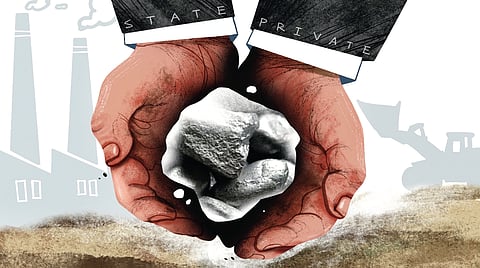

India has stopped exports of lithium-ion battery black mass, the mineral-rich powder left after used batteries are shredded. The government wants to keep this material in the country so domestic recyclers can recover lithium, nickel, cobalt and other valuable minerals.
The decision raises a larger question: can discarded batteries become a dependable source of critical minerals for India? Recycling offers an alternative to mining, but recovering minerals is only part of the challenge. India must also find ways to collect used batteries, refine the recovered material to the required purity and make the business commercially viable. Here, we examine how prepared is the country, and what difference will the export ban make.
What has the government announced, and why does it matter?
The Directorate General of Foreign Trade (DGFT) has prohibited exports of lithium-ion battery black mass with immediate effect. Notification No. 49/2026-27, dated November 10, moves ITC (HS) Code 85491400 from 'Free' to 'Prohibited' until further orders.
The government says Indian shredders were exporting black mass even as some domestic recyclers were importing it. The restriction is intended to make more raw material available to Indian plants and improve capacity utilisation.
Was black mass being exported? Yes, although the volumes are unknown. Hazardous-waste rules already required Environment Ministry permission and a DGFT licence. Yet official records show no exports. Ajay Srivastava of the Global Trade Research Initiative notes that India recorded zero exports in 2025-26. He warns that exporters can evade scrutiny by declaring the material as cobalt powder or a nickel intermediate.
The Centre for Social and Economic Progress says exported material largely reaches China. An industry representative also identifies refiners in South Korea.
Why are discarded batteries becoming an important source of critical minerals?
India's battery demand is expected to grow rapidly, driven by electric vehicles and energy storage. A January 2026 NITI Aayog report prepared by TERI, Advancing Circular Economy of Waste Electronic and Electrical Equipment (E-waste) and Lithium-Ion Batteries in India, projects demand rising from 16 GWh in 2023 to 248 GWh by 2035, an annual growth rate of about 26%.
The volume of end-of-life batteries available for recycling is expected to increase from 19,000 tonnes to 233,000 tonnes over the same period.
Recovering minerals from products already in circulation is known as urban mining. It allows valuable materials to be reused instead of relying entirely on fresh mineral extraction.
What is black mass, and how are minerals recovered from it?
Used batteries are collected, sorted, discharged, dismantled and shredded. Plastics, aluminium and copper are separated, leaving a powder made up of material from the cathode and graphite anode. This residue is called black mass.
There are two main methods of recovering metals from it. Pyrometallurgy uses high temperatures to smelt the material and recover nickel, cobalt and copper, although some material is lost in the slag.
Hydrometallurgy uses chemical solutions to dissolve the powder and separate metals through leaching, solvent extraction and crystallisation. It can produce lithium hydroxide, nickel sulphate and cobalt sulphate.
NITI Aayog favours hydrometallurgy because it offers higher recovery rates and uses less energy.
Which critical minerals can India recover from discarded batteries?
The main minerals are lithium, nickel, cobalt and manganese. Graphite, aluminium and copper can also be recovered as by-products.
The quantities depend on battery chemistry. Nickel-manganese-cobalt (NMC) batteries are rich in nickel and cobalt. Lithium iron phosphate (LFP) batteries, increasingly used in electric vehicles and energy storage, contain iron and phosphate instead of nickel and cobalt, making them less valuable to recyclers.
What India can recover will therefore depend on the types of batteries entering the recycling system.
How dependent is India on imported critical minerals?
Almost entirely. NITI Aayog's September 2026 Trade Watch puts India's import dependence at 100% for lithium, nickel and cobalt.
Supplies are concentrated in a few countries. In 2024-25, Chile accounted for 41.5% and China 38.3% of India's lithium oxide and hydroxide imports. Finland supplied nearly 60% of cobalt imports, according to the Institute for Energy Economics and Financial Analysis (IEEFA), cited by Down To Earth.
India has identified lithium resources of its own, but commercial extraction remains uncertain. On February 13, 2023, the Ministry of Mines announced that the Geological Survey of India had found 5.9 million tonnes of inferred lithium resources at Salal-Haimana in Reasi district, Jammu and Kashmir. Billed as a first for India, the discovery was offered for auction twice. The second round attracted no bids, and Mines Minister G Kishan Reddy confirmed that the auction had been annulled. Reasi remains an inferred resource, not a proven reserve.
Globally, reserves are unevenly distributed. The US Geological Survey's 2026 summary estimates world lithium reserves at about 37 million tonnes. Chile holds 9.2 million tonnes, Australia 8.4 million, China 4.6 million, and Argentina and the United States 4.4 million each.
The Democratic Republic of Congo holds half the world's cobalt reserves, estimated at 6 million tonnes out of 12 million, and accounted for an estimated 73% of mined production in 2025. China, despite holding about an eighth of global lithium reserves, leads in refined cobalt and battery manufacturing.
Recycling cannot eliminate India's import dependence, but it can reduce it over time.
Does India have the capacity to recycle discarded lithium-ion batteries?
India has 57 lithium-ion battery recyclers registered with the Central Pollution Control Board (CPCB), with a combined annual capacity of 5.17 lakh tonnes. However, capacity specifically for processing black mass is about 75,500 tonnes.
India is believed to have the capacity to process more black mass than it currently generates, leaving refiners short of material. The larger challenge is converting the powder into battery-grade chemicals. Producing black mass and refining it to the required purity are different operations.
The Ministry of Mines has cleared 58 companies under the incentive scheme, with proposed capacity of 8.5 lakh tonnes and investment commitments of about Rs 5,000 crore, according to a Press Information Bureau release dated April 30, 2026. Clearance does not mean production has begun. The plants must still be commissioned.
Is battery recycling commercially viable in India?
It depends on the battery chemistry. The NITI Aayog report models a plant processing 10,000 tonnes annually. It estimates total recycling costs at Rs 294-350 per kg, against revenue of Rs 368-408 per kg. Of this, Rs 256-283 comes from recovered materials and Rs 112-125 from Extended Producer Responsibility (EPR) certificates.
Estimated margins before interest and tax are 24% for NMC batteries and 17% for lithium cobalt oxide batteries. For LFP batteries, the margin is negative 13%, reflecting their lower mineral value.
The report recommends a chemistry-specific EPR price for LFP batteries. Without additional support, their thin or negative margins make large-scale recycling commercially difficult.
What is the role of the Rs 1,500-crore incentive scheme?
Approved by the Cabinet in September 2025 under the National Critical Mineral Mission, the scheme supports recovery of critical minerals from battery waste, electronic waste and industrial scrap.
It aims to help companies move beyond producing black mass to extracting individual, saleable minerals, a process requiring substantial capital and specialised chemical expertise.
The scheme and the export ban serve different purposes. The restriction keeps the raw material in India, while the financial support helps build the means to refine it. Delays in commissioning plants could weaken the impact of both measures.
Does India already have a regulatory framework for battery recycling?
Yes. The Battery Waste Management Rules, 2022, impose Extended Producer Responsibility on manufacturers and importers. They must ensure that batteries they sell are collected and recycled or refurbished, and demonstrate compliance through EPR certificates purchased from registered recyclers.
Recovery targets for portable and electric vehicle batteries rise from 70% in 2024-25 to 80% in 2025-26 and 90% from 2026-27. New batteries must contain a minimum proportion of recycled material from 2027-28.
The CPCB tracks compliance through an online portal. However, NITI Aayog warns that weak monitoring allows non-compliant recyclers to generate spurious EPR certificates.
What are the biggest obstacles to building a domestic recycling industry?
The first is collecting used batteries. Many remain with consumers, enter informal channels or are processed outside the formal system. Collection is difficult and expensive because batteries are scattered across households, workshops and e-waste networks.
Technology is another hurdle. Extracting high-purity compounds requires specialised chemical processing, and a plant designed for one battery chemistry may struggle to handle another.
Taxation adds to the burden. Battery scrap attracts 18% GST, and recyclers have sought a reduction to 5%, arguing that the higher rate increases working-capital requirements. Competition from established Chinese recycling hubs adds further pressure.
Safety is also a concern. Battery dismantling and chemical processing carry risks of fires and toxic releases. Expansion without adequate monitoring could create another waste-management problem.
Will prohibiting black mass exports make India self-reliant in critical minerals?
Not by itself. Retaining black mass increases the supply of material available for recycling, but does not guarantee that it can be refined economically or sold.
Recyclers must produce battery-grade minerals at competitive prices, and cell manufacturers must be willing to buy them. An export notification cannot ensure either.
The failure to attract a bidder for Reasi's lithium block shows that having a mineral resource does not necessarily make it commercially attractive.
The real test will come when India's recycled lithium reaches the market. Will there be manufacturers willing to buy it?
