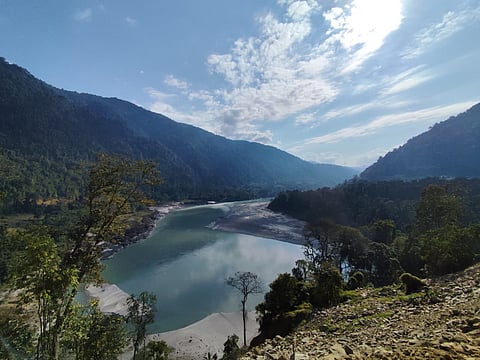

The proposed Siang Upper Multipurpose Project (SUMP) in Arunachal Pradesh has triggered growing opposition from indigenous communities, putting the BJP government led by Chief Minister Pema Khandu under pressure. Although tensions in the Siang region have eased following the release of four anti-dam activists, the underlying differences between the government and protesting communities remain unresolved. The government sees the project as important for national security and water management, particularly in view of China’s proposed mega dam upstream. However, local communities fear displacement, loss of ancestral land and environmental damage. The controversy has also raised concerns in Assam over the project’s possible downstream impact. Here is a look at the project, the reasons behind the opposition and the continuing standoff.
Where is the Siang Upper Multipurpose Project planned?
The hydropower project has been proposed on the Siang River in Arunachal Pradesh, near Geku in Upper Siang district, close to the border with China. The Yarlung Tsangpo River, which originates in Tibet, becomes the Siang when it enters Arunachal Pradesh. Further downstream in Assam, the Siang is joined by the Dibang and Lohit rivers to form the Brahmaputra River. The Siang plays an important role in sustaining the Brahmaputra’s flow, contributing around 32% of its total discharge.
Who envisaged SUMP, and why?
SUMP is a national project with an estimated power generation capacity of 11,000 MW. It was envisaged as a counter to China’s proposed 60,000 MW hydropower project. Once commissioned, it would strengthen India’s ability to regulate downstream water flows by storing excess monsoon water and releasing it when required.
It can handle Arunachal’s current peak demand of around 180 MW. At present, local available power is about 120 MW and the shortfall is managed through imports from the central grid.
The project could also significantly increase India’s hydropower generation capacity and help manage annual floods in Assam.
However, the project feasibility report is yet to be completed. So, the project costs and deadlines are still unclear. Anti-dam protests broke out even as the government initiated the surveys.

How has the anti-dam movement evolved over the years?
Opposition to dam projects on the Siang River dates back to the 1980s, when local communities resisted the Brahmaputra Board’s first proposal to build a hydropower project on the river. The movement gained momentum in the early 21st century, with local resistance becoming more organised through platforms such as the Siang People’s Forum and the Siang Bachao Federation. In 2017, NITI Aayog proposed SUMP.
What fuelled the recent tensions?
Tensions had been building in the Siang region for about a year, although the protests initially remained peaceful. The movement gained pace earlier this year through local organisations, including the Siang Indigenous Farmers Forum, after the government decided to conduct a pre-feasibility report (PFR) survey. The alleged mobilisation of security personnel in the region and the formation of a high-powered committee to oversee the survey further escalated tensions.
Why are local communities opposing SUMP?
The main concerns include the possible submergence of villages, displacement of families, loss of ancestral land, forests and livelihoods, and damage to the Siang River ecosystem. Members of the Adi and Galo tribes are expected to suffer the most. There are also fears about the risks of constructing a mega dam in a seismically sensitive region.
Some members of the local population are particularly unhappy that communities were not adequately consulted before the project moved forward. They view the PFR survey, which they describe as being conducted forcefully, as a violation of their fundamental rights. Protesters say they would welcome smaller hydropower projects on other rivers but oppose a dam on the Siang, which they regard as their mother and worship.
Why is the Assam Congress opposing the project?
Congress MP Gaurav Gogoi recently wrote to Union Jal Shakti Minister CR Patil, expressing serious concerns about SUMP’s potential impact on Assam. He pointed out that the Siang is an important part of the Brahmaputra basin and sustains Assam’s agricultural economy, riverine ecosystems and livelihoods.
He argued that any major intervention in the river’s flow must be carefully assessed for its possible implications for flood risks, water security and downstream communities. While acknowledging that SUMP is being projected as a strategic response to China’s proposed mega dam, Gogoi stressed that the interests of communities downstream in Assam must receive equal consideration.
What is the Arunachal Pradesh government’s stand?
The Arunachal Pradesh government is defending SUMP mainly on grounds of national security and water security. Chief Minister Pema Khandu has described China’s proposed mega dam as a ticking “water bomb” and an existential threat to the people of Arunachal Pradesh and their livelihoods.
He has argued that China is not a signatory to any international water treaty and therefore cannot be trusted. Pointing to the uncertainty over China’s actions, he said it could even use the dam as a “water bomb”.
How does the government justify the project against local concerns?
Khandu has argued that India would have little reason to worry if China had signed an international water treaty. He warned that a sudden release of water from the Chinese dam could destroy the entire Siang belt. Given this perceived threat, he said the Arunachal Pradesh government proposed SUMP as both a defensive measure and a way to ensure water security.
However, local communities have opposed the project and staged several protests. Khandu has appealed to the protesters to come forward for talks, but they have questioned the value of dialogue when the government continues to push ahead with the project.
What happened during the October 23 bandh?
On October 23, several protesting organisations jointly called a 12-hour bandh across the Siang region to oppose SUMP. Although the bandh passed off peacefully, widespread violence broke out that night in Pasighat, the headquarters of East Siang district. The violence continued into the early hours of October 24.
Protesters set fire to an office of the National Hydroelectric Power Corporation and vehicles parked on the premises of a police station. They also vandalised the houses of three politicians, including two MLAs, and clashed with security personnel, leaving several people injured. Dozens of people were arrested for their alleged involvement in the violence.
How has Arunachal East MP Tapir Gao added to the controversy?
Arunachal East MP Tapir Gao has further fuelled the controversy with his recent remarks at an event, where he declared that the “dam on Siang will be built, come what may”. The Congress and other critics condemned his statement, accusing him of supporting the project while ignoring the concerns of indigenous communities.
Has the standoff between the government and protesters ended?
No. Although no major incident has been reported since the violence in Pasighat, the deadlock over SUMP continues. Last week, four anti-dam activists were released from jail, nearly a month after their arrest under the Arunachal Pradesh Unlawful Activities (Prevention) Act, 2014, for leading the opposition to the project.
The state government agreed to release them as a goodwill gesture. It said the move was intended to build confidence and create a positive atmosphere for dialogue and reconciliation. However, the release has eased tensions without resolving the fundamental disagreement between the government and the protesting indigenous communities.