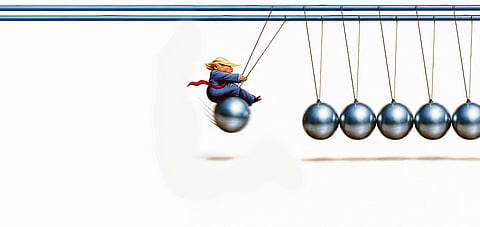

With the Trump administration proposing a 25% tariff on Indian exports under Section 301 of the U.S. Trade Act of 1974, experts caution that Washington is explicitly linking a lower tariff rate to the conclusion of a bilateral trade agreement. Here is what happened and how it could shape the trade negotiations.
What exactly has the Trump administration announced, and how much tariff could Indian goods face in the US?
On November, the US proposed tariffs of up to 25% on several Indian exports, alleging that India's industrial policies fuel structural excess capacity, affecting the US economy and industry. Of the 14 economies on which the US proposed to tariffs, India faces the second-highest levy of 25% after Vietnam (35%).
The 25% ceiling is net of the existing Section 301 duties, with some goods exempt, and could be adjusted for other US levies. It could fall to 17% if India signs a reciprocal trade agreement with the US. The USTR has asked for comments on January 5, with hearings from January 25. The final decision will be taken thereafter.
The US accusations against India and what they mean
Washington alleged that many of India's state-backed initiatives to boost manufacturing have led to excess production, beyond what the market demand can sustain, at the expense of US producers.
The Office of the United States Trade Representative (USTR) flagged schemes like Make in India and production-linked incentives (PLI), which reward companies for incremental sales, while weak labour protections in India lead to low wages and lower costs. It cites solar module capacity of 154 gigawatts against domestic demand of 53GW, and India's large share of US generic drug supplies.
The US also pointed to the growing dependence of Indian exporters on inputs from China, and other countries it classifies as non-market economies.
The finding could affect India’s negotiating power for the Bilateral Trade Agreement (BTA). Some exporters and economists have flagged that the US is using the move as a pressure tactic at a time when both countries are engaged in negotiations.
Make in India and PLI: The chief US concerns
Washington has specifically flagged the Make in India initiative, Atmanirbhar Bharat and the PLI schemes for promoting manufacturing and exports without necessarily being aligned with market demand. It also alleges that India is trying to replicate industrial strategies of China, Japan and South Korea to drive export-led growth through PLI schemes. It called out India for low domestic value addition with low investment in domestic research and development, particularly in electronics, where critical components such as semiconductor chips and sub-assemblies are imported from China.
Labour protections and enforcement gaps
While acknowledging that Indian labour laws are, on paper, broadly compliant with international standards, the US alleges inadequate enforcement at the national and state levels allows forced labour and debt bondage to persist, potentially giving Indian manufacturers an unfair competitive advantage.
Financial support and market-access barriers
India's system of directed lending and government-backed financial support has also been under the radar of USTR. It also flagged the Reserve Bank of India's Priority Sector Lending framework, under which commercial banks allocate 40% of their net bank credit to designated sectors, including agriculture, micro, small and medium enterprises (MSMEs), housing, renewable energy and social infrastructure has helped the sectors flourish and gives them a competitive edge over industries in other countries. Washington argues that this directs financing towards government-prioritised industries that might not otherwise receive comparable credit under market-based lending. The US criticised India’s financing system as opaque and unpredictable.
Over-reliance on Chinese imports
At a time when India is scaling exports up, Washington criticised India’s over reliance on relatively inexpensive Chinese intermediate goods and capital equipment, including semiconductors, photovoltaic cells, electric accumulators, electrical equipment and textile machinery.
Due to its access to cheap imports, the US alleges that Indian manufacturers enjoy a cost advantage, potentially displacing inputs from market-based economies, including the US. India's pursuit of a free trade agreement with the Eurasian Economic Union, which includes Russia, has also attracted scrutiny.
Sector-specific concerns: Steel and solar in focus
The US claimed India’s steel capacity growth is outpacing projected domestic demand, increasing the risk of structural overproduction. It has also questioned India's continued expansion of coal-dependent blast furnace capacity under the National Steel Policy, 2017.
Similarly, in the solar sectors, the US bashed the PLI scheme favouring domestic manufacturers over foreign suppliers.
The broader investigation also identified pharmaceuticals, medical devices, information and communications technology, textiles, automotive products and construction materials as sectors where industrial support, import policies and reliance on non-market-economy inputs could affect competition.
Impact on US economy
The US contends that India's policies restrict commercial opportunities for American manufacturers and exporters, both in India and in international markets. It argues that subsidised production and access to cheaper imported inputs can put US companies at a disadvantage, resulting in lost manufacturing output, exports, jobs and investment.
Beyond trade competition, Washington frames the issue as one of economic security, warning that growing dependence on inputs from non-market economies could create vulnerabilities in strategic supply chains.
India's defence
The commerce department has refuted US allegations of structural excess capacity in any manufacturing sector. New Delhi also advocated that trade-related concerns should be addressed through ongoing negotiations.
Nullifying the claim of over production of steel, the Indian Stainless Steel Development Association (ISSDA) says 85-90% of India's steel capacity is privately owned and expansion is driven by commercial demand rather than government mandates.
“India is both the second-largest producer as well as the second largest consumer of steel. So, there is no question of any lack of alignment between production and consumption. Despite being the second-largest consumer of steel, per capita consumption is only 115 kgs as opposed to global average of 220 kgs,” said Rajamani Krishnamurti, President, the Indian Stainless Steel Development Association (ISSDA).
As for labour laws, the industries assured that they comply with domestic laws and argued that comparisons should account for differences between developed and developing economies.
How did US tariffs on Indian exports reach the proposed 25% level, and what happened to the earlier 50%, 18% and 10% rates?
Washington announced a 26% reciprocal tariff on India on April 2, 2025. It announced a 25% rate in July, effective August 7, then added a separate 25% penalty over Russian oil purchases from August 27, taking the burden to 50%. The Supreme Court struck down the reciprocal tariffs on February 20 calling it illegal; later a 10% global surcharge followed, replacing the same by a 10% Section 301 duty in July. Now Washington proposes up to 25%, or 17% with a trade deal.
Does the proposed 17% tariff mean Indian exporters will definitely pay 17% if a trade deal is signed? What conditions and exemptions apply?
No. The USTR notice of November 25, 2026, is a proposal for public consultation, not a final tariff order. It says Washington would consider a 17% rate if India reaches a reciprocal trade agreement that responds to the investigation’s findings.
Currently, MFN tariff is imposed on the Indian imports to the US in addition to 10% tariff after the US court struck down the varied reciprocal tariff on different countries. If the additional 25% is imposed under Section 301, then this 10% tariff will be subsumed under this
The proposed tariff however, exempts goods like steel, aluminium and copper products, passenger vehicles and parts, medium- and heavy-duty vehicles and part, which are already covered by Section 232 national-security tariffs.
What exporters would actually pay will therefore depend on the product’s classification, whether it appears in the exemption annex, the final negotiated rate and any other applicable duties.
Which Indian exports to the US will be affected, and which products are exempt from the proposed tariffs?
The proposed tariffs could affect labour-intensive and manufactured exports such as textiles and apparel, gems and jewellery, shrimp and seafood, solar products, pharmaceuticals beyond the exempt categories, medical devices and engineering goods.
Under the proposed tariff framework, India has the highest tariff after Vietnam. For sectors like textiles, this can proved to particularly fatal as other major competitors like Bangladesh, Thailand will get a competitive advantage and might lead to shrinking India’s share in the US market.
While the USTR had provided some exemptions under Section 232, the exemptions are product-specific, not blanket sector-wide exclusions.
Which Indian industries, exporters and workers stand to lose the most if the 25% tariff becomes final?
The biggest exposure is among labour-intensive exporters, particularly shrimp and seafood, gems and jewellery, textiles and apparel, home furnishings and carpets. Smaller manufacturers and exporters with thin margins and heavy dependence on US buyers could struggle to absorb higher duties or divert orders, putting production and jobs at risk.
“Tariffs raise landed costs and retail prices, potentially dampening US consumer demand and affecting jobs and businesses across the value chain in both countries. The US remains a major jewellery market, supporting roughly 200,000 jobs,” said Kirit Bhansali, Chairman, GJEPC.
How does India's proposed 17% tariff compare with the rates offered to China, Vietnam, Bangladesh and other competing Asian economies?
The proposed tariffs vary across the 14 economies, with higher rates serving as leverage for trade deals. India faces up to 25%, falling to 17% if an agreement is reached; Vietnam 35% or 20%, while Bangladesh and four Southeast Asian economies face 25% or 18%. China faces up to 20%, alongside existing Section 301 duties. The EU, Japan, South Korea and Taiwan retain negotiated 15% ceilings. Existing agreements and certain earlier levies also limit the stacking of additional duties.
How much could the new tariffs affect India's exports, trade surplus and economic growth?
India’s goods exports to the US in April to September this year stood at more than $50 billion. The US being India’s largest export market, a 25% tariff could erode the competitiveness of Indian exporters, prompting US buyers to shift orders to rivals such as Vietnam and Bangladesh. Lost orders would weaken export growth, affecting employment.
What does the US want India to give in return for the lower tariff rate, and which Indian interests could be affected?
US has often criticized India for its protectionists measures and several non-tariff barriers. India committed to eliminate or lower tariffs on US industrial goods and a range of agricultural products, while addressing non-tariff barriers affecting American medical devices, food and agricultural exports, and information and communications technology products. The US is also seeking greater access to India's dairy market, negotiations on digital-trade rules and changes to regulatory restrictions.
Could India's purchases of Russian oil trigger another round of American tariffs, and how does this complicate the trade negotiations?
While the US waived off any tariff as a penalty for purchasing Russian oil, the threat is not over. The USTR in its report released on November 25, criticised India for Russian imports. Washington has retained the option of restoring the earlier 25% penalty if India resumes or increases Russian oil imports. A separate US law also provides for potential tariffs on countries buying Russian energy, adding another layer of uncertainty.
USTR said, “India has long-standing trade, investment, and defense ties with Russia that have remained even through recent geopolitical issues and global sanctions. While India has recently significantly reduced its Russian oil purchases, these belowmarket energy inputs have given Indian producers in certain sectors a cost advantage vis-à-vis producers in other markets.”
Why have India and the US struggled to conclude their bilateral trade agreement despite announcing a framework in February 2026?
India and the US remain divided over agricultural and dairy market access, tariff reductions, digital-trade rules and regulatory barriers. India is seeking durable tariff relief and protection for sensitive sectors, while Washington wants wider access for American exporters and changes to Indian policies. The US Supreme Court ruling and subsequent tariff measures have further complicated negotiations.
What are India's options if Washington insists on the proposed tariffs, and what happens if the two countries fail to reach a trade agreement?
GTRI in its report highlighted that under the proposal, Indian imports face a 17% tariff if a trade pact is finalized—offering a calculated 1% edge over Bangladesh, Cambodia, Indonesia, Malaysia, and Thailand (18% deal rate) and a 3% edge over Vietnam and China (20% deal rate)—while rising up to 25% without a deal, alongside the risk that an adverse USTR ruling could bring further duties or import quotas.
India thus has three broad options: intensify negotiations to secure the 17% tariff cap and exemptions; challenge Washington’s findings through consultations and potentially the WTO; or prepare calibrated retaliation while diversifying export markets and supporting vulnerable sectors.
Failing to secure a trade deal would raise costs for Indian exporters, weaken their competitiveness and prolong uncertainty for businesses.
