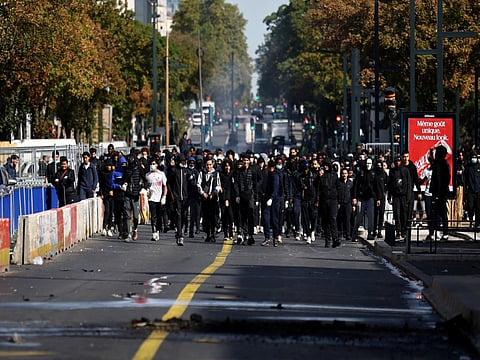

Roughly about a month after the Cockroach Janata Party (CJP) launched its nationwide campaign, School Thik Karo (Fix the School) on August 15, high school students in Paris suburb Créteil started a protest to highlight the poor condition of French schools. The localised, mid-September demonstration has since snowballed into a nationwide movement that now appears to be spreading across Europe with students in Belgium, Italy, Greece, Ireland and Austria hitting the streets. They are protesting overcrowded classrooms, shortage of teachers, dilapidated school buildings, rising costs of education and cuts to government spending on school education. While there may be no direct link between the CJP’s school campaign and the student protests in Europe, strong comparisons are drawn towards the common thread — students’ anger about the systemic issues plaguing the education sector due to neglect by government.
What is the School Thik Karo campaign?
The CJP launched the School Thik Karo campaign on August 15 to check the basic facilities in government schools, especially in rural areas, and to flag the lapses found in such audits. The party's volunteers have so far conducted 'inspections' in various government schools in Rajasthan, Uttar Pradesh, Haryana, Madhya Pradesh, Punjab and Assam. Designed as a grassroots initiative, the School Thik Karo project relies on civic involvement rather than formal bureaucracy to improve the conditions of schools. Parents, students and local volunteers are roped in to take up social monitoring within their communities.
The focus areas are sanitation and hygiene; basic amenities such as clean drinking water and electricity in classrooms to keep students safe in harsh weather conditions; fixing unsafe buildings, crumbling classroom walls and damaged roofs; and ensuring classroom essentials such as healthy seating arrangements and proper teaching equipment.
After each inspection, the findings are handed over to the local gram panchayats and school committees for further action. The audits are also shared on social media to create awareness and put pressure on the authorities to address the glaring lapses.
How did the protests start in France?
On September 17, students of the Saint-Exupéry high school in Créteil on the outskirts of Paris joined teachers protesting the lack of resources and adequate number of staff. The protests took a serious turn after students started blocking the school’s entrance from September 21, disrupting its regular functioning.
The authorities rushed additional staff to the school to pacify the protesters and the strike ended. However, it kicked off a much bigger campaign as new protests spread through the Paris region and then to other major cities including Marseille, Lyon, Strasbourg, Toulouse and Lille. Student leaders attributed it to their genuine concerns and bare minimum demands.
By October 1, over 1,000 high schools in France had been affected and there were violent clashes between young protesters and police. In response, the government has suspended all regular classes till the situation improves.
How big are the French protests?
According to the government, around 2.5 lakh people demonstrated across the country while student outfits pegged the number at 4.5 lakh. French media reports claimed that 1 lakh people marched in Paris, 30,000 in Marseille and Toulouse, 25,000 in Lille, and 20,000 in Lyon. Besides, several thousand young students took to the streets in Nantes, Strasbourg, Mulhouse, Grenoble, Bordeaux, Rennes and other cities.
Media reports say as many as 1,800 high schools are either locked down by authorities or blocked by students. Similarly, around 60 universities are affected due to the protests. Reports peg the damage to schools in the Paris region alone at 7 million euros.
How did the French government respond to the protests?
Initially, the government tried to stamp down protests through police crackdowns. However, brutal police action angered the young protesters who retaliated by burning down public properties and clashing with the riot police.
According to reports, over 5,000 people have been taken into custody and 90% of them are minors. A major flashpoint was when a 15-year-old boy lost his hand after police fired a stun grenade during a crackdown. After this incident, the government suspended the use of such weapons. Public outrage forced the police to open internal investigations into misconduct by its personnel.
As the protests widened, the government softened its stance with Prime Minister Sébastien Lecornu publicly acknowledging the "anger and anxieties of young people".
Why can't the French government accept all demands by students?
France is going through a financial crisis and the government is in no position to commit to spending huge unplanned amounts on education. According to a French government report, France spent 199.2 billion euros on its education system in 2025.
This is estimated to be 6.7% of the GDP. Public debt remains high at 120% of the GDP and at least 90 billion euros are needed next year towards interest payments alone. In 2026, the French government is trying to cut spending to save at least 70 billion euros. The students fear there will be squeeze on education funding.
French youth have already been disgruntled with the unemployment rate touching 8%. Economic growth is virtually stagnant with zero per cent expansion recorded in the first quarter of this year. In the previous quarter when economy actually grew, it was a feeble 0.2% growth. Public expenditure figures are equally worrisome, with as much as 14% of the GDP spent on pensions -- one of the highest payouts in Europe. To address the pension burden, the government in 2023 increased the retirement age from 62 to 64, triggering one of the most intense protests by unemployed youth.
To deal with the current protests, the French education ministry has offered talks and also launched an online portal for students to share their concerns and ideas for improving the education system.
What factors led to the crisis in high schools?
French students complain their classes are overcrowded with as many as 35 students per class. This may not look like a big problem in India, where classrooms brimming with 40-45 students is a common sight. However, this is an unacceptable number under European standards. In France, reports say 70% of schools have more than 30 pupils per class.
According to a CNN report, the government is partially to blame as it cut down on funding and teacher appointments expecting a fall in student enrolments.
This turned out to be a blunder as France witnessed a fertility spike around 2010, which consequently led to a rise in students in schools. Currently, estimates show that secondary schools have fewer teachers while student enrolments have shot up by 2.5 lakh.
How is France planning to address students’ demands?
Though Lecornu has agreed to do the needful to address students’ concerns, there seems to be confusion within the government about how to go about it. According to French Education Minister Édouard Geffray, professional activists have taken over the protests and students have been pushed out of the movement. "There are activists — particularly from the far-left — who have infiltrated the high school student movement, hijacked it from the students themselves, and engaged in extreme violence," he said recently.
To support his theory, he cited how a protest by high school students has now spread to universities and rued that the protesters are constantly shifting the goal posts to keep the movement going. "One of the difficulties of this movement is that there are no national demands. It all started with local demands,” he said.
With emotions running high and the government having no magic wand to improve things overnight, the protests are likely to continue.
