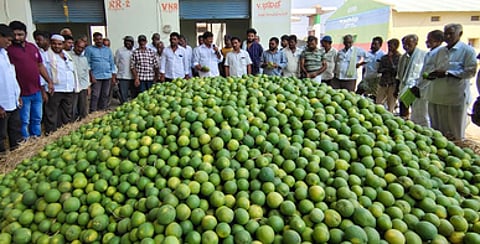

The Rayalaseema region of Andhra Pradesh has never suffered from a production problem. Drive through Chittoor or Tirupati in summer, and mango orchards stretch for kilometres. Madanapalle's wholesale market sees enormous tomato arrivals during peak season, while Gudur's lemon yards and the banana, papaya, citrus, and other horticulture belts of Annamayya, Kadapa, Kurnool, and Anantapur contribute millions of tonnes of produce every year.
The problem begins after harvest. A bumper crop often leads to a glut, pushing prices down and forcing farmers to sell at distress prices. The government laid the foundation stone of a Rs 1 lakh-crore project to transform the region’s horticulture economy on October 2. It is called Global Horticulture Hub–Rayalaseema Rising (GHH). The key question is whether the proposed infrastructure and systems will reach farmers and improve their earnings.
Will the horticulture hub solve the problem of bumper harvests and crashing prices?
This is perhaps the most immediate test. In Annamayya district, horticulture covers nearly 67,700 hectares, with tomato and papaya among the major crops. During peak arrivals, the Madanapalle market receives huge quantities of tomatoes, causing prices to fall sharply.
When prices collapse, farmers have very little room to delay harvesting. Leaving produce in the field means losing the crop altogether, while transporting it to the market can itself become uneconomical.
The GHH will need to build adequate storage and processing facilities and provide alternative marketing channels so the entire harvest doesn't hit the wholesale market at once.
Will farmers get scientific grading and transparent price discovery?
Chittoor's mango economy highlights this challenge. Mango cultivation covers roughly 1.12 lakh hectares, with Totapuri accounting for nearly 86,000 hectares and supplying the pulp-processing industry. Despite the large processing ecosystem, farmers still depend on factory procurement systems and prevailing market conditions.
The GHH will need to ensure standardised grading, transparent quality assessment, and predictable procurement prices. Without these systems, expanding production could mean larger volumes arrive at the same factory gates, further pressuring prices.
Will cold storage reach farmers rather than remain concentrated in major markets?
For horticulture growers, being able to store produce even a few days can make a significant difference. Small, decentralised cold rooms near production clusters could let farmers wait for better prices instead of selling immediately after harvest.
Why is cold storage alone insufficient to address glut situations?
Different crops require different storage and handling methods. Tomatoes may need rapid marketing or processing into pulp and paste; mangoes require careful maturity management, ripening and pulp-processing facilities; onions need appropriate curing and ventilated storage; and citrus fruits require suitable temperature, humidity and packaging.
The project therefore needs crop-specific infrastructure, processing capacity and identified buyers rather than relying on conventional cold storage alone.
Can the project address the water crisis along with the market crisis?
In parts of Rayalaseema, increasing horticulture production is inseparable from water availability.
Anantapur illustrates the challenge. According to the 2023 APSAC District Survey cited in the project-related data, horticulture covers 4,608 hectares, including sweet orange (2,851.91 hectares), banana (655.66 hectares), mango (551.94 hectares), and pomegranate (270.87 hectares).
For farmers dependent on groundwater, prolonged dry spells and declining borewell yields can threaten entire orchards. The horticulture hub will therefore need to complement market infrastructure with water-efficient irrigation, micro-irrigation, crop insurance and climate-resilient cultivation practices.
Where will the water come from, and can the expansion be sustained?
The proposed Rs 20,884-crore allocation covers irrigation and water management, but it alone does not ensure long-term water availability. The government needs to publish basin-wise water budgets, groundwater assessments, crop-wise irrigation requirements and details of the irrigation projects supporting the expansion. Cultivation should be phased according to dependable water availability, including during drought years.
How can a drought-prone region like Rayalaseema produce a glut of tomatoes, bananas, onions and mangoes?
The irony is that Rayalaseema faces water scarcity, yet some of its areas produce large quantities of horticultural crops. Irrigation and groundwater allow farmers to grow these crops despite the region's arid conditions. When many farmers grow the same crops and harvest them around the same time, markets are flooded with produce even as the region faces water shortages.
How will the Global Horticulture Hub solve this problem?
The GHH should focus on a core issue: scientific crop planning so farmers grow crops based on water availability and market demand.
Will farmers be able to hold their crops until prices improve?
To do that, the GHH will need to build enough storage capacity near production centers and link it to market-price information and farmer-producer organisations. Scientific storage that lets farmers hold onions for several weeks could prevent them from selling immediately after harvest, when prices may be at their lowest.
Will farmers get direct access to buyers and reduce their dependence on intermediaries?
Kadapa district has more than 83,000 hectares under horticulture, with plans for further expansion under the GHH. When market prices fall below harvesting and transportation costs, farmers abandon or dump perishable crops. Such incidents underline the need for alternative procurement channels.
The project can strengthen Farmer Producer Organisations, connect farmers directly with food-processing units and retail chains, and set up digitised systems that let farmers sell their produce directly to buyers.
Where will the project’s Rs 1 lakh crore investment come from?
The proposed investment is approximately Rs 1,00,352 crore: Rs 40,352 crore from the government and Rs 60,000 crore expected from the private sector. The government component includes Rs 20,884 crore for irrigation and water management, Rs 14,906 crore for horticulture development and Rs 4,562 crore for rural roads.
Is the investment committed, or is much of it still a target?
Treat the Rs 1 lakh-crore figure as an announced investment target unless supported by sanctions, signed financing agreements, and confirmed investor commitments. A proposed Rs 60,000-crore private investment isn't fully committed without signed contracts.
If today's problem is a glut of produce, how will nearly doubling production avoid creating bigger gluts?
Production is projected to increase from 222 lakh metric tonnes to 435 lakh metric tonnes by expanding horticultural cultivation from 8.41 lakh hectares to 14.41 lakh hectares. Without corresponding growth in demand, processing, exports and market access, this expansion could worsen price crashes. Crop expansion should therefore be linked to demand forecasts, staggered harvesting, processing capacity and confirmed market opportunities.
Will the hub give farmers stronger bargaining power or make them more dependent on a few large buyers?
The outcome will depend on procurement rules and market competition. Written purchase agreements, transparent quality standards, minimum purchase commitments, time-bound payments and independent dispute-resolution mechanisms would protect farmers. Linking Farmer Producer Organisations to multiple processors, exporters, wholesalers and retailers would reduce dependence on a single corporate buyer. It remains to be established whether these safeguards are formally included in the GHH.
Will independent mechanisms resolve disputes over quality, weights, and delayed payments?
The government has yet to disclose whether it has established such a mechanism. District-level committees with farmer representation could address disputes over quality, underpayment and delayed settlements.
How will the project ensure competition among buyers rather than dependence on a single processing plant or corporate purchaser?
The project should encourage multiple processors, exporters, wholesalers and retailers in each horticulture cluster. Common-use processing and storage facilities, transparent access rules and FPO-led collective marketing can prevent monopolistic dependence.
Who will operate and maintain the new infrastructure, and can small farmers afford it?
The government must clarify whether the facilities will be operated by special departments, FPOs, cooperatives, private companies or public-private partnerships. Published user charges, maintenance budgets, affordable shared services and transparent access rules are essential. Small and marginal farmers should be able to use pack-houses, grading centres, cold stores and processing units without bearing prohibitive individual investment costs.
