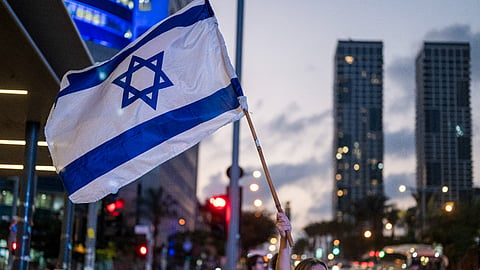

Three years after the October 7 attacks, Israelis are voting on Tuesday, and the surprising thing is how little the count may settle. No party has ever won the 61 seats needed to govern alone, and the polls can’t agree on which camp is closer.
One broadcaster has the opposition’s Gadi Eisenkot ahead of Benjamin Netanyahu’s party. Another has Netanyahu’s allies sitting at exactly 61.
The next prime minister may be decided not on election night but in the weeks of bargaining after it.
What is happening?
Israel is electing all 120 members of its Knesset, the parliament. It is the country’s sixth national vote since 2019, but the first in 38 years to arrive at the natural end of a full parliamentary term. The Knesset was formally dissolved on July 17.
Who are the main contenders?
Prime Minister Benjamin Netanyahu leads the governing bloc through his Likud party. His coalition held 60 of 120 seats when parliament was dissolved. He has headed the government since late December 2022, and is on trial on corruption charges, which he denies.
His main rival is Gadi Eisenkot, a former army chief, who leads a new party called Yashar. Polls show the two parties running close. Naftali Bennett, Yair Golan and Avigdor Liberman each lead parties that could matter too.
Israel’s Arab citizens make up roughly a fifth of the population, and their voice is split between two main political forces. On one side is the Joint List, and on the other is Ra’am (the United Arab List), headed by Mansour Abbas.
In one Channel 12 poll, the Joint List won seven seats and Ra’am five. Several polls project the Arab parties together at roughly 11 to 14 seats.
How Israel’s voting system work?
Israel uses proportional representation.Voters pick a party list, not an individual candidate. Any list that wins at least 3.25 percent of the vote enters parliament.
The majority mark is 61. No party has ever won that many seats on its own, so every Israeli government is a coalition.
Who’s ahead?
It depends on whom you ask.
A Channel 12 poll, from a broadcaster seen as centrist and often critical of Netanyahu, had Yashar on 23 seats and Likud on 20.
Channel 14, which openly backs the prime minister, had Likud on 29 and his allies at exactly 61. An average of eight polls put Netanyahu’s bloc near 54 seats and the Zionist opposition near 49. A separate Channel 12 survey found 41 percent preferred Eisenkot as prime minister against 38 percent for Netanyahu.
Why do the small parties matter so much?
Because a handful of them are sitting right on the 3.25 percent line. Whether they get in or not could shift several seats from one camp to the other. A vote for a party that falls short simply disappears.
The main Jewish parties have mostly ruled out leaning on Arab lawmakers to form a government.
There was also a legal fight over whether two of them could run at all.
The Central Elections Committee voted to bar Ra’am and the Joint List, but the Supreme Court unanimously overturned the decision on October 2, saying the evidence fell short of the legal bar.
What are people voting on?
Accountability for October 7: For many voters, this is the question underneath all the others. Accountability for the attack is central to the campaign, nearly three years after it exposed catastrophic failures in Israel’s security and political leadership.
Netanyahu’s critics say the people in charge that day must face the voters. His supporters say he has since led a recovery that no rival could match.
Israel’s social contract under strain: Chatham House has described the vote as a referendum on the legacy of October 7 and the future of the social contract.
A big part of that is the fight over whether ultra-Orthodox Jews should serve in the military, an argument that has only grown sharper through years of war.
The state of Israeli democracy: Many voters, especially on the opposition side, see the election as a test of whether the country’s institutions can hold.
And the big foreign questions: The long-term post-war governance of Gaza, the persistent regional standoff with Iran, and the delicate alignment with Washington. While these three pillars will define the country’s trajectory, political parties have intentionally kept their stances
