
Most issues with commercial water purifiers don’t arise from a lack of purification; they stem from using the wrong technology for the wrong water type. RO, UV, and UF are often treated as interchangeable options, but each of them solves a very different problem.
Water quality directly affects daily operations, safety and consistency of your employees, making it crucial for you to understand where each purification technology fits and then choose the right commercial water purification system.
Quick Overview: RO vs UV vs UF
To compare these systems correctly, you should understand their core function:
● RO (Reverse Osmosis): It removes dissolved salts, heavy metals, and chemical impurities from your water
● UV (Ultraviolet): It kills bacteria and viruses from your water.
● UF (Ultrafiltration): It removes the suspended particles and larger microorganisms, such as bacteria and protozoa, from your water.
Key Differences
How to Choose the Right System Based on Your Water Source
One of the most important factors in choosing a system is the quality of water you are getting.
● In case of a high TDS or borewell/tanker supply, an RO system is generally useful as it reduces dissolved solids.
● In case of a Low TDS but high microbial risk, UV or UF systems are usually sufficient.
● In case of Mixed or inconsistent supply, generally a combination of RO + UV or UF is preferred.
In commercial environments, water quality can vary significantly, which is why it is important to test the water before selecting a suitable commercial water purifier system.
Application of Purification Systems in Commercial Environments
In commercial spaces, water purification is rarely done by a single water purifier. Businesses use multiple purification systems based on
- how much water they require and,
- where that water will be used.
● Centralised treatment for large volumes
An RO water plant is commonly used where large quantities of water need to be purified on a regular basis, especially in cases of high TDS levels. It ensures uniform water quality across all water outlets.
For instance, a hospital might have to install an RO water plant as the demand for clean water is consistent to maintain hygiene and patient care.
● Point-of-use access through water coolers
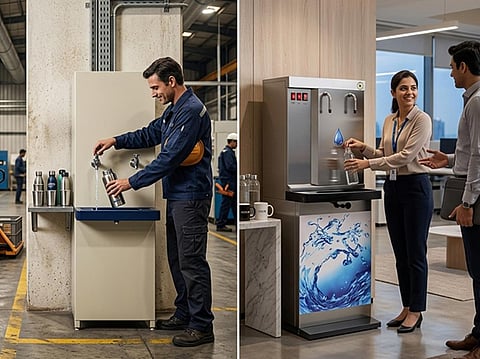
At the consumption level, systems like a water cooler provide easy access to clean and safe drinking water without a delay. Many water coolers come with an in-built purification system, adding an extra layer of safety and security, ensuring water remains safe at the final stage of dispensing.
What to Keep in Mind When Choosing a Commercial Water Purification System
Selecting the right purification system requires careful consideration of your water quality and how a purification system will perform, and not just the basic features.
Keeping the following points in mind can help you to ensure better performance and long-term reliability:
• Water quality should always be prioritised over cost when selecting a system.
• It is important to evaluate the RO plant price, the water cooler price, but the capacity, recovery rate, and long-term efficiency of the commercial water purifier need to be evaluated as well.
• It is advisable to get your water tested before installing an RO plant or water cooler to ensure the system matches your needs
• Daily consumption and peak usage should be considered while buying a commercial water purifier.
Conclusion
RO, UV, and UF are not alternatives and cannot be used interchangeably. They are designed to solve different types of water problems. What works best will depend on your source water, how much water is being consumed on a daily basis, and the level of purification required.
In many commercial environments, the most effective setup is a combination of RO+ UV+UF that work together to deliver consistent results.
Instead of focusing only on product type or cost, businesses should equally prioritise water quality, system capacity, and long-term performance to make the right choice.
Disclaimer: This content is part of a marketing initiative.
