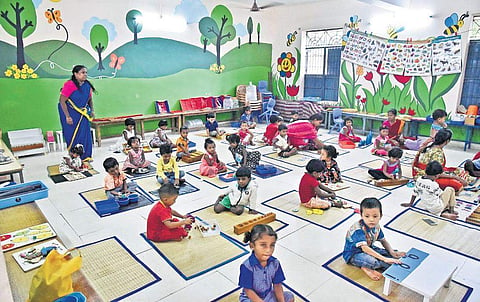

CHENNAI: People tend to associate government schools with poor quality and infrastructure, and authorities want to change that brand image. Last academic year, the government chose one school from each district to be upgraded as ‘model’ schools. The idea was to equip these institutions with state-of-the-art facilities and offer training programmes, so that they become a model worth emulating for other government schools in the state.
The model schools are being developed through public-private partnerships, with government offering substantial funds.
Nidhya Guhan, the correspondent of AV Meiyappan Matriculation Higher Secondary School, is a member of the State Model School Committee. She has been involved closely with the revamping of the Presidency Model Government Girls Higher Secondary School in Chennai. Express caught up with Nidhya to understand the work being done by the committee...

What were the different aspects you were looking at when you started revamping the school?
A. My objective was to develop this government school on par with any good private school in the city. If government school students have same access to training and facilities, they would, eventually, be on par with private school students. For that, we had to upgrade the school infrastructure, renovate mismanaged spaces, encourage extra and co-curricular activities, and empower the faculty to take ownership of the school.
What infrastructure was renovated, and how will it impact students?
The labs did not have required equipment. We arranged for gas to be supplied to the chemistry lab and for the broken equipment to be fixed. We completely reorganised the library, created a virtual lab system through which students now have access to 42 tablet computers. Six smart classrooms and various conference rooms equipped with projectors have been constructed.
To attract and engage young children, we repainted walls of classrooms in bright colours, with colourful images. We brought in toys that could be used for hands-on learning. We got them tiny tables and chairs, which could be moved around easily to make the classrooms dynamic.
Will this improvement to infrastructure impact learning outcomes?
Absolutely. Students, who might otherwise not have access to digital learning at home can do that at school now. When I first walked into the school, the entire space was cluttered. All empty spaces were piled up with unused furniture and other objects. They were in the back of classrooms, corridors, spaces between buildings.... Students did not have common spaces they could enjoy.
So, I decided to rework the floor in the assembly area. We built elevated surfaces beneath trees, cleaned up spaces between buildings... Now the spaces are being used by students to sit and study, do yoga and for physical education. We are also developing an athletic track & field, and a basketball court. A comfortable and motivating atmosphere in school directly boosts efficiency of learning.
How do these changes translate into students’ development? What challenges did you encounter while implementing these?
The biggest challenge was resistance to change. We also had to deal with internal and external stigma. Majority of stakeholders within the system had internalised a theory that government schools are not required to meet industry standards. There was no motivation to make schools look desirable and smart. Classes were run down, furniture broken and gadgets unfixed. To be able to fix these issues, every government school headmistress must take ownership. They must consistently ensure everything is in order.
But it requires a transformation in attitude...
Yes. Often even proactive headmasters do not know how to implement the vision they have for the school. But when the headteacher takes ownership and enforces a robust monitoring practice, it will trickle down till the students. When headmistresses stopped yelling at teachers and kept the conversation firm, professional and empathetic, it started pushing teachers towards treating students the same way.
Have teachers and students been receptive to these changes?
Students are extremely excited and love the changes. They are young and explorative. We have encouraged teachers to teach during special classes instead of simply monitoring students for self-study. There is a ground rule that there can be no classroom without a teacher, so we now have a system of substitute teachers.
We have engaged with a part-time counsellor too. What I realised is many students who go to government schools have difficult backgrounds. Many children, especially the naughty ones, are starved of affection. Sometimes simply allowing them to express themselves freely and smiling back at them when they speak about their ideas has improved teacher-student relationship significantly.
How do other government schools that use this school as a model seek funding?
Funding is never an issue. Apart from the funds that come from the government, there are always enough people who want to invest in education. The majority of these funds come from Corporate Social Responsibility and philanthropists. At times we even use people’s services.
For example, a person wanted to donate Rs 5,000 to this school every month and I asked him to pay for yoga classes for these students. A bank had asked us what we needed. We asked for fans and lights. Many of them who contribute to schools get demotivated when they see that the infrastructure they paid for, gets broken within a year. So we have come up with a quarterly monitoring system that will make sure that everything is maintained well. By regular monitoring, the accountability of all stakeholders in the school increases significantly.