
SHIVAMOGGA: Anyone who has visited the Malnad region will remember its green hills and arecanut palms -- and the heavy rains if they’ve been there in the monsoon. The monsoons have become increasingly unpredictable in recent years, threatening the region’s agrarian economy and prompting many to seek alternatives to arecanut. And now, they are turning to the spiny wonder.
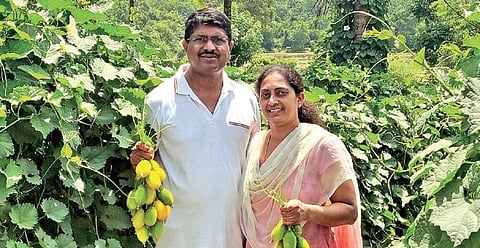
One such person is HC Shankaramurthy, a BCom graduate who worked as a stock broker in Shivamogga city for 20 years and decided to call it quits to return to his agricultural roots and look after his family land in Kuppalli village, Shivamogga district, full time. But that choice was fraught with uncertainties and calculated risks, says Shankaramurthy.

The decades-old enchantment with arecanut plantations has dwindled over the years, as the palms are plagued by disease for which there is no real solution. So he wondered if there was an alternative that could be more financially viable than an arecanut plantation that occupies most of 25-acre land. On the suggestion of a friend, he decided to approach the Central Horticultural Experiment Station Chettalli (CHES, Kodagu district), for advice.
That’s when he discovered teasel gourd the crop. Teasel gourd the vegetable, he had known his whole life -- it is popular among the Konkani-speaking community, it is used in festivals celebrated by Brahmins in the region, and there are stories about Balaji of Tirupati associated with the small, spiky vegetable. Weighing the pros and cons, Shankaramurthy decided that teasel gourd -- or maada hagalkayi in Kannada -- was a good bet. “Profits from arecanut are only once a year. That too is uncertain because of disease and the threat from ban on gutka (which has arecanut).
But teasel gourd creepers have a cycle of one-and-a-half months from planting to harvest,” he said. “I planted the Assam variety in mid-February, on the guidance of horticulture scientist Dr Bharathi. By the first week of April, I had a yield. During the lockdown, I went around wherever there was local demand and sold my produce. Between April and the second week of August, I sold 200kg,” Shankaramurthy told The New Sunday Express.
Each kilo fetched him between Rs 150 and Rs 200 – much higher than returns on other vegetable crops. In cities such as Bengaluru, profits can be double of that. There is good demand for the crop in Dakshina Kannada, Udupi and Uttara Kannada districts. “With increasing health consciousness, more people are likely to consume the vegetable. Malnad’s farmers can venture into teasel gourd cultivation as the climate here is suitable and it also has more commercial value,” said Dr Nagarajappa Adivappar, horticulturist at University of Agricultural Sciences, Shivamogga.
To start with, Shankaramurthy planted 1,000 saplings of the female creeper and 100 of the male creeper on one acre. Dioeceius in nature, the teasel gourd requires pollination by hand. For now, Shankaramurthy and his wife H C Chandana, an ayurvedic doctor, begin each day pollinating the creepers, so that they have a harvest by mid-October. And then, they will repeat the process again, for another crop, and another one after that.
FOR THE GOD
Devotees commonly put seeds of the teasel gourd into the hundi at the Tirumala Temple, believing that cash donations will not reach the God, but the seeds will. Powdered teasel gourd seeds are ground into the ‘tilaka’ that is applied to the idol of Balaji.