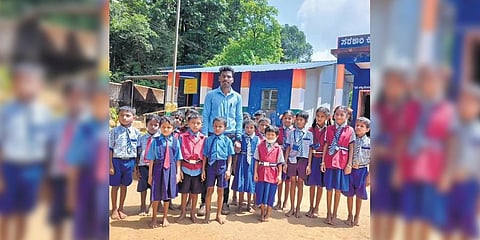

KARWAR : When people think of schools, the conventional image is of students sitting with unwavering attention following teachers’ lessons, taking notes and asking questions while worrying about the next exam. But at the Government Primary School Waghbandh of Joida taluk, there are no permanent teachers. Despite that, it has become a model for other schools in rural parts of Karnataka. Villagers here have taken up the role of teachers educating their wards and inculcating skills that can sustain them till teachers are appointed.
Education of students here, like the rest of the country, was affected over the last two years because of Covid. “Schools in many villages do not have teachers. We have brought this to the notice of top officials, including the Deputy Commissioner of Uttara Kannada, but all we have got are assurances,” said Ravishankar Derekar, a villager.
Schools in villages around Waghbandh, like Shirola, Pathagudi, Bamane, Maire, Soliye, Asuli, Kanne, Karanjoida, Teloli, Kheloli, Kharsinga, Rundali and others, too do not have teachers. Around 17 students study at the Waghbandh school, where classes are taken by Nivas Gouda, a guest teacher, at a makeshift arrangement set up by the education department.
The gathering comprises students from Classes 1 to 5. Earlier, the school had a teacher, Leeladhar Moger, who had undertaken a slew of activities to connect students with earth. That triggered the transformation of the school, which was just a building with a classroom, into a bed of greenery. He encouraged students and involved them in farming and horticulture activities. “He taught students how to do farming, plant horticulture trees and nurture them. We are continuing with the initiative.
Since our children have a lot of time in the absence of regular classes, we take them to plant saplings, and show them how to cultivate vegetables, particularly tubers, fruiting trees, paddy and sugarcane,” said Yogish Derekar, another villager.
The vegetables cultivated are used for the mid-day meals, and fruits like jackfruit, pineapple, guava, mango and chikku are distributed among kids. “There are many fruit-bearing trees. We pluck the fruits in such a way that the supply does not get exhausted. We harvest them in a few trees until a portion of fruits is left for the birds and animals. We do the same with jackfruit trees. Sloth bears, deer and sambar deer are seen around the trees,” says Ravi.
The 58-year-old school has adopted a policy that any student leaving the school should plant a tree and nurture it throughout his or her life. Priyanga, Chief Executive Officer, Zilla Panchayat, Uttara Kannada district, said scheduling of teachers is in progress. “The Education Department is already working on directing teachers to those schools that have few or no teachers. Also, more teachers will be appointed soon,” she said.
