
CHENNAI: It was a fine morning in February 2024 when a quiet moment at the Government Institute of Mental Health (IMH) in Kilpauk was interrupted by the arrival of a photograph – of 44-year-old Johan (name changed) smiling beside his mother, thousands of miles away in Rwanda. For the IMH team, this was more than just an image. It was a picture of hope and the culmination of a long journey – the kind that unfolds behind the scenes at one of Asia’s oldest and largest mental health hospitals, established in 1795, where the mandate extends far beyond treatment and into the realm of family and belonging.
Johan’s arrival in Chennai from Rwanda was anything but ordinary. Once a student at Annamalai University, the Rwandan’s life took a dramatic turn in 2014 when he dropped out of college and found himself stranded after his roommates moved out. Adding to his challenges was a missing passport, an expired visa, and, what followed for Johan, a descent into anonymity – years spent wandering the streets, off the grid, until the police found him and placed him at Anbu Jothi Ashram. After its closure, he was sent to IMH – an institute that strives to reunite lost individuals with their families.
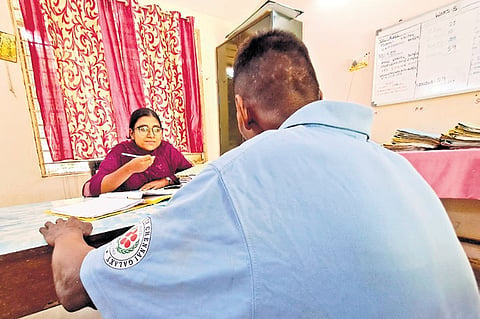
Johan’s case put the IMH team’s skills and patience to the test. He was, quite literally, stuck in the country as he had lost his travel documents. K Mohan, a psychiatric social worker at IMH, recalls the turbulent times vividly. “The process began with notifying the Rwandan embassy. Later, we contacted the Foreigners Registration Regional Officer (FRRO) in Nungambakkam to secure an exit permit. They charged us a heavy penalty of Rs 80,000 for overstaying, which was waived after an intervention from the IMH director,” he says.

The ordeal did not end there. Painstaking paperwork followed – a “no deficiency certificate” to confirm that no police cases were registered against Johan anywhere in the state, a clearance certificate from the police, and the logistical hurdle of booking Johan’s flight back home, which was resolved thanks to a friend of his brother.
“He flew back home in February 2024 and sent us a happy picture of himself with his mother. He was reunited with his family after almost a decade,” Mohan recounts, pride in his tone. Such success stories arise from deep collaborative work, as IMH social workers and its director coordinate with police, NGOs, local communities, and, often, even international embassies.
According to the Institute data, in 2024 alone, 212 homeless, wandering, mentally ill persons were admitted. Of these, 124 were reunited with families, 42 found new homes in rehabilitation centres, and 46 remained living at the Institute.
But the numbers do not fully capture the intricacies of their work. “In some cases, the families don’t want to take them back. We keep such inmates at the hospital and provide them with jobs or send them to rehabilitation homes,” says Dr M Malaiappan, Director of IMH. The team deploys every possible resource – an MoU with the Shraddha Rehabilitation Foundation helps trace families in northern India, and college students fluent in rare languages assist with communication when patients arrive from overseas.
“Our social workers are very good at tracing addresses. Sometimes the patient provides only meagre details, but with that, the social workers and the entire team often manage to trace the patient’s address,” says Malaiappan, highlighting the detective work that runs behind the scenes.
“In many cases we succeed, but in some cases the families don’t accept them. Even then, we don’t lose hope. We try to keep in continuous touch with the family. If we guarantee jobs, the family is more willing to accept them,” explains D Sumathi, social welfare officer.
Dr Malaiappan points out that IMH has reunited patients with families in Sweden, Kenya, Ireland, and more, and is seeking help from UIDAI to trace patient addresses using iris recognition technology. “When the thumb impression is marked, their address is displayed if they have already registered,” he explains.
IMH’s campus is as intricate as its work, reflecting its multi-faceted role with an acute care and medium-stay psychiatric hospital, de-addiction centre, child and adolescent psychiatric unit, care for mentally ill prisoners, long-stay wards, a sheltered workshop, day centres, and halfway homes.
But what stands out is the perseverance and humanity at the core of this institute. A single photograph from Rwanda closes the loop – not just for Johan, but for every lost individual for whom IMH becomes the bridge between being found and, finally, going home.
(Edited by Divya Ramkumar)