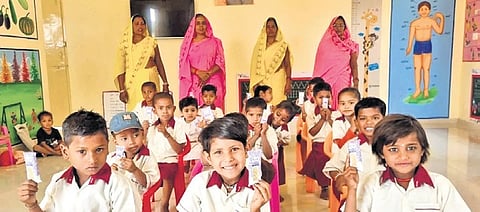

UTTAR PRADESH: ANGANWADIS are often spoken of in policy circles as the foundation stones of India’s future. But on the ground, they have long struggled with poor infrastructure, low attendance and limited impact. In Varanasi, however, that story has begun to change—quietly but decisively—over the past few years.
Between September 2022 and October 2025, over 3,000 Anganwadi centres across the district underwent a transformation under Mission Parivartan, an initiative led by Himanshu Nagpal, a 2019-batch IAS officer who served as the Chief Development Officer of Varanasi.
The effort, carried out under the guidance of District Magistrate S Rajalingam, recently earned Nagpal the ‘Nexus of Good Annual Awards, 2025’. He is now the municipal commissioner of Varanasi, the parliamentary constituency of Prime Minister Narendra Modi.
The stakes could not have been higher. Early childhood—from six months to six years— is the most critical phase of human development. Experts often point out that one rupee invested at this stage yields returns equivalent to `100 spent later in life, for both the child and the nation. Yet Varanasi was facing a crisis. According to the 2019 NFHS-5, 13.3% of children aged zero to six in the district were classified as suffering from Severe Acute Malnutrition (SAM).
“Malnutrition is a big challenge faced by the tiny tots, hampering their ability learn and grasp,” Nagpal says. “While the administration was already working to tackle malnutrition in the district, I would still see many malnourished children in Anganwadis.”

Mission Parivartan was conceived as a comprehensive response. Over 2.5 years, 2,382 Anganwadi buildings were rejuvenated, and 692 new centres were constructed, pushing coverage to 96 per cent across the district. Attendance surged from 35 per cent to 80%, and severe malnourishment dropped from 7.7% to just 0.12%. Over 3.5 lakh children benefited.
“Any intervention would not have been effective if children did not come to the Anganwadi centres. So, we renovated 2,200 centres and built 600 new ones, earlier in rented spaces,” Nagpal says.
All centres were brought into compliance with 18 basic Kayakalp parameters, including baby-friendly toilets, hand-washing units, BaLA-based painting and child-friendly outdoor play equipment. Digitisation followed, with LED TVs, writable floors, low wall green-boards and low-hanging wall displays that turned every corner into a learning space. Solar panels with rooftop rainwater harvesting, Poshan Vatikas, furniture, kitchen items, toys and first-aid kits completed the makeover.
To improve children’s nutritional absorption capacity, the district rolled out daily iron and multivitamin supplementation. Millet-based supplements and plant-produced fortified foods provided an added boost for both children and mothers. “Manual scales were replaced with digital measurement equipment at Anganwadi centres for accurate measurement of children’s weight and height, a critical component to measure the scale of malnourishment,” Nagpal adds.