
CHENNAI: The wind picks up dust, stirring it into the air as grey clouds hang low, as if carrying the weight of untold stories. Suddenly, the quiet is pierced by the sound of pounding feet — 15 boys, school bags flapping wildly, dash down a narrow lane, their laughter rising like a challenge to the gloom. Books jostle inside, worn soles slap against the wet road, and youthful energy crackles in the air. From behind a rusted iron gate on Kattabomman 6th Street in Kodungaiyur, a voice calls out, half stern, half loving: “Don’t bunk classes!”
The boys live in Magizhvagam, a children’s home established by the Street Vision Social and Charitable Trust, founded by R Seetha Devi. Standing behind the gate as she sends off the boys, Devi says, “These kids were orphans, rescued from the streets, kids whose parents are in prison, or belonging to parents suffering from communicable diseases.”
Believing education is the ultimate solution for societal betterment, Devi runs a children’s home, ensuring they receive proper education and care. “My idea is to make them self-sustainable through education, so that they can establish a future for themselves,” says Devi, remembering how education transformed her life from a street dweller to someone who serves the underprivileged.
Growing up on the streets of Wall Tax Road near Chennai Central Railway station with her five siblings, Devi understood the need for shelter and tools to uplift her life and others. “My father worked as a porter. He had left home at age six and grew up around the central station,” she says, recalling the brass badge labelled ‘Coolie’ her father wore. “My mother, from the streets of Bombay, studied till Class 10. Even though we lived on the streets, my parents prioritised our education.”
The legacy of serving the helpless has been carried on by her grandmother, Amirthavalli. She was a Sri Lankan Tamil and came to Mumbai in the 1950s as a refugee. Being multilingual, she wrote letters for a living while living on a platform. “My grandmother used to notice girls being sold at red light areas. She would approach them alone, speak to them regardless of language, and write letters to their families for rescue,” says Devi, recalling the stories told by her mother.

Taking inspiration from her grandmother, Devi developed an interest in helping stranded, lost, and “commercialised children” (those rented out for begging). “In 2002, I started taking classes for children begging in Marina under a lone palm tree beside the Kannagi Statue,” she says, “That’s how it all started.”
In 2015, she founded the trust. In 2022, she established Magizhvagam under the Juvenile Justice Act, 2015. Later, in collaboration with the Greater Chennai Corporation, Devi established Vazhvagam under Street Vision, providing shelter for urban homeless women. Street Vision also manages Thayagam, providing shelter to the elderly and beggars.
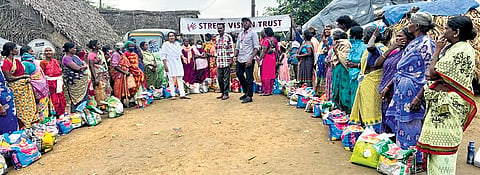
A faint voice calls from outside the home: “Amma, Amma.” Swiftly, Devi instructs a worker to provide food from green plastic containers large enough to hold food for 20 people. The containers line up in rows, awaiting placement in an Omni van for distribution across Chennai to the needy, part of the Food Drive, another Street Vision project.
Standing beside the lined-up containers, a blue-painted auto waits to rescue abandoned and stranded women, the elderly, and children. But that wasn’t the auto’s only duty. The deeds done in this auto earned Devi the title “India’s First Oxygen Woman.”
After her mother died, waiting 12 hours for oxygen during Covid-19 in 2021, Devi launched India’s first ‘Oxygen Auto’— an auto with oxygen cylinders. Her grief-turned-mission has saved 800 lives, preventing other families from facing similar heartbreak. “I lost my mother to Covid due to lack of oxygen, but when we helped an old woman with our oxygen auto, she survived. I felt as if I’d saved my lost mother,” says Devi.
But her courage did not stop there. In 2023, after a video surfaced of two women being assaulted and paraded naked in Manipur, Devi said she couldn’t sleep. “I couldn’t bear that such a thing could happen to women,” she recalls. While many warned her it would be suicidal to step into a conflict zone with no contacts, she set off alone to Manipur. “They told me I’d be killed. But I couldn’t sit back.”
At the airport, she met a Meitei man who helped her travel to the conflict zone, hidden in the back of a vegetable truck. There, she later met a Kuki family. After hearing her story — of living on the streets, of building homes for the abandoned, and of saving lives with her oxygen auto — the family was moved. They went on to establish a relief centre at her request, honouring her vision.
Devi has bigger dreams to make Chennai a haven with no begging and homeless kids, or elders, by 2030. She had just laid a foundation stone on 16,000 sq ft of land her trust owns in Gummidipoondi, envisioning a home ‘Niraivagam’ for disadvantaged women, caring for them from pregnancy through childbirth, nurturing as they grow, and caring for the elderly. “I don’t have any money to establish the home. Just blind faith in God that he’ll help,” says Devi with hope, adding, “My only mission is to give an identity to the disadvantaged poor who live in the streets; one they can embrace with dignity.”
The blue auto rumbles to life again, containers loaded, destination fixed. Another rescue awaits. Another meal. Another shot at life. And at the gate of Magizhvagam, Seetha Devi stands — not as a saviour, but as a survivor who chose not just to rise, but to lift.
(To report or rescue stranded, ill, disabled, or lost women, children, men, or elderly in Chennai, contact Street Vision Trust on 98400 38410)
(Edited by Dinesh Jefferson E)