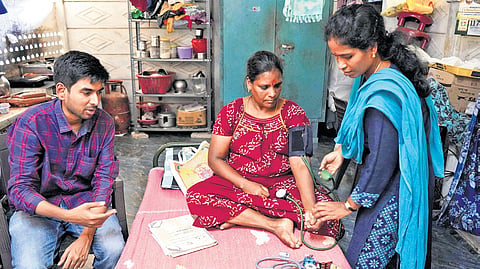

PUDUCHERRY: In many homes across Puducherry and the adjoining areas of Tamil Nadu, illness has reached a stage where medicine can no longer promise a cure. Yet, thousands of families fronting that reality aren’t battling their ordeals alone, thanks to Sanjeevan and its team of caregivers. For the past 13 years, this community-based palliative care initiative has been quietly bringing home-based care to the elderly, chronically bedridden and terminally ill, proving that even when treatment ends, care does not have to.
An initiative of the Sri Aurobindo Society (SAS) in collaboration with the Institute of Palliative Medicine (IPM), Kozhikode, HelpAge India and Tata Trust, Sanjeevan is founded on the belief that end-of-life care should be holistic, compassionate and rooted in human dignity. “Rather than being disease-focussed, it is patient-centred, addressing physical, psychological, emotional, social and spiritual needs,” says Kaushal Sharma of SAS. Providing home-based care with limited medical intervention has remained a constant challenge, he adds.
The programme began in 2013 with just 20 patients in Kuruvinatham village, following the advice of Dr Suresh Kumar from IPM Kerala, who continues to guide the project. Today, it has expanded to 118 villages and hamlets across Puducherry and adjoining parts of Tamil Nadu, serving 2,180 patients suffering from nearly 20 to 30 different medical conditions.
Palliative care is often misunderstood as care meant only for the final days of life. But Dr S Mohan, who has been associated with Sanjeevan since its inception, says that it is much broader than that.
Its capacity-building programmes have reached doctors, nurses, auxiliary nurse midwives (ANMs), medical and paramedical students, police personnel, ASHA workers, anganwadi workers, self-help groups and even school students. Over the years, nearly 10,000 people have been trained, around 60% from the medical fraternity and the remaining from the community. Diploma-level courses are also conducted, and recognised certificates are issued, says Sharma.
The impact of Sanjeevan is perhaps best understood through the lives it touches. A 75-year-old woman in Murungapakkam became bedridden after suffering a stroke and later developed dementia. Her elderly husband could no longer care for her, while their unmarried daughter worked long hours at a petrol bunk to support the family.
According to Dr Mohan, the need for palliative care is enormous. “Out of every 1,000 people, nearly six require palliative care. Yet, sadly, only about 4% of those who need it actually receive such services.” Though its mission remains intact, Sanjeevan’s financial position has not been steady over the months. The initiative has been facing monetary challenges since the initial support from Tata Trust ended a year ago. The costs of paying staff, transportation, medicines, preparing case sheets, maintaining medical records and tracking patients are substantial. With a growing geriatric population, managing the programme is becoming increasingly difficult, Kaushal Sharma points out, adding that government support is now essential.
As Puducherry’s population ages and chronic illnesses increase, Sanjeevan’s home-care model shows that end-of-life care need not be confined to hospitals. Yet, sustaining that work remains a challenge.
