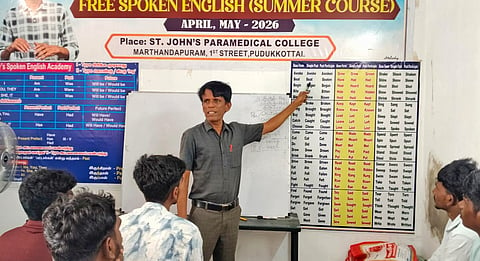

PUDUKKOTTAI: Every April and May, when most teachers close their classroom doors and leave the village for vacation, one modest house in Vellathirakottai is full of students from dawn to dusk. Four batches a day, learners arrive in a steady stream -- schoolchildren clutching notebooks, anxious graduates polishing answers, and young aspirants practising introductions like tiny rehearsals -- the summer break, for them, is not a holiday; it is a season of reinvention, where spoken sentences are trained and confidence is rebuilt.
What began as hushed practice sessions outside school hours has, over 29 years, become a lifeline. Antony, a 57-year-old government school teacher, has helped more than 40,000 students pass through those rooms, turning fear into fluency.
Antony teaches at Ramasamy Deivanaiammal Government Higher Secondary School in Vellathirakottai, near Alangudi. Alongside his regular duties, he holds free spoken English classes every day, welcoming school students, job aspirants and young graduates from across the region. The classes are held from his home, and during summer vacations, turning the break into a season of language and labour.
“I come from a village and I know how difficult it is for rural students to learn English. When I was in Class 3, I had an English teacher who taught me how to read and write properly. He inspired me to learn the language. That experience stayed with me,” Antony recalls.

A single teacher’s kindness has germinated into this vocation. After finishing college and earning a B.Ed from Annamalai University, Antony became a teacher. He never forgot his mentor who had opened the door for him, or the students who still stood outside it. “There were very few opportunities to learn spoken English when I was studying. I wanted to be like my teachers. I felt other students should not lose opportunities because of lack of guidance. That is how these classes started,” he says.
On an ordinary evening, his living room doubles as a classroom. About 30 students come regularly; in summer the numbers swell as school and college students use the break to sharpen their communication skills. Lessons concentrate on spoken English, grammar, writing and interview preparation.
“Many students understand English but hesitate to speak it. Sometimes, it is hard for them to understand grammar. But, once that fear goes away, they become more confident. That confidence helps them in writing, speaking and in college, during interviews and later in their careers,” he explains.
For those students, Antony is less a teacher than a bridge-builder. He spends a portion of his own salary on the effort, runs the classes entirely free and even offers small incentives to encourage steady attendance. “Earlier, I used to give Rs 1,000 to students who attended classes regularly. As more students became eligible, I reduced it to Rs 500, so that a larger number could benefit,” Antony adds.
The classroom afterglow is visible in the lives of his former pupils. Many have become engineers, teachers and professionals. Some even work for multinational firms or abroad.
“Many of them still keep in touch. Some call me when they get a job or move abroad. Even when they don’t, I hear about their achievements through others. Knowing that they are doing well gives me a sense of achievement,” Antony says.
Teaching, however, is only one arm of his work. Antony has authored 18 books, seven of them focused on spoken English and grammar. He has also published poetry in both Tamil and English. He believes reading feeds language the way sunlight feeds a sapling. Wanting to plant a forest of readers, he has distributed over 40,000 books free to students and schools over three decades.
Seven years ago, Antony formalised his efforts into the Pachai Poomi Foundation, a volunteer group that blends education with environmental action. Volunteers have planted saplings, dispersed seed balls and provided notebooks and other materials to students facing economic hardship. Learning and environmental work are fuelled by the sole conviction that a better educated child can improve both family life and the wider world. “If a student who is struggling receives the right guidance and education, he can improve his own life and help others too,” he reflects.
Antony entered government service in 2002. “My government service will end one day. But I will continue teaching as long as I can,” he says with promise. For a village boy who once learned to read and write because a teacher reached out, Antony’s life is now a steady, stubborn journey of reaching back. He has turned the small, everyday work of teaching into an expansive, almost heroic patience. His measure of success is in the voices of his students who once whispered and now speak aloud.
(Edited by Divya Ramkumar)