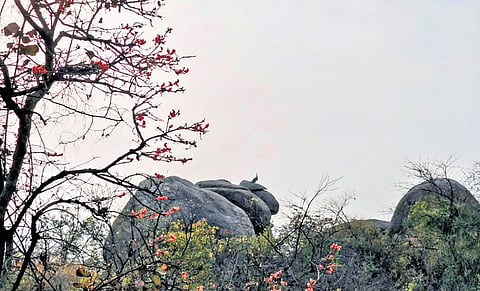

HYDERABAD: A trip around Hyderabad might suggest the city is defined by malls, flyovers and a handful of historic monuments. But long before the glass towers and concrete roads, it was a city of rocks — granite boulders that have stood for 2.5 billion years. On the third Sunday of every month, a group of residents gathers among these ancient formations to remind the city what it is losing. Their message is simple: a tree can be replanted, but a rock blasted away is gone forever.
The location changes every month — Osmania University, Shamirpet, Moula Ali, Pahadishareef, Gachibowli, Golconda, Asifnagar and Sitarambagh. The walkers include children, seasoned trekkers and residents who have spent years driving past Hyderabad’s rocks without really noticing them.
For visitors like Amulya, seeing the formations up close changes how they view the city. “I have lived in Hyderabad for years, but I had never looked at its rocks this closely. While climbing, you realise how massive and ancient these formations are. It makes you wonder how easily we pass them every day without understanding their value,” she tells TNIE.
Before each walk, volunteers explain the route and simple ground rules. Then comes the day’s most enduring lesson. “Once a rock formation is blasted, it is gone forever,” says Vasu Nugala, a life member of the Society to Save Rocks.
One parent says the experience teaches children more effectively than a classroom lesson. “They touch the rocks, climb them carefully and ask questions without feeling they are in a classroom.”
A city of rocks and lakes
Hyderabad was once known as both the City of Rocks and the City of Lakes — identities conservationists say have always been intertwined. “Our initial work focused on identifying rocky outcrops and hillocks,” says Society vice-president Sangeeta Varma. “We also worked with experts to understand their ecological role. These granite formations help recharge groundwater, which in turn sustains lakes. The two ecosystems are closely connected.”
The Society to Save Rocks was formed in 1996, though its origins go back to 1992, when Hyderabad’s rapid expansion began erasing its rocky landscape, particularly in Banjara Hills and Jubilee Hills. Concerned residents believed the city could continue to grow without destroying the formations that gave it its distinctive character. Rather than freezing Hyderabad in time, they advocated integrating rocks into buildings, campuses and public spaces.
Among those captivated by the landscape was Frauke Quader, a German national who moved to Hyderabad after her marriage in 1975 and later became secretary of the Society. “Not only is Hyderabad culturally fascinating, but its landscape captivated me from the start. The strangely balanced rocks seemed like the playthings of giants. I kept wondering how they came to be stacked and scattered like that,” she says.
That fascination soon became a concern. “As the city expanded, many rocks were cut for building material. We realised these remarkable sculptures of nature were disappearing. That’s when the Society to Save Rocks was started,” she adds.
The Society began with just 26 members and has since grown to around 300.
A landscape 2.5 bn years old
The rocks are far more than scenic landmarks, says Sangeeta, adding, “These formations are reservoirs of minerals. Research has shown that crops grown in rocky regions can contain more nutrients than those grown in areas without such formations.”
Their natural crevices trap rainwater, allowing it to recharge aquifers and sustain lakes. “Where there is water, vegetation flourishes, and where there is vegetation, biodiversity follows. These rocks silently sustain entire ecosystems, yet many people remain unaware of the vital role they play,” she adds.
As their ecological significance became clearer, the Society began working with governments to secure legal protection. In 1998, the undivided Andhra Pradesh government declared nine rock formations as heritage precincts through a GO. About a decade later, another 16 formations were added, taking the total to around 25. All were proposed by the Society and included in HUDA’s, now HMDA’s, Heritage Conservation List. “Our aim has always been twofold — creating public awareness and working with government departments to preserve these formations,” Frauke says.
The Society continues to engage with government agencies. One recent campaign focused on protecting Fakhruddingutta, where sustained engagement with HYDRAA led to the fencing of the site. “Securing the site is a significant milestone, but much of our work still involves working with government agencies to ensure Hyderabad’s rock heritage receives the protection it deserves,” Sangeeta says.
Yet official recognition is only part of conservation. The bigger challenge, she says, is persuading Hyderabad to see these formations not as vacant land but as an irreplaceable part of the city’s identity.
Learning to look at rocks
The Society’s monthly Rock Walk is its longest-running awareness initiative. Each month features a different location, with programmes ranging from half-day outings to overnight trips where participants learn about geology, ecology and biodiversity.
“When people experience these landscapes firsthand, they understand much more easily why they matter,” Sangeeta says.
Vasu, an experienced climber and mountaineer, helps coordinate the walks and ensures the safety of participants. “I am passionate about the outdoors and rock landscapes. More importantly, we hope these experiences inspire people to appreciate and protect these formations throughout their lives,” he says.
“Our aim is not to oppose development,” Vasu says. “We believe development and conservation can go hand in hand. But if every rock formation disappears, future generations may have to travel hundreds of kilometres to experience the landscape that once defined Hyderabad.”
“My message to young people is simple: care about the natural spaces in your neighbourhood. Conservation begins with awareness,” Vasu adds.
A classroom without walls
If Rock Walks introduce adults to Hyderabad’s ancient landscape, the Society’s work with schools aims to foster that appreciation much earlier.
Uma Maheshwari joined the Society over 20 years ago after attending her first Rock Walk. “After my first Rock Walk, I was completely hooked. I wanted to contribute beyond simply participating.”
Today, she heads the Society’s Schools and Educational Institutions Subcommittee, working with schools, colleges and institutions. “If we can change the way people look at the landscape around them, we’ve taken an important step forward. That’s why we’ve continued this work for more than two decades,” Uma says.
Members scout routes, coordinate with government departments and conduct classroom sessions explaining how the Deccan Plateau was formed, why its rocks matter and why they deserve protection. Schools also request exclusive Rock Walks, allowing students to learn directly from the landscape. “If, through our work, we can encourage even one person to appreciate the natural world and live more responsibly, that effort is worthwhile,” Uma adds.
At places such as Durgam Cheruvu, children climb rocks, observe birds and vegetation and ask questions. Children, she says, are often the most enthusiastic audience, eagerly examining rock samples and asking questions. Even if only a few eventually join a Rock Walk, changing how they view their surroundings is itself a success.
Art among ancient stone
The Society’s work extends beyond walks and classrooms into art, photography and community events. Over the years, it has organised Hyderabad Rockathon, Run for Rocks, Earth Day celebrations and painting workshops where children learn about Hyderabad’s rocks before translating their impressions into art.
“It is always fascinating to see how imaginative they are and how they interpret these ancient landscapes,” Sangeeta says.
Photography and art exhibitions at Metro stations, the State Gallery of Art, Goethe-Zentrum and other venues have encouraged residents to recognise familiar rock formations from campuses such as the University of Hyderabad, MANUU and NITHM.
Some institutions, including the LV Prasad Eye Institute, have consciously preserved their rocky landscapes, demonstrating that development and conservation can coexist. Preserved boulders become defining features of campuses and public spaces, giving them a character that concrete alone cannot. The rocks have also become venues for music concerts, theatre performances and artists’ workshops, allowing people to experience the landscape rather than merely hear about it.
Frauke has spent nearly five decades asking Hyderabad to look again. “This work keeps me connected to life in the city. After so many years, I no longer feel like an expat.”
The Hyderabad she first saw in 1975 has changed dramatically. Roads have widened, neighbourhoods have expanded, and many hillocks have disappeared. Rocks that once served as landmarks now survive only in photographs and memory. Yet, on the third Sunday of every month, people still gather among the surviving boulders. They walk, climb, ask questions, and, often for the first time, discover that the ground beneath their feet began taking shape 2.5 billion years ago.
