
BENGALURU: Yashas Bharadwaj is a snake charmer with a difference. He is the rescuer. For most people snakes hold revulsion mixed with terror despite their divine status in mythology. For, snakes can kill. In fact it is the fear of snakes that is fatal more than their sting. Yashas (28) tells us not to fear snakes.
His affair with snakes began when he was as little as five when he started to accompany his father, Simhadri MN (61), a wildlife enthusiast who has led numerous pilot projects, including Karnataka’s earliest teams for tiger census and BBMP forest cell, which began in 2005.
His first snake rescue in his neighbourhood in South Bengaluru became the beginning of a lifelong relationship with wildlife, one that has quietly grown over two decades into a mission of rescue, conservation and education.
While Yashas earns his livelihood by managing his father’s power tools business, he devotes the majority of his time as a researcher, nature educator, and field herpetologist, rescuing injured wildlife, both urban and wild, documenting biodiversity, conducting awareness programmes and helping people understand that the creatures they fear are often the very ones keeping ecosystems alive.
As a kid, Yashas, under the guidance of his father, rescued snakes, owls, squirrels and birds that frequently found themselves in distress or in conflict with expanding urban spaces. He gradually learnt how to rescue and rehabilitate wildlife responsibly. Yashas says, “Between 2005 and 2010, we were rescuing at least 10 birds in South Bengaluru alone. After observing its condition, we would take it for rehab if the issue was serious, like a broken bone, torn wing or any other serious injury.”

He has also rescued exotic and protected animals like Australian pig, green iguana, black buck fawn. “Exotic animals cannot be released into the wild as they will disturb the ecosystem. They will be the ‘invasive species’. These animals must inevitably be raised in captivity.”
He joined as an intern for research projects and surveys by Wildlife Rescue and Rehabilitation Centre (WRRC), Bannerughatta, Indian Institute of Science (IISc), Bengaluru and World Wildlife Fund (WWF) for eight years, studying mammals, reptiles, and butterflies. Working with veterinary doctors and rehabilitators, he learnt how to nurse injured animals and birds, why the human-animal conflicts arise and how to mitigate them.
“Studying the behaviour of animals in areas with human-animal conflicts is very important. Wild animals have the basic instinct to hide from humans; they avoid entering human settlements. But when we spot a wild animal outside its habitat, it is important to understand the cause and map a mitigation plan rather than just capture the animal,” he says.
Yashas spent nearly a decade in the Western Ghats of Karnataka studying the reptiles, snakes in particular. After working with WHO on projects like Snakebites in India and Living with Snakes, he realised why the awareness among the public is low, “Though India accounts for over half of the total snake bites in the world, the pharma companies have realised that this is a poor people’s problem. The snake bite is a work-hazard disease, with the victims often from the working class, like labourers or farmers. The medical industry can make little to no profit and the issue is often ignored.”
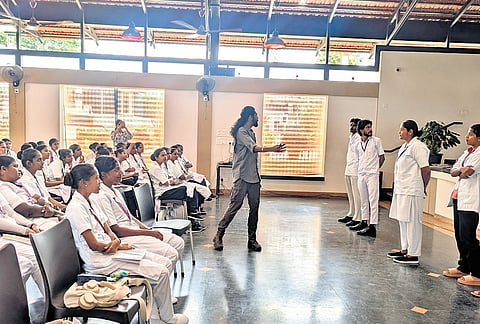
To learn how to raise awareness and reach the people, he completed a Masters in mass communication, learning to break jargon and simplify complex topics. Using the skills and knowledge, he began free immersive sessions for students from orphanages, government and low-income schools. Yashas is currently working on educating the residents of Bengaluru. “The environmental literacy in the city is 3% and declining each year,” he says.
He organises nature walks in Bangalore University, Jnanabharathi campus, every Sunday for the public. Working with schools, he covers up to 25% of their science curriculum by taking them out on nature walks, surveys, and mapping flora and fauna around their school.
“I teach for 60 hours in a combination of classroom and outdoor lessons, giving the children first-hand experience in understanding their ecosystem,” he says. “I worked with six schools in 2025. Two were government, and the other four were low-income schools. This is in sync with the National (2020) and State Education Policy (2025), which encourages experiential learning and practical skills over passive textbook learning,” he adds.
He also responds to snake rescue calls, works on human-wildlife conflict mitigation, conducts awareness programmes, and can help access anti-venom in case of snake bites.
Contact at +91 99809 45701.