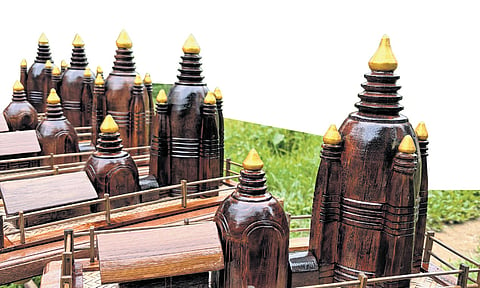

ASSAM: Pankaj Raidongia took the bold decision to quit a cushy corporate job in Bengaluru and return home to Assam when the world was battling the Covid-19 pandemic. The risk paid off. In less than five years, he has built a reputation as a promising wood sculptor while inspiring others to take up woodcarving.
Born in the Bakata Nemuguri village in upper Assam’s Sivasagar district, Raidongia fell in love with drawing and painting as a child. While in high school in the mid-1990s, he often travelled 24 km to Moran town in neighbouring Dibrugarh district to take art lessons from Anuj Duwara, an alumnus of the Government College of Art and Crafts in Guwahati.
After Class 12, Raidongia enrolled at the same college and graduated in sculpture. He then moved to New Delhi for a shoe designing course before taking up a visual merchandiser’s job at a multinational company. Over the next 12 years, he designed store layouts, window displays and product arrangements at malls in Mumbai, Ahmedabad and Bengaluru.
During the first Covid-19 lockdown, when public movement was restricted, he felt the urge to do something on his own, though returning to Assam was not yet on his mind. He resumed drawing and began posting his sketches and creative display designs online, where they received positive feedback.
“The idea of returning to Assam and doing something independently took shape during the second Covid-19 lockdown. I was bored with my city apartment life. I also always struggled to find the right kind of raw materials at my workplace. Eventually, after discussing it with my wife Poli, we returned home,” says Raidongia.

Bamboo and cane crafts were common in his native village. Locals made Assamese “japi” (traditional wide-brimmed conical hat), baskets and items using bamboo and cane.
In 2021-22, he launched his entrepreneurial venture, “Prarambh”, to preserve, promote and modernise these crafts. He encouraged about a dozen local youths to work with him. Initially, he shared his designs with villagers, who made the products for him. The venture gained momentum only after a few YouTubers featured his products.
“Although my helpers are not formally trained, they are passionate about woodwork. A couple of them worked as carpenters before. They prepare the wood pieces before I carve them at my small workshop at home. They earn about `15,000 each per month,” says Raidongia.
He enjoys working with driftwood—trees, branches or wooden debris carried downstream by rivers. He buys driftwood from people, and sometimes they approach him directly.
According to Raidongia, ordinary wood is more susceptible to termite infestation, reducing its durability. Driftwood, on the other hand, retains only its skeletal structure after prolonged immersion, making it more durable. “In the case of driftwood, nature gives you the shape. All you have to do is use your creativity. You don’t have to cut down trees and thus, you save nature. It also takes less work,” Raidongia explains.
He primarily carves statues and mementoes. One of his most appreciated works was a statue of legendary singer, songwriter and filmmaker Bhupen Hazarika. Following Zubeen Garg’s passing, he carved a statue of the singer-musician as a tribute.
Photos of the work went viral on social media, earning admiration and generating orders. “A pall of gloom had descended on Assam after Zubeen Da’s untimely death and we were all emotional. We had given our best effort when we carved his statue,” says Raidongia.
While statues command good prices, most of his orders are for mementoes. Organisations such as student bodies, Oil and Natural Gas Corporation, and Oil India Limited, commission them as gifts for guests at functions.