
TIRUPPUR: There is no guarantee that a palm seed pushed into the ground today will one day grow into a tree. It may dry up in the summer, be washed away by rain or simply refuse to sprout.
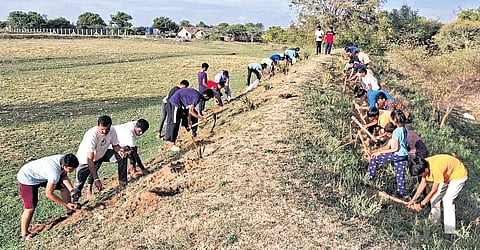
Yet, for the past decade, farmer M S Sampath Kumar has returned to the banks of ponds and lakes across Tiruppur district, planting one seed after another with the belief that even if only a few survive, they will outlive him.
That belief gave birth to the Gramiya Makkal Iyakkam, a voluntary organisation based in Thoravalur village in the Tiruppur district that has spent the last 10 years restoring waterbodies and conserving indigenous tree species.
Through the movement, Sampath and his volunteers have sown and distributed nearly 4 lakh palm seeds and distributed more than 2 lakh native saplings free of cost, turning a personal passion into a community-driven environmental movement.
An organic farmer cultivating his ancestral land in Thoravalur, Sampath is supported in his efforts by his wife, Devaki, and son, Karthik. While farming remains his livelihood, social service has become his life’s mission.
“Our family is originally from Thoravalur, but my father worked in the customs department. So I spent my childhood in Puducherry and Coimbatore,” Sampath Kumar recalled. “Even during my school days, I loved planting saplings. Along with my friends, I formed a group called ‘We Are For You’ (WAFY), and we planted trees whenever we could. The group dissolved after we completed school, but the passion stayed with me.”

After completing his college education in Chennai, he entered business in Coimbatore in 1995. Family circumstances, however, brought him back to his native village in 2012. A visit to the local government school soon changed the course of his life.
“The roof of the school building was damaged and I repaired it using my own money. Later, I learnt there was a shortage of teachers. I appointed three temporary teachers and paid their salaries for nearly four years. We also arranged evening tuition classes in five Scheduled Caste habitations,” he said.
As his involvement in the village deepened, Sampath revived his old passion for tree planting with a few like-minded friends. What began as an informal effort gradually grew into an organised movement. On November 15, 2015, they founded the Gramiya Makkal Iyakkam, which was inaugurated by N Ramaswami, then Inspector General of Registration in Maharashtra. The organisation’s first initiative was to plant and maintain 5,000 saplings in the Tiruppur North Union. The palm tree soon became the movement’s defining symbol.
“Palm trees provide food, medicine and prevent soil erosion. Yet they have disappeared from many parts of Tamil Nadu,” Sampath said. “Every year, we collect palm fruits after June and sow the seeds from July until December. For four consecutive years, we never missed a single Sunday. Later, we resumed the work by hiring labourers for one day every week. The Green Tamil Nadu Mission also encouraged palm conservation, making our task easier,” he added.
“So far, we have sown and distributed around four lakh palm seeds,” he said. “Only about 20% have germinated because we cannot water them regularly. Whenever drought affects germination, we simply sow again.”
The movement’s efforts extend beyond palm trees. One of the organisation’s most visible achievements stands on the banks of the Thoravalur pond. A Miyawaki mini forest, created on a 25-cent plot using 2,500 saplings representing 60 native species, has transformed what was once open land into a thriving green patch. The project was inaugurated on November 15, 2017, by the then governor Banwarilal Purohit after the site was prepared by raising the ground level with a four-foot layer of soil.
Besides afforestation, the Gramiya Makkal Iyakkam undertakes plastic removal drives in lakes and ponds, works to improve local water bodies.
Sampath’s concern for water conservation also drew him into public activism. He was among the social activists who coordinated the protests demanding the implementation of the Athikadavu-Avinashi project, the Rs 1,900-crore scheme that now supplies water to 1,045 water bodies across Erode, Tiruppur and Coimbatore districts.
“It was a long-standing demand. Our 12-day hunger strike in February 2016 drew the government’s attention and the preliminary work began only afterwards,” he said. “However, around 1,400 water bodies are yet to be covered under the first phase. We continue to urge the government to implement the second phase.”
For Sampath, the measure of success is not merely the number of seeds sown, but the trees that endure. And so, even after a decade, he continues to return to the banks of village ponds, carrying another sack of palm seeds and the hope that the next one might take root.