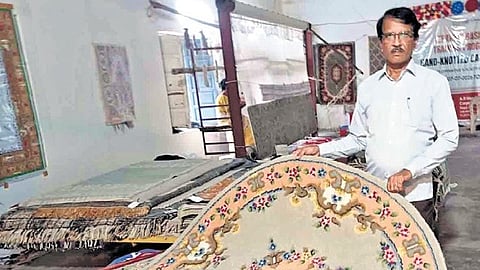

ELURU: From Persian roots to a new generation of artisans, Eluru’s handmade carpet industry is slowly weaving a fresh story of hope. For decades, the lanes of Tangellamud, Shanivarapupeta and Adivarapeta echoed with the sound of looms, where skilled artisans transformed wool, cotton and jute into carpets known for their quality, durability and intricate designs.
The carpets travelled from Eluru to the USA, Australia, Germany and England, providing livelihoods to thousands of families and giving the city a unique identity. “When people heard the name Eluru, they immediately remembered carpets. That was our identity,” recalls Abdul Nayeem, owner of Hafeez Carpets. He closely witnessed the industry’s journey, recalls that nearly 1,000 families once depended on the craft.
Today, only a few families remain associated with the traditional industry. However, the industry later faced severe challenges with the arrival of machine-made and Chinese carpets, declining orders, limited training and marketing opportunities and the Covid-19 pandemic.
The number of artisans and looms fell sharply, forcing many workers to shift to other livelihoods.
Yet, the traditional skill and knowledge of Eluru’s artisans have survived. “Our skill is still alive. We only need an opportunity,” says Jayprakash Morya, an artisan, who came to Eluru from Bhadohi-Varanasi in 1986, also saw the rise and decline of the carpet trade.
“We saw the industry rise, decline and almost disappear. But the skill and infrastructure were still here. That gave us the courage to start again,” he says.
Revival efforts initiated in recent years have brought fresh hope. With government support and assistance from departmental officials, artisans have begun participating in trade fairs, buyer-seller meets, handloom and handicraft exhibitions and promotional programmes through Lepakshi Industries.

Modern marketing, social media promotion and government handloom portals are also helping artisans reach new customers. The number of active artisans, which had fallen to around 40, has now increased to 110. New products and designs, including Double-Sided Pile Hanging Carpets and Dari with Pile Design, are being introduced. Improved metal-frame looms and better workspaces are helping artisans combine traditional skills with modern technology.
The revival is also creating interest among women and the younger generation, with training programmes encouraging new entrants into the craft.
Meanwhile, the Central and State governments are preparing a Detailed Project Report for a Rs 10-crore carpet cluster in Eluru.
For artisans, the proposed cluster is more than an infrastructure project. They see it as an opportunity to revive a historic industry, create employment and reconnect the younger generation with its heritage.
The artisans are seeking training, modern machinery, design support, raw materials and better access to Lepakshi exhibitions, DWCRA bazaars and craft fairs. “If training and marketing support are provided, many young people can get employment through this industry again,” say the workers.
The future of Eluru’s carpet industry lies in bringing tradition and technology together. With modern designs, digital marketing, stronger market linkages and dedicated training, the craft can once again reach national and international buyers.
From Persian roots to local looms, from international recognition to a period of decline and now towards revival, Eluru’s handmade carpets continue to tell a story of resilience and hope. “Our skill is still alive. We only need an opportunity,” the artisans say, and with a new generation slowly returning to the looms, Eluru’s timeless carpet legacy is preparing to weave its brightest chapter yet. Eluru carpet industry set to weave bright future.