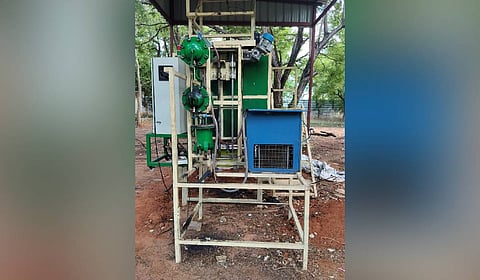

TIRUPATI: What if flower offerings from temples, discarded plastic bottles, kitchen scraps, and even hazardous waste could all be transformed into useful industrial products without leaving behind a single kilogram of residue? A pioneering pilot project at Sri Venkateswara University, Tirupati, has demonstrated exactly that, marking a significant step towards sustainable waste management.
The 12-day pilot trial, conducted jointly by SVU engineering experts and Chennai-based Entity One Company between May 10 and 22, tested an innovative plasma pyrolysis technology capable of processing waste streams in a single machine. Operating at temperatures between 300°C and 500°C, the 50 kg capacity prototype converted diverse materials into biofuels, liquid hydrocarbons, fertilisers and carbon-based products.
Unlike conventional incineration systems, the Ramcharan Pyrolysis Reactor functions in a sealed, oxygen-free environment. The closed-loop process eliminates combustion, preventing the release of dioxins, soot and heavy metal emissions.
The technology was tested on ten waste streams that closely match Tirupati’s daily waste profile as one of the country’s major pilgrimage centres, receiving over 1 lakh visitors each day. The feedstock included solid waste, floral waste, tender coconut shells and poultry waste, plastics, and thermocol.

Each trial produced two commercially useful outputs. Floral waste yielded esters and clean fertiliser, fish and poultry waste produced biofuel and fertiliser, while mixed plastics and tyres generated liquid hydrocarbon fuels along with battery-grade. Coconut shells were transformed into fuel and activated carbon.
Researchers were most impressed by the minimal segregation required before processing. Every trial concluded with virtually zero landfill residue. “One of the biggest advantages of this technology is its ability to handle both wet and dry waste in a single reactor,” said Prof. Varadarajan of the SVU College of Engineering. “Municipalities normally require separate systems for different categories of waste.
Our approach simplifies the entire process while recovering fertilisers, carbon-rich materials and recyclable plastic derivatives. The long-term goal is to provide an environmentally sustainable for urban waste management.”
The project gains significance as local bodies across India face shrinking landfill space. Tirupati alone generates substantial quantities of organic, plastic and temple waste, posing a challenge for municipal authorities.
Guided by the vision of creating a “waste and residue-free society”, Sri Venkateswara University is positioning itself at the forefront of sustainable waste management research. Through its collaboration with Entity One Company, the university is advancing the philosophy that ‘Clean up home and create value doing it’. The project seeks to encourage households, to view waste segregation, recycling and resource recovery as opportunities for environmental protection.
Prof. Varadarajan stressed that the initiative aligns with SVU’s broader commitment to developing technologies that address challenges while promoting sustainability. “Our objective is to demonstrate that a cleaner environment and value creation can go hand in hand,” he said.
G Ravi, Revenue Officer of Tirupati Municipal Corporation associated with the project, believes the technology could transform waste management practices in the region. “Instead of treating waste as a disposal problem, this technology views it as a resource,” he said. “The process can substantially reduce the quantity of waste reaching dumping yards while generating valuable by-products. If scaled up, it could provide a practical solution for municipalities and create economic value from materials that are currently discarded.”
As the pilot project moves towards larger-scale implementation, researchers believe the technology could help cities reduce landfill dependence and move closer to the goal of a truly waste-free society where every discarded material finds a productive second life.