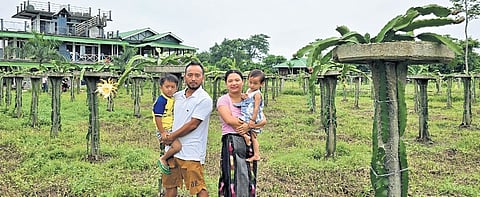

He once liked turning the pages of John Milton’s Paradise Lost and William Shakespeare’s Hamlet. A master’s degree in English literature followed naturally. Little did he know that his true calling lay elsewhere—in farming.
For years, Kaling Siram of Arunachal Pradesh nurtured a passion for English literature. While many of his friends sought white-collar jobs after completing their postgraduate studies, he chose a different path, inspired by his mother, a successful farmer.
In less than a decade, he has carved out a name for himself through diversified farming in the quaint village of Sille in East Siang district, where few educated youngsters opt for agriculture over the security of a government job.
Growing up in his native village of Debing, Siram watched his mother, now in her sixties, cultivate rubber, oranges, turmeric and ginger on a large scale while his father, a schoolteacher who has since passed away, spent most of his time away at work.
“I fell in love with farming after watching my mother grow crops. So, after my master’s degree, I did not look for a government job. I worked as a contractor and saved enough money to buy 40 acres of farmland at Sille in 2017,” says Siram.
He built a farmhouse and initially focused on dairy farming. Starting with three crossbred cows, he earned a monthly profit of Rs 15,000 to Rs 20,000 from milk sales while continuing to work as a contractor. Buoyed by the steady income, he ventured into fish farming and had five ponds dug.
The largest measures 120 metres by 60 metres, while the others are half that size. Fed by perennial groundwater, the ponds never run dry. He also experimented with poultry and goat farming. “Digging the ponds entailed expenditures of lakhs of rupees, but I took that risk.
I bought fingerlings and yearlings at Rs 550 per kg. I released 20-25 kg of fingerlings each into three ponds, and 10-12 kg of yearlings each into the other two,” he says. The following year, he sold fish to local traders and organisers of an Adi festival, earning around Rs 5 lakh.
The business has been thriving. From there, Siram expanded into agriculture and horticulture. Alongside paddy, he cultivates mustard and sesame and has introduced exotic crops such as avocado, dragon fruit, mangosteen, longan and macadamia. “I believe dragon fruit will be the most profitable crop for me. Its retail price in local markets is around Rs 500 per kg and I am likely to harvest about 3,000 kg this year.
If I sell it to wholesalers, I can earn around Rs 12 lakh. The other exotic plants are still growing, and I am expecting avocado yields soon,” he says. Last year alone, sesame brought him a profit of `7 lakh. His next ambition is to venture into tea and oil palm cultivation. While he learnt some of the basics from his mother, Siram credits YouTube as his most valuable tutor. He regularly watches videos on scientific farming techniques.
Inspiration also came from a relative, an executive engineer in a government department, whose farm featured exotic fruits and a fish pond. Yet he believes genuine farmers often struggle to access official support. “I had approached local officials for technical guidance when I was digging my fish ponds, but got no response.
The government does help, but assistance does not always reach genuine farmers like me,” he says. So far, Siram has invested around `1.5 crore, including the cost of land and tractors. A substantial portion of his earnings is ploughed back into the farm every year.
Ten workers are employed on the farm throughout the year, earning monthly salaries of Rs 12,000 to Rs 15,000. For Arunachal Pradesh’s youth, he has a simple message: turn to farming. Government jobs, he points out, are limited, while most people in the state have access to land.
He believes that, with scientific methods, farming can provide a secure future. Success, he says, depends on understanding when to plant, how to nurture crops and how to manage a farm efficiently.
“My sister, who is a state government officer, will be busy with work from morning till evening. But if you take up farming, you will be your own boss. You will not be under pressure from anyone,” says Siram.
Despite the long hours he spends in the fields, literature remains close to his heart. “Shakespeare, Milton and Charles Dickens are still my favourites,” he says with a smile.
